Small software project budget discussions come up frequently during our discovery calls. If your engineering budget is under $20,000, SynthWeb is not the right partner for you—and we will tell you that on the first call. This post explains why we have a minimum project size, what we have learned about the economics of small engagements, and, more importantly, what your realistic options are if your budget falls in the $0–$20K range. We receive this question often from thoughtful founders, so rather than spending time on a discovery call that will likely end with “we cannot help,” we believe it is more useful to publish a transparent answer.
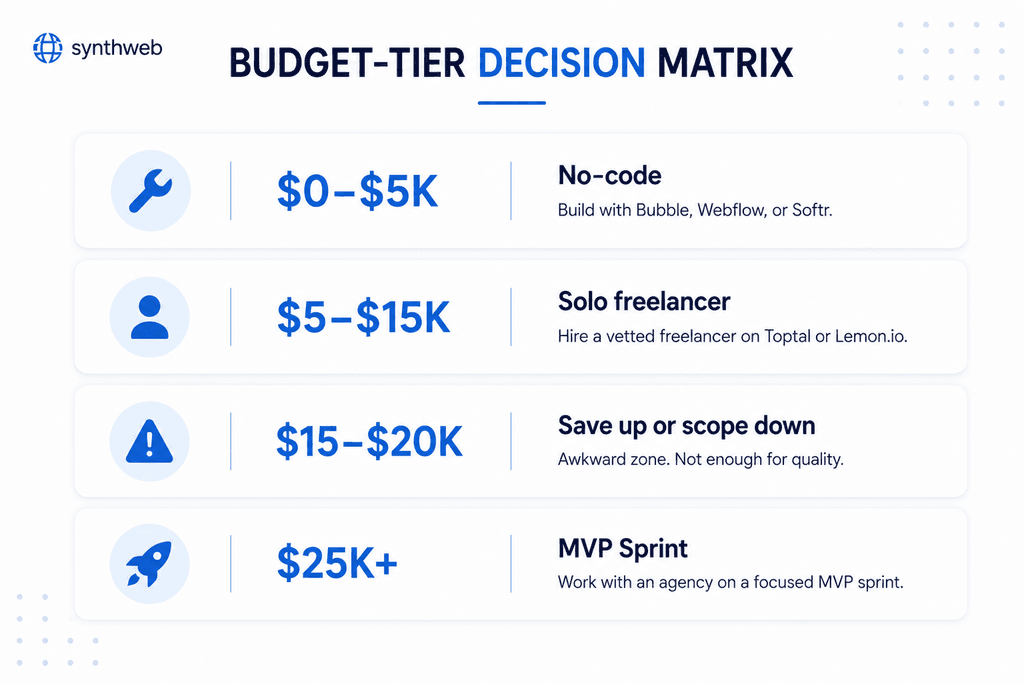
The reason this matters is that small-budget founders waste enormous time getting kicked between agencies, freelancers, and platforms that do not match their actual situation. The honest map below saves you that month.
Why we do not take projects under $20K
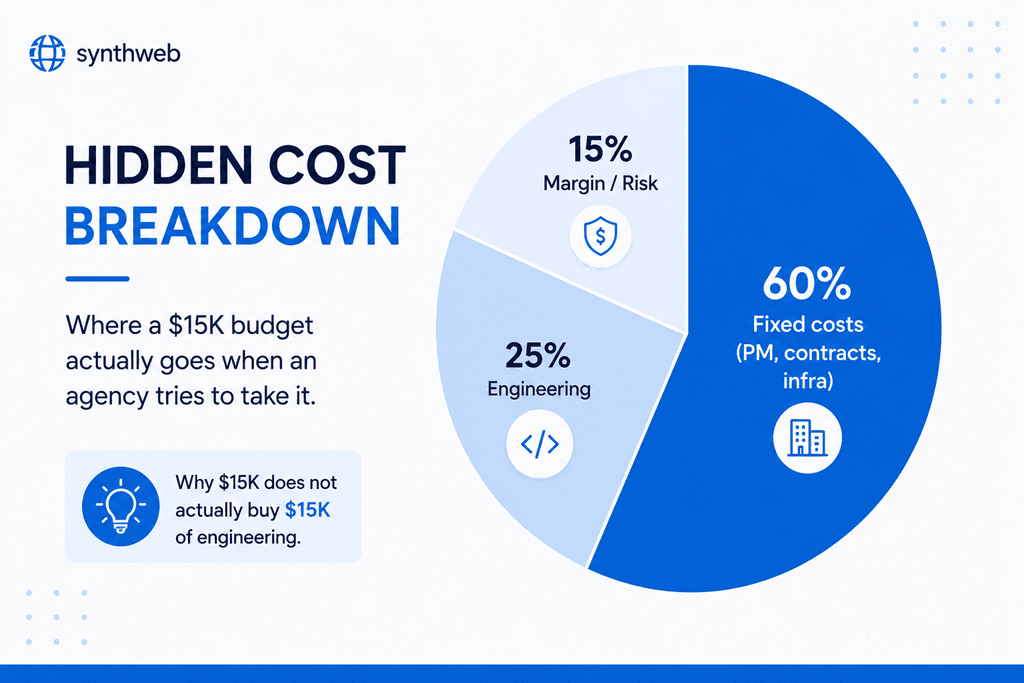
Three reasons of why we can’t help you if you have a small software project budget, none of them about us being too good for you. First, the fixed costs of running an engagement — discovery, project management, design, code review, deployment infrastructure, contracts — total roughly $7,000 to $9,000 regardless of project size. On a $15K project, those fixed costs eat half the budget; the remaining $7K buys two weeks of engineering, which is not enough time to deliver something that meets our quality standard.
Second, the support-after-launch problem in a small software project budget. Software does not stop costing money the moment it ships. Bug fixes, security patches, dependency updates, and the occasional production incident are all part of the actual cost of owning a software product. A $15K initial build creates a $5K-$10K annual support tail that the buyer almost never has budget for. We have watched this play out enough times to refuse the engagement at the start.
Third, the expectations problem. A $15K budget against a “build me an MVP” scope sets up a relationship where the buyer’s expectations and the agency’s deliverables permanently misalign. The buyer thinks $15K should buy them what other founders got for $40K. The agency cannot deliver that without losing money. The relationship deteriorates. Nobody wins.
What to Do If Your Small Software Project Budget Is $0–$5K
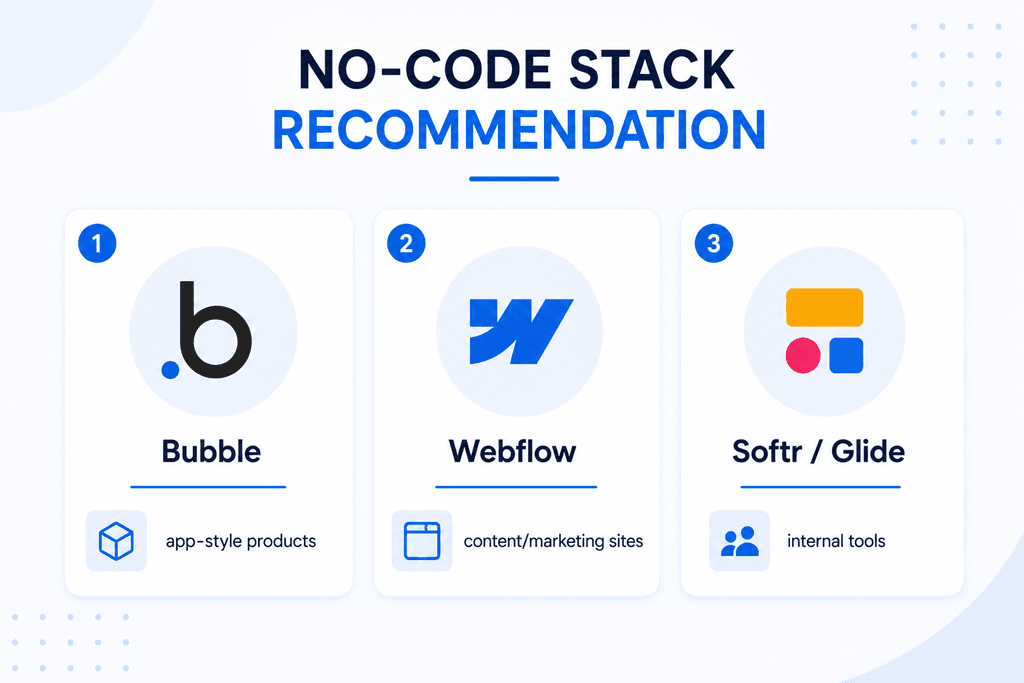
Build with no-code. In 2026, Bubble, Webflow, Softr, and Glide are mature enough to build genuine MVPs that handle thousands of users and meaningful revenue. The trade-off is ceiling — at some scale or complexity you will hit a wall and need to rebuild on real engineering. That is fine. The first version of many funded startups was built on no-code; the rebuild happens after product-market fit, not before.
Specifically, we recommend Bubble for application-style products (logged-in dashboards, multi-user apps), Webflow for content-driven products (marketing sites, blogs, simple ecommerce), and Softr or Glide for internal tools. If you have small software project budget, plan to spend $5-$15 per month on the platform, plus 80-120 hours of your own time learning and building.
What to do if your budget is $5K to $15K
If you have a small software project budget, hire one good freelancer for a focused scope. Not three freelancers, not an agency, not a “project team” — one engineer who can take a clearly-scoped piece of work and ship it. Use Toptal or Lemon.io for vetted freelancers in this band, or post on Indie Hackers and YC Work at a Startup if you are willing to do your own filtering.
The scope has to be tight. “Build me a marketplace” is not a $15K project; “Build me a Stripe-integrated payment flow on top of my existing app” is. Write the scope yourself or with help, then let the freelancer estimate against it.
What to do if your budget is $15K to $20K
This is the awkward middle. Too small for most agencies, too ambiguous for a single freelancer to scope confidently. The honest answer is to either save up or scope down. Save up to $25K-$30K and you become eligible for our MVP Sprint. For companies that need ongoing product development rather than a one-off build, our engineering pods model can provide a dedicated team that scales with your roadmap.
Scope down to a single feature or workflow, and a senior freelancer can deliver it.
If neither of those is possible, look at startup grants and accelerators in your country. The UK has Innovate UK grants for tech startups; the US has SBIR for certain technical domains; YC, Techstars, and similar accelerators often invest enough to push your engineering budget past the $25K threshold.
Also Read: How We Run Seamless Daily Standups Across UK and India Time Zones (Without Burning Out the Team)
FAQ
Will you ever make exceptions on the $20K minimum? Very rarely, and only when the engagement is structured as a small first phase of a larger committed scope.
Can you recommend specific freelancers? We maintain a small list of trusted freelancers we have worked alongside; happy to share via email if your scope is a fit.
If we get to $25K, what does that buy us? See our MVP Sprint page — fixed-scope MVP in 10 weeks, $28K-$45K range.
What about non-technical co-founder matching? Y Combinator’s co-founder matching tool and Indie Hackers are the best two free resources we know of.