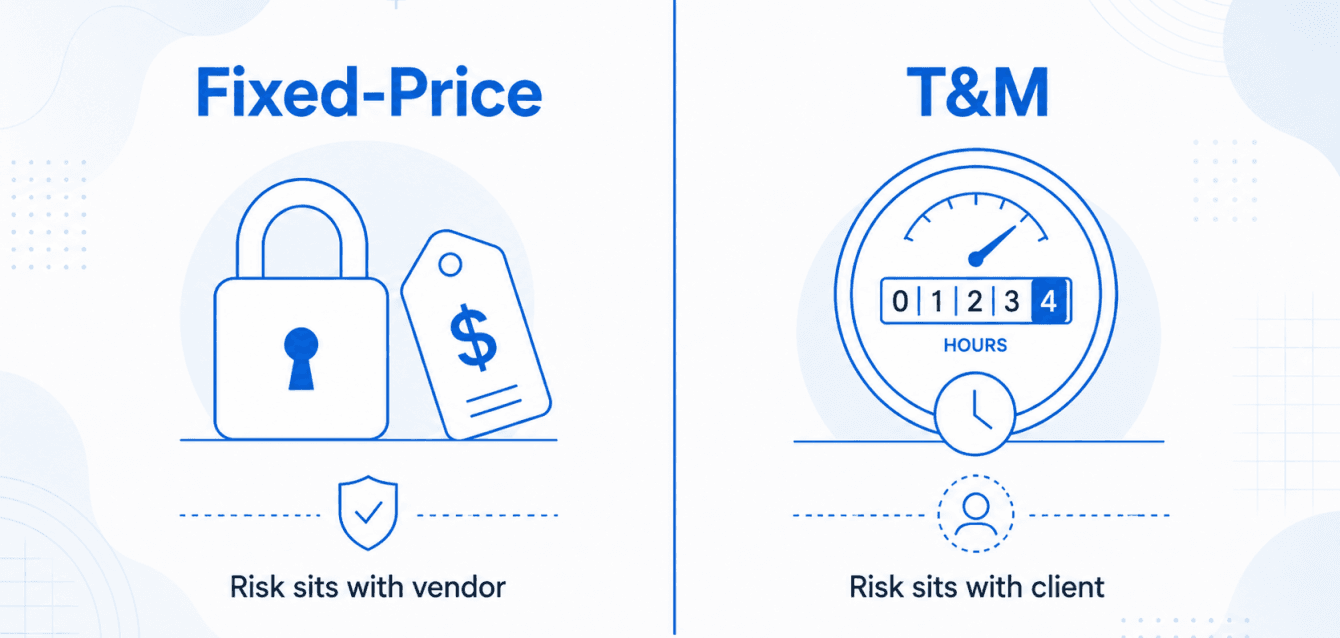
Fixed-Price vs Time & Material is one of the most important decisions founders make before signing a software development contract. Choosing between a fixed-price and a time-and-material contract is not a preference — it is a risk-allocation decision. Every hour of engineering work carries a cost. The contract type determines who absorbs the risk when that cost is higher than expected. Get this wrong and a well-scoped project becomes an open-ended invoice. Get it right and you know what you are spending before the first line of code is written.
At SynthWeb, roughly 60 percent of engagements start as fixed-price MVP Sprints. The remaining 40 percent are time-and-material Engineering Pod retainers. About 40 percent of Sprint clients eventually move to a Pod. The two models are not competing — they are sequential, and they serve different phases of the product lifecycle.
Throughout this guide, we’ll compare Fixed-Price vs Time & Material contracts to help founders choose the right software development model.
Fixed-Price vs Time & Material: How Fixed-Price Protects You
On a fixed-price contract, scope is defined, agreed, and locked before the build starts. The vendor quotes a number. If the build costs more than that number, the vendor absorbs the difference. If it comes in under, the vendor keeps the margin. The client knows their total exposure before signing.
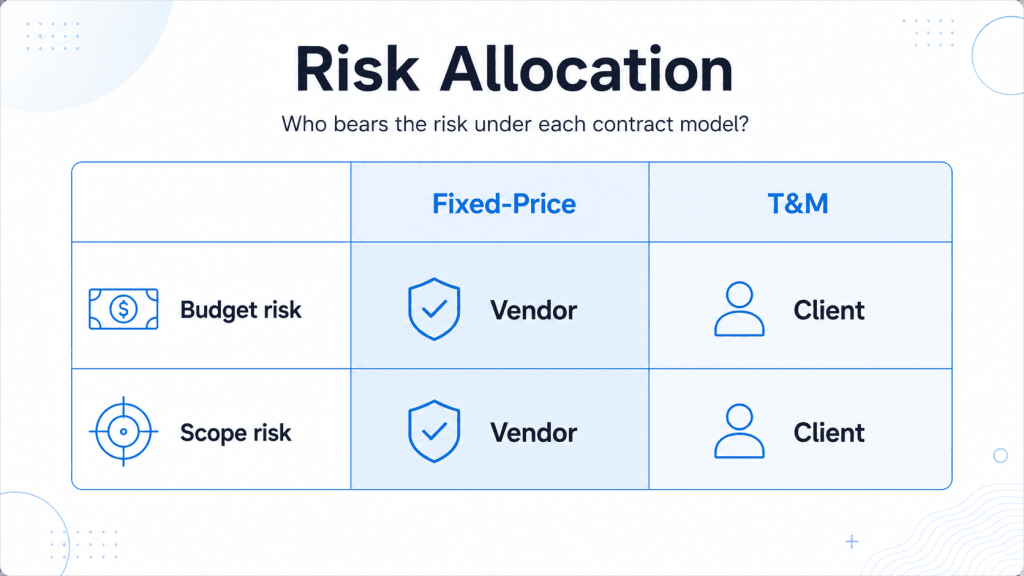
This model protects founders in three specific ways. First, budget certainty: you can tell your board the engineering budget for the next 10 weeks without a range. Second, vendor accountability: a vendor who underestimates a fixed-price scope pays for it, which aligns their incentive with getting the scope right. Third, scope discipline: because additions change the price, both sides think hard before adding features. This keeps MVPs lean.
Where it fails: fixed-price is only as good as the scope document. If requirements are ambiguous or likely to change, a fixed-price quote will either be high (padded for uncertainty) or will generate change requests that erode the savings. Fixed-price works best when you know what you are building and can articulate it clearly.
As Martin Fowler explains in his discussion on fixed-price software contracts, pricing models work best when project scope is well understood before development begins.
How time-and-material works — and where it protects you
On a T&M contract, the client pays for hours delivered at an agreed day rate. There is no ceiling. The vendor bills actuals. If scope expands, the invoice expands proportionally. What changes is that the client gets flexibility: you can add, remove, or reprioritise work without a change-order process. This model works especially well for long-term mobile and web application engineering projects.
T&M protects clients in product-development phases where the roadmap is emergent — when user feedback, market conditions, or investor requirements are actively shaping what gets built. A team that needs to pivot in week four without renegotiating a contract will almost always outperform a team locked into week-four deliverables defined in week zero.
The Agile Alliance also highlights that adaptive planning and iterative delivery are better suited to projects where requirements evolve throughout development.
Where it fails: without strong sprint discipline and a weekly written scope document, T&M engagements drift. Meeting overhead, vague briefs, and unclear acceptance criteria turn billable hours into cost with no clear output. This is why SynthWeb’s Engineering Pod model uses monthly T&M but with a structured sprint cadence and a defined scope of work per sprint — the flexibility of T&M with the discipline of a fixed deliverable cycle.
The three-question decision framework
Before choosing a model, answer three questions. First — is the scope clear enough to lock at signing? If you can describe exactly what you are building and your requirements are unlikely to change, fixed-price is appropriate. If the scope is still being defined, fixed-price will cost you more, not less. Second — is this a build-and-ship or ongoing product development? A defined MVP with a clear launch date is a fixed-price project. A product with a living roadmap is T&M. Third — what matters more: budget certainty or flexibility? If your board needs a fixed number, choose fixed-price. If your product team needs room to respond to users, choose T&M.
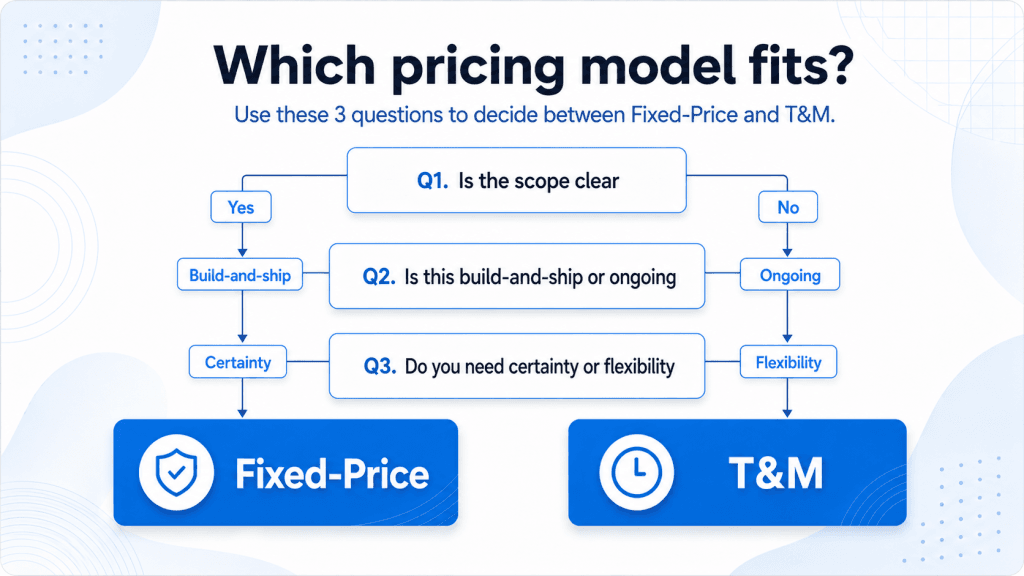
At SynthWeb: MVP Sprint ($28K–$45K, 10 weeks) is fixed-price. Engineering Pods ($8K–$18K/month) are T&M with sprint structure. The transition between them is intentional — Sprint to prove the product works, Pod to build what comes next.
Learn more about our Product Engineering Solutions and how we help funded startups build beyond the MVP stage.
FAQ
Can you switch contract models mid-project? Not cleanly on a fixed-price engagement — switching mid-build requires renegotiating scope and usually incurs a cost increase. On a T&M Pod, you can adjust scope monthly. The cleanest approach is to start fixed-price for the MVP and move to T&M for the post-launch phase.
Is one model cheaper than the other? Fixed-price is predictable; T&M reflects actuals. A well-run T&M engagement on a mature scope will often cost less than fixed-price (no contingency padding). A poorly scoped T&M engagement will cost significantly more.
What do investors prefer? No preference on contract type, but investors do care that founders understand their engineering spend. A fixed-price Sprint with a clear deliverable is easier to explain in a board meeting than an open-ended T&M retainer.