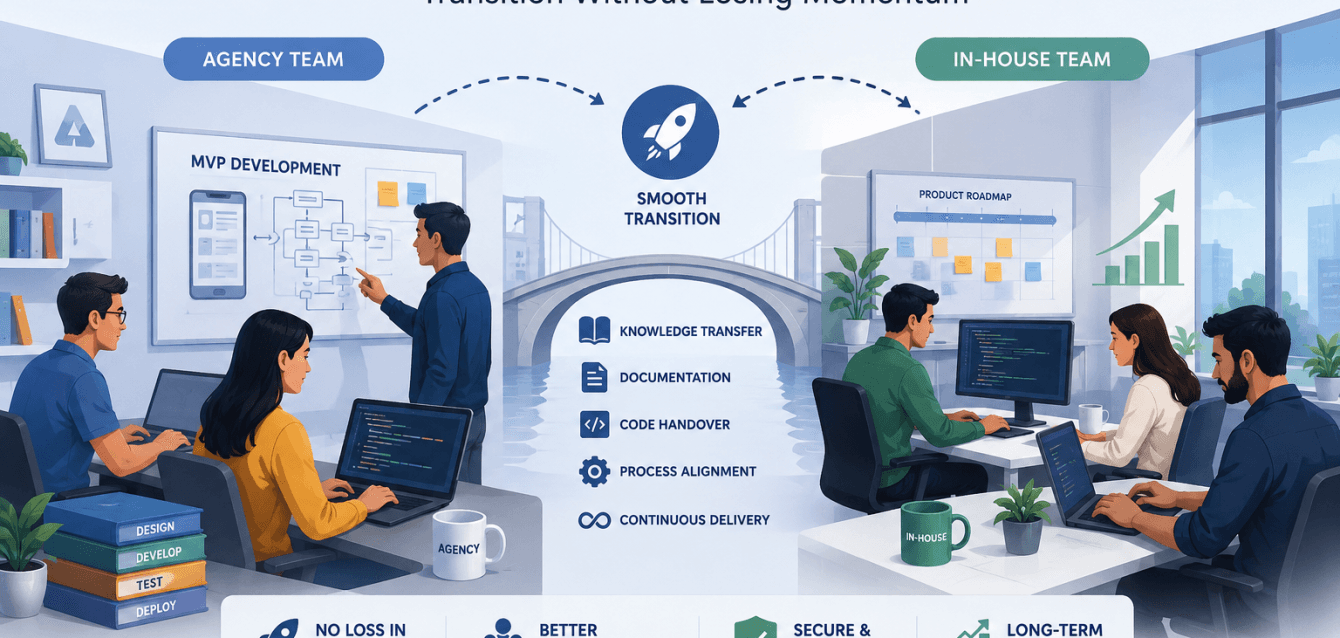
Building a successful Minimum Viable Product (MVP) with a software development agency like SynthWeb is a smart way to validate product ideas quickly. Businesses looking to accelerate product launches can explore SynthWeb’s MVP Development Services to transition from an Agency-Built MVP to In-House Team transition requires careful planning to ensure product development continues without delays or technical setbacks for startups and growing businesses to validate ideas quickly. However, once the product gains traction, many companies decide it’s time to bring development in-house. The challenge isn’t making the decision it’s ensuring the Agency-Built MVP to In-House Team transition happens without slowing product development, introducing technical debt, or disrupting customer experience.
A poorly managed transition can result in knowledge gaps, delayed releases, frustrated developers, and increased costs. On the other hand, a well-planned handover allows businesses to continue innovating while building a stronger internal engineering culture.
This guide explains how to make the transition successfully while maintaining product momentum.
Why Companies Move From an Agency-Built MVP to an In-House Team
Hiring an agency for MVP development allows businesses to launch products faster without investing heavily in permanent engineering teams. Agencies provide experienced developers, designers, and project managers who can rapidly build and validate new ideas.
As the business grows, priorities often change, prompting many companies to bring product development in-house. This transition allows organizations to build long-term product expertise, gain greater control over the product roadmap, and strengthen collaboration between engineering and business teams. It also helps protect valuable intellectual property while reducing long-term development costs by establishing a dedicated internal team focused on the company’s strategic goals.
While these are valid reasons, the transition should be treated as a strategic process rather than a simple transfer of code.
Plan the Transition Before Hiring Developers
One of the biggest mistakes companies make is recruiting an internal team before defining a clear transition strategy.
Before hiring developers, create a roadmap that answers questions such as:
- What responsibilities will the agency continue handling?
- Which systems need documentation?
- What knowledge must be transferred?
- When should ownership officially change?
Having a structured Transition from Agency to In-House Team plan prevents confusion and minimizes downtime.
Ensure Comprehensive Documentation
Documentation is the foundation of every successful handover. Documentation becomes even more valuable during an Agency-Built MVP to In-House Team transition because it helps new engineers understand the architecture quickly. Comprehensive documentation plays a critical role in every Agency-Built MVP to an In-House Team transition by helping new developers understand the codebase, architecture, deployment process, and engineering standards more efficiently.
Your new engineering team should receive documentation covering:
- System architecture
- Backend services
- Frontend framework
- Database design
- APIs
- Deployment process
- Infrastructure
- Security practices
- Third-party integrations
Without proper documentation, new developers spend weeks understanding code instead of improving the product. For additional best practices on software architecture and maintainable code, developers can also explore the resources shared by Martin Fowler, a well-known software engineering author and architect.
A reliable development partner such as SynthWeb emphasizes clean architecture and maintainable documentation, making future transitions significantly easier.
Transfer Knowledge Gradually
Avoid expecting the agency to step away immediately after the handover. Instead, implement a phased knowledge transfer process that gives your in-house team enough time to understand the product, architecture, and development workflows. This process should include technical walkthrough sessions, pair programming, architecture reviews, live debugging sessions, and active participation in code reviews. A gradual transition allows internal developers to gain practical experience, ask questions, and confidently take ownership of the product without disrupting ongoing development.
This allows the in-house engineers to understand not just what the code does, but why important technical decisions were made. During an Agency-Built MVP to an In-House Team transition, regular knowledge-sharing sessions reduce onboarding time and help internal developers gain confidence more quickly. Knowledge transfer should happen over several weeks rather than a few meetings.
Keep the Original Development Team Available
Many businesses make the mistake of ending their agency contract immediately after hiring internal developers.
Instead, keep the agency available during the first few months. Every successful Agency-Built MVP to In-House Team migration should include sprint planning and knowledge transfer.
The agency can:
- Answer technical questions
- Fix unexpected production issues
- Explain legacy decisions
- Support infrastructure changes
- Help onboard new engineers
This overlap dramatically reduces business risk during the transition.
Maintain Development Velocity
One of the biggest concerns during an Agency-Built MVP to an In-House Team transition is losing development momentum. Rather than pausing development altogether, businesses should continue delivering value to users throughout the transition. Keep releasing small features, maintain consistent sprint cycles, and prioritize bug fixes to ensure the product remains stable and continues to evolve. At the same time, avoid making major architectural changes until the internal team has gained sufficient knowledge and confidence in managing the existing system. This gradual approach helps maintain product quality, minimizes disruptions, and ensures a seamless transition for both the development team and end users.
Following the principles of the Agile Manifesto can help teams maintain consistent delivery, encourage collaboration, and ensure customer value remains the primary focus throughout the transition. Customers should never notice that ownership has changed.
Maintaining consistent release cycles builds confidence among both users and stakeholders. A successful Agency-Built MVP to In-House Team strategy focuses on maintaining release cycles while gradually transferring engineering ownership.
Avoid Rewriting the Entire Product
New engineering teams often believe rewriting the MVP is the best solution.
One of the biggest challenges during an Agency-Built MVP to an In-House Team transition is maintaining development momentum. Rather than pausing development, continue releasing small features, keep sprint cycles consistent, and prioritize bug fixes. Delay major architectural changes until the in-house team is fully familiar with the existing system to ensure a smooth and efficient transition.
Modernizing components gradually is far safer than rebuilding everything from scratch.
Build Strong Internal Processes
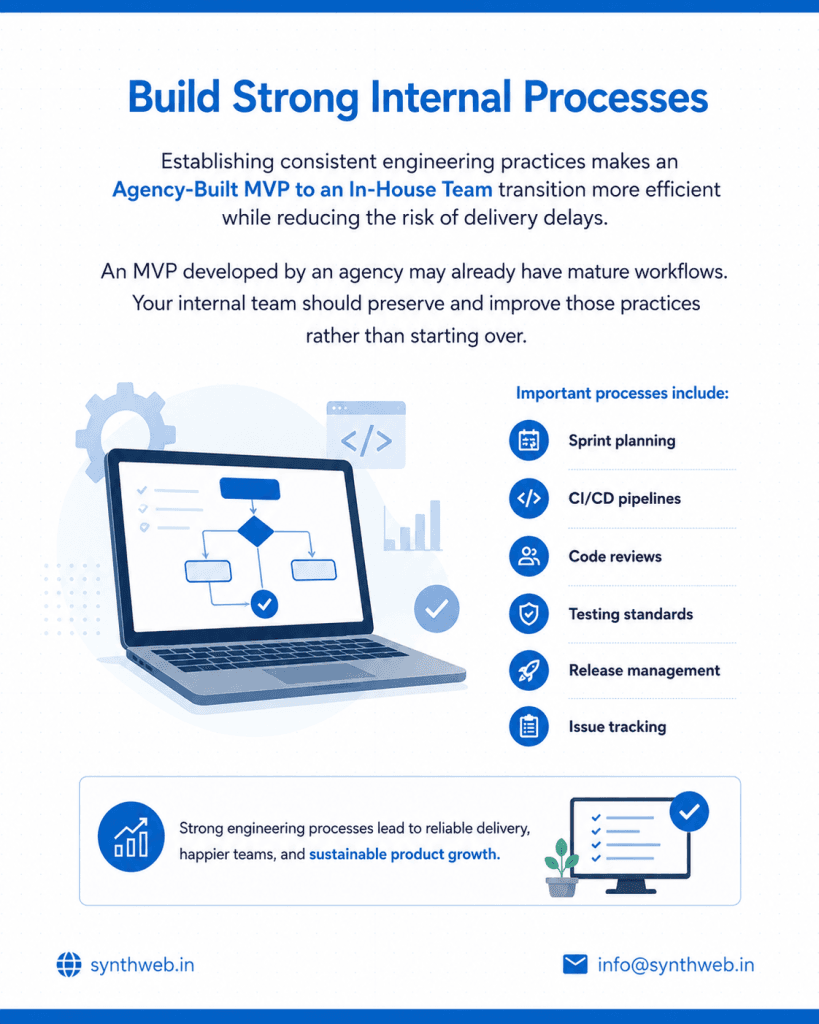
Establishing consistent engineering practices makes an Agency-Built MVP to an In-House Team transition more efficient while reducing the risk of delivery delays. An MVP developed by an agency may already have mature workflows. Your internal team should preserve and improve those practices rather than starting over.
Important processes include:
- Sprint planning
- CI/CD pipelines
- Code reviews
- Testing standards
- Release management
- Issue tracking
Strong engineering processes help sustain long-term product growth. Investing in well-defined workflows makes an Agency-Built MVP to an In-House Team transition more predictable, improves collaboration across teams, and reduces operational risks as ownership shifts to the internal engineering team.
Invest in Developer Onboarding
Hiring talented engineers isn’t enough.
Every developer should understand:
- Business goals
- Customer pain points
- Product vision
- Technical roadmap
- Current architecture
The faster new engineers understand the product, the faster they begin contributing meaningful improvements.
A structured onboarding process shortens the learning curve considerably.
Monitor Product Stability During the Transition
Moving development ownership doesn’t end after the final handover. Measuring success after an Agency-Built MVP to In-House Team transition ensures development continues without interruptions.
Track important metrics, including:
- Deployment frequency
- Bug rates
- Application uptime
- Customer support tickets
- Feature delivery speed
- Team productivity
These indicators reveal whether the transition is maintaining business momentum or creating hidden issues.
Early monitoring allows leadership to solve problems before they become expensive.
Choose an Agency That Plans for the Future
The best agencies don’t build products that only they can maintain.
Instead, they create software that future internal teams can confidently manage.
When selecting a development partner, look for agencies that prioritize:
- Clean architecture
- Maintainable code
- Documentation
- Knowledge sharing
- Scalable infrastructure
- Transparent development practices
SynthWeb follows this collaborative approach by building scalable software solutions designed for long-term growth. Rather than creating dependency, the focus is on empowering businesses with maintainable systems and structured knowledge transfer, making future team transitions far more efficient. Businesses planning long-term software growth can also explore SynthWeb’s Custom Software Development Services, which focus on scalable architecture, maintainable code, and seamless team collaboration.
Final Thoughts
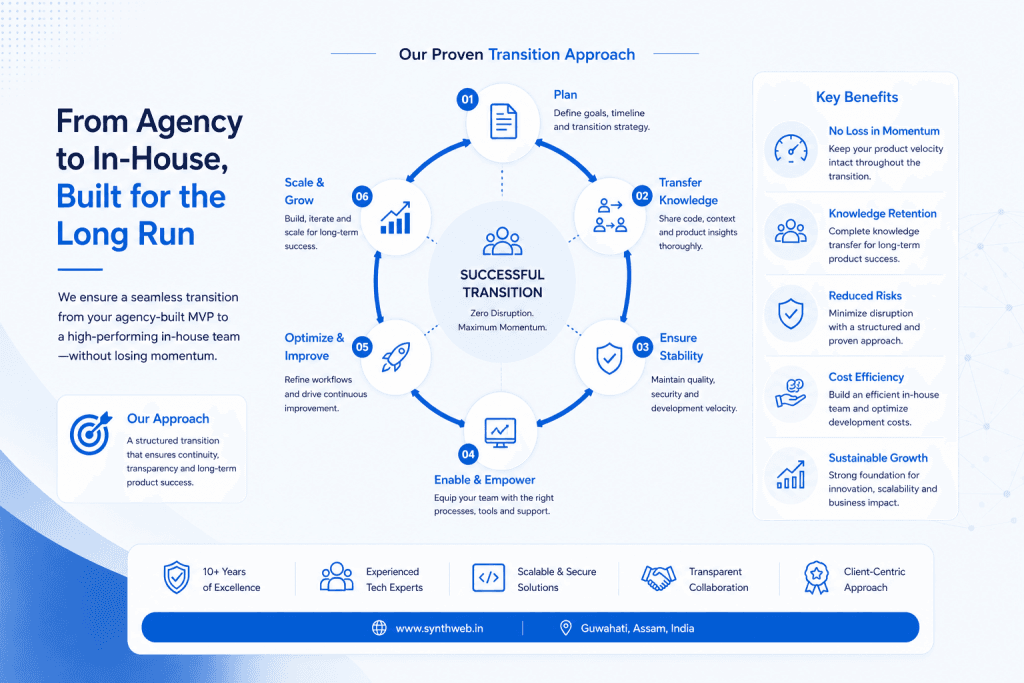
Every organization approaches an Agency-Built MVP to an In-House Team transition differently, but success depends on careful planning, transparent communication, and a structured knowledge transfer process that keeps product development moving forward. Every Agency-Built MVP to In-House Team transition should prioritize documentation, collaboration, and continuous product delivery to minimize operational risks. Transitioning from an Agency-Built MVP to In-House Team is a major milestone in a company’s growth journey. Done correctly, it strengthens internal capabilities while preserving the speed and innovation that helped the product succeed in the first place. A successful Agency-Built MVP to In-House Team strategy protects product quality, reduces risk, and helps companies scale faster.
The key is preparation. Thorough documentation, phased knowledge transfer, ongoing collaboration, and disciplined engineering practices ensure the transition happens smoothly without disrupting customers or delaying product development.
Whether you’re preparing to scale your startup or planning long-term ownership of your software, partnering with an experienced development company like SynthWeb can make the transition significantly more structured and less risky. By focusing on maintainable architecture, transparent communication, and scalable development practices, businesses can confidently move from an agency-built MVP to an internal engineering team while continuing to grow without losing momentum.