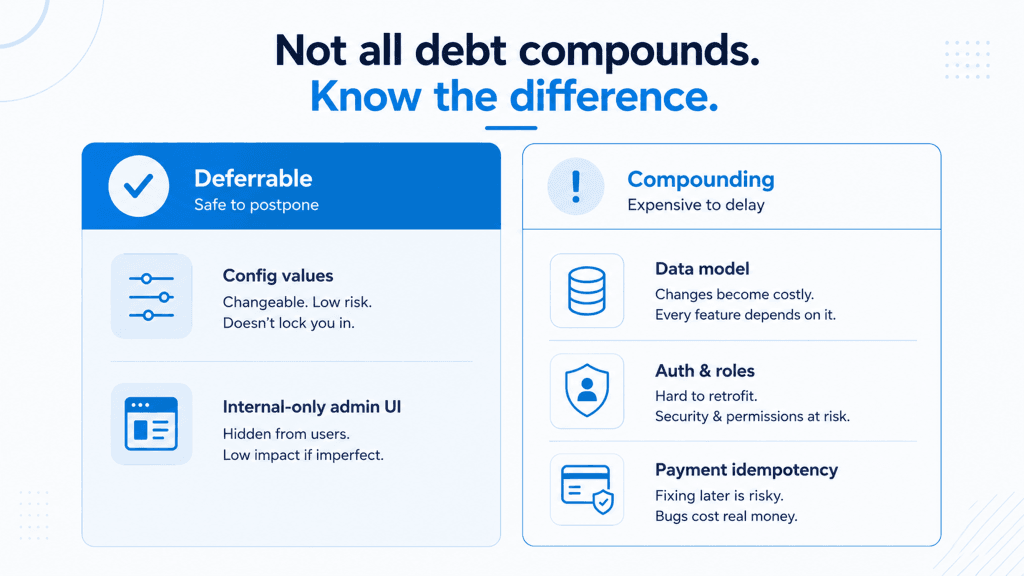
Every founder eventually faces the technical debt cost startup products incur when saying “we’ll fix it in V2″—one of the most reasonable-sounding sentences in software, and one of the most expensive if said about the wrong thing. Some shortcuts are genuinely free to defer: a hardcoded config value or a missing admin UI for something only the founder touches. Others compound every week they’re left alone, and the founder usually can’t tell the difference until the bill arrives.
Why the Technical Debt Cost Startup Curve Isn’t Linear
A shortcut in isolated code stays cheap. Nothing else depends on it, so you can rewrite it whenever you get around to it. A shortcut in shared infrastructure; auth, the data model, the billing logic, behaves differently. Every feature that ships after it makes a small, unspoken assumption about how that piece of infrastructure works. None of those assumptions get written down anywhere.
By the time the shortcut is flagged as a problem, three other systems already assume it will keep behaving exactly the way it does today. Fixing it at that point isn’t a fix; it’s a coordinated migration: new schema, new auth flow, new billing logic, and a plan for moving live customer data through all three without downtime.
The Technical Debt That’s Actually Expensive to Defer
Three patterns show up across almost every build we’ve scoped that drive up the technical debt cost startup teams face. Multi-tenancy left out of the data model when the roadmap already includes a second customer type is cheap to add in week two, but becomes a multi-week schema migration once tenants are live and their data is intermixed.
Auth without role separation, when a second user type is already on the roadmap, is another: adding roles later means retrofitting permission checks into every endpoint that assumed a single user type. The third is payment logic that isn’t idempotent, meaning a retried request can double-charge a customer. This one doesn’t surface in testing; it surfaces the first time a payment provider times out and retries, and it’s a support ticket and a refund, not a code review comment.
Each of these looks like a minor omission in week two. Each becomes a multi-week rewrite the moment real usage depends on the shortcut being wrong.
How We Decide What to Build Correctly vs. Defer at Scoping Stage
We split technical debt into two buckets before a sprint starts: deferrable and compounding. Deferrable debt gets flagged and left alone on purpose. That’s a legitimate way to hit a ten-week timeline, and building it out anyway just slows down the parts of the project that didn’t need the extra care. Compounding debt gets built correctly the first time, even if it costs an extra few days, because we’ve seen what the same shortcut costs to unwind at Series A: usually mid-fundraise, usually with a live customer base already depending on the thing being rebuilt.
The Fix: How to Keep V2 From Costing More Than V1
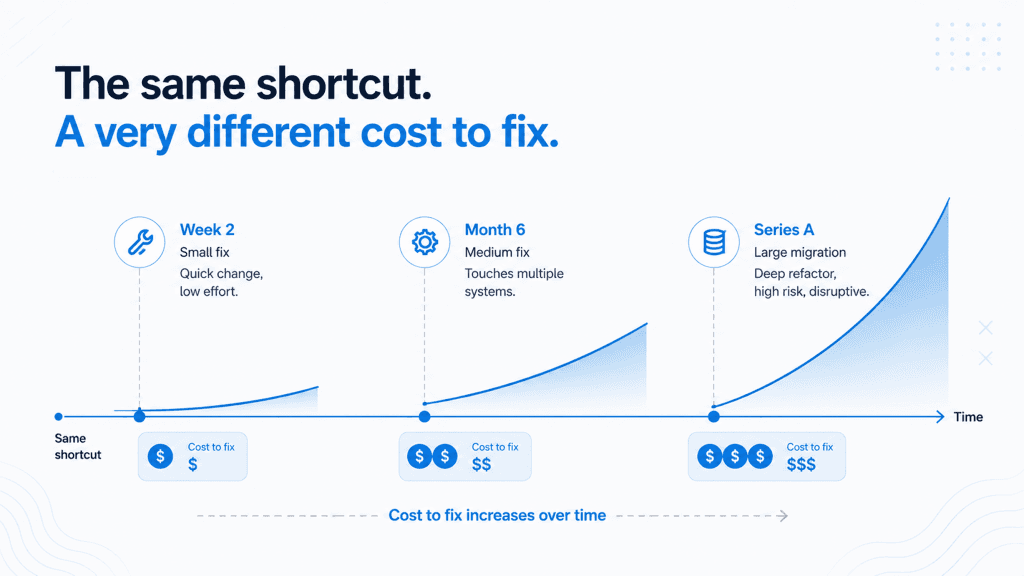
Naming the debt at scoping stage—deferrable or compounding—is what keeps the technical debt cost startup teams pay from turning “we’ll fix it in V2” from becoming a euphemism for “we’ll rebuild this under pressure in six months.” This is also the reasoning behind Engineering Pods that stay attached past MVP stage: a team that already knows which of its own shortcuts are load-bearing catches the compounding kind before it compounds, instead of finding out during a scaling push.
FAQ
What’s the difference between deferrable and compounding technical debt?
Deferrable debt sits in isolated code nothing else depends on. Compounding debt sits in shared infrastructure—auth, data models, billing—and gets built on top of by every feature shipped after it, making it more expensive to fix the longer it’s left.
What technical debt is most expensive to defer in an MVP?
Multi-tenancy gaps in the data model, missing role separation in auth, and non-idempotent payment logic are the most common expensive-to-defer shortcuts we see.
How does SynthWeb decide what to build correctly vs defer at MVP stage?
We flag debt as deferrable or compounding at scoping stage. Deferrable debt is left alone intentionally to hit timeline; compounding debt gets built correctly even at extra short-term cost.
Also Read:
How to Transition From an Agency-Built MVP to an In-House Team Without Losing Momentum