For most growing businesses, the honest answer is: use SaaS for 70–80% of your operations. The exception — and it matters enormously — is the 20% that’s directly tied to how you make money.
Build vs buy is one of the most consequential decisions a founder or operations director makes. Get it wrong in either direction and you’re either overpaying for software that doesn’t quite fit, or you’re 18 months into a custom build that’s still not finished. This post gives you the framework SynthWeb uses when a client asks us this question — and we’ve been asked it dozens of times, across retail, fintech, healthcare administration, and logistics.
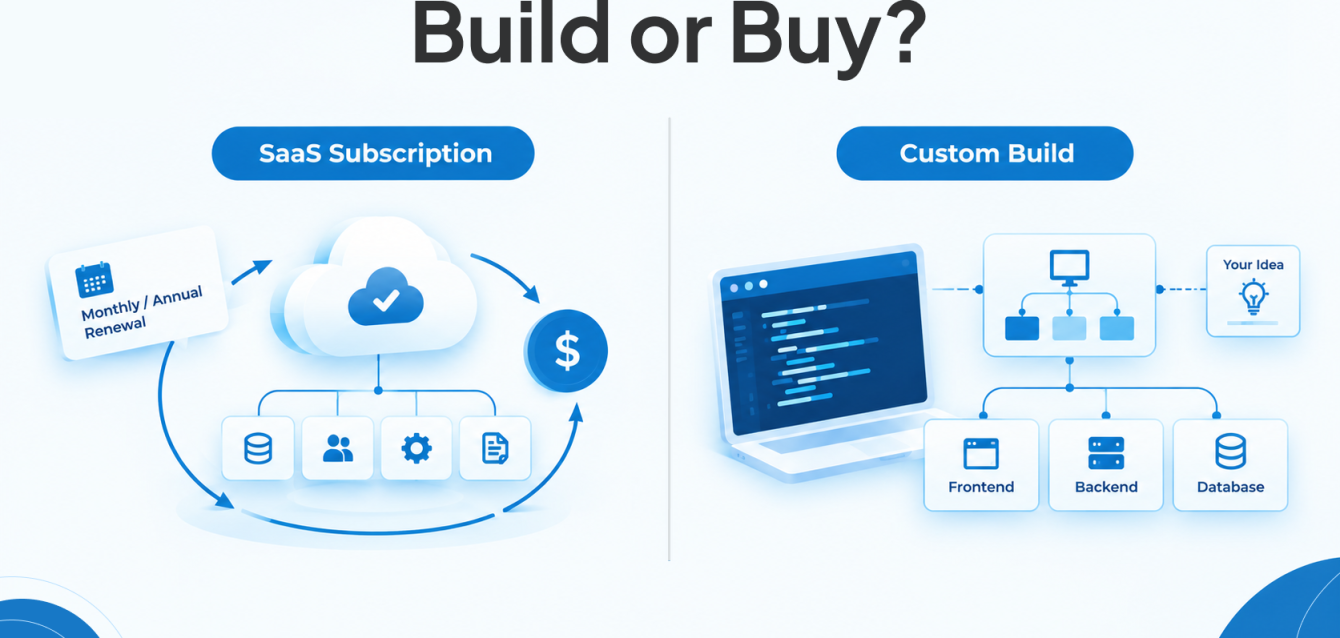
The short version: buy SaaS for commodity functions. Build custom when your core value delivery depends on software that no off-the-shelf product can replicate. Everything else sits in a middle ground where the decision depends on volume, margin, and how fast your process is changing.
What ‘Build vs Buy’ Actually Means in Practice
‘Build’ means commissioning custom software — either through an in-house team or an offshore engineering partner like SynthWeb. You own the codebase. You control the roadmap. You pay upfront development costs and ongoing maintenance.
‘Buy’ means subscribing to a SaaS product. Salesforce, HubSpot, Xero, Shopify, Calendly — these are all ‘buy’ decisions. You pay monthly or annually. You get updates automatically. You accept the product’s constraints.
The framing of ‘build vs buy’ can be misleading because it suggests these are permanent positions. They’re not. Many businesses start on SaaS (lower upfront cost, faster to implement) and migrate to custom once their volume and process complexity justify it. The question is really: where are you in that journey, and what does the economics look like right now?
The Five Dimensions That Determine the Right Answer
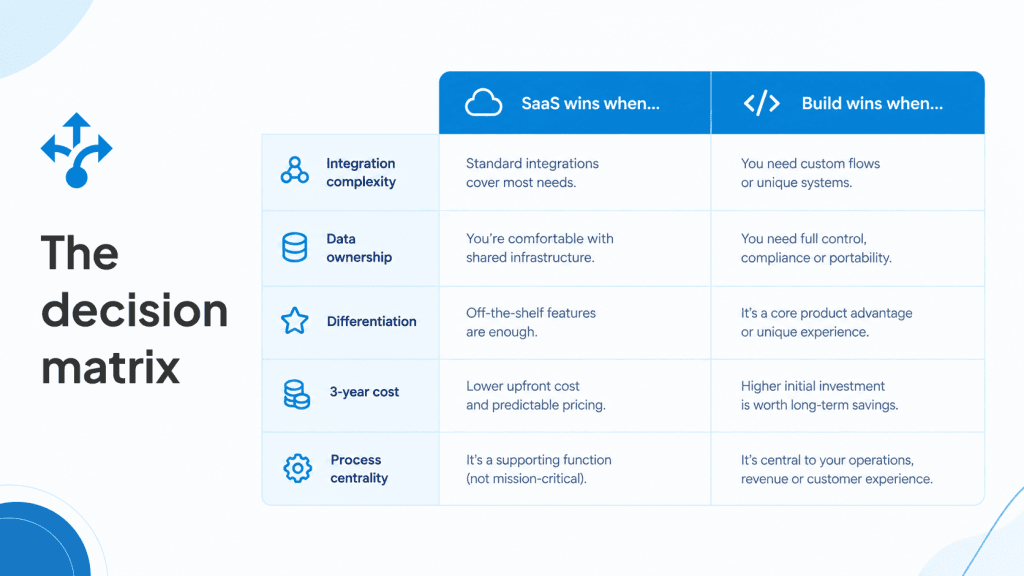
We evaluate build vs buy decisions across five dimensions. No single factor is decisive — the answer comes from the combination.
1. Is this your core value-creation process?
If the software touches how you deliver your product or service — how you price, fulfill, invoice, communicate, or support — it’s a candidate for custom. If it’s HR, email hosting, accounting, or calendar management, buy SaaS.
2. Does a SaaS product handle your volume and edge cases?
A £2m/year e-commerce business can run fine on Shopify. A £20m/year business with 12 warehouse locations, custom pricing tiers, and next-day B2B fulfillment probably can’t. The issue is almost never the average case — it’s your edge cases, the ones that represent 30% of your revenue.
3. What does the total cost of ownership look like over 36 months?
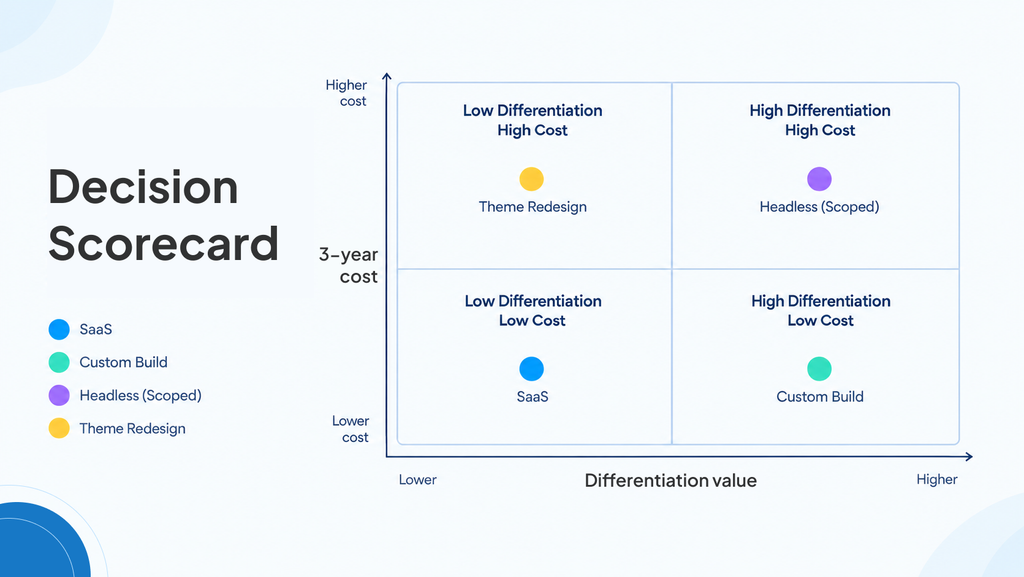
SaaS feels cheap month-to-month. Custom feels expensive upfront. Run the numbers over three years including SaaS seat costs, integration costs, and the opportunity cost of working around limitations. The crossover point is lower than most founders assume.
4. How fast is your process changing?
If you’re iterating your core process every 90 days — new pricing models, new fulfillment flows, new customer segments — you need a codebase you control. SaaS products move on their own roadmap. You can’t make Salesforce add a field in two weeks.
5. What’s the integration complexity?
Every SaaS product you add is a new integration surface. When you have seven SaaS products talking to each other through Zapier and a bespoke middleware layer, you’ve often spent more engineering time than a single custom platform would have required — and you have less reliability and more vendor risk.
When SaaS Is the Honest Answer
SaaS is the right answer when all three of the following are true: the process is not your core differentiation, a strong product exists in the market, and your volume is within normal ranges for the platform.
Common examples where SaaS consistently wins:
– Accounting: Xero or QuickBooks for businesses under £10m turnover. Custom finance tools almost never make sense below that threshold.
– CRM (at early stage): HubSpot Free or a basic Pipedrive for teams under 10. Custom CRM only makes sense when you have workflows that no standard CRM can model.
– Team communication: Slack, Microsoft Teams. Never build your own messaging tool.
– Email marketing: Mailchimp, Klaviyo, ConvertKit. These have years of deliverability infrastructure you can’t replicate.
– Basic booking: Calendly, TidyCal. Unless your booking logic has multiple conditional flows, custom availability rules, or integration into a proprietary inventory system.
If you’re paying £200/month for a tool and it handles your use case completely, the decision to build custom needs a very strong business case to justify the £30,000–£80,000 development investment.
When Building Is the Only Real Option
Custom software becomes necessary when SaaS products represent the ceiling of your scale, not the floor. Here’s where we consistently see clients outgrow their SaaS stack:
Multi-location operational complexity. A single-location restaurant chain might run fine on a standard POS. A twelve-location chain with central kitchen inventory, variable menu by location, and daily cost reporting needs something custom or heavily customised — and usually the customisation cost exceeds the custom build.
Proprietary pricing or margin logic. If your pricing model involves more than three variables — volume tiers, location factors, customer history, dynamic inputs — you’ll spend more time maintaining spreadsheet workarounds in your SaaS platform than a proper system would cost.
Regulatory or audit trail requirements. Healthcare, financial services, legal. Many SaaS platforms cannot produce the audit records your regulatory environment requires. Custom gives you full control of what gets logged, for how long, and in what format.
Integration into legacy systems. If you’re running operations on a bespoke ERP built in 2009, no SaaS product connects to it cleanly. Custom middleware or a full replacement is often the only real path.
You’re building a product, not running a business. If software IS your product — your IP, your competitive moat — you build. You never outsource your core product to a SaaS subscription.
A Worked Example: Professional Services Firm, 45 Employees
A UK-based professional services firm running project-based work for enterprise clients. They were running: Salesforce (CRM), Harvest (time-tracking), Xero (accounting), Float (resource planning), and Google Sheets for project margin reporting. Total monthly SaaS cost: £2,400. Two full-time staff spending 30–40% of their week reconciling data between systems.
The problem wasn’t any one tool — it was the gaps between them. Harvest didn’t feed cleanly into project margin reporting. Resource planning in Float wasn’t connected to actual hours logged. Salesforce opportunity data didn’t flow into project setup automatically.
We built a single internal platform that handled project intake, resource allocation, time-logging, and margin reporting. Development cost: £55,000. Annual saving on SaaS licences: £18,000. Staff time recovered: approximately £60,000/year equivalent. Payback period: under 12 months.
This isn’t always the outcome. But when you map the actual cost of working around SaaS limitations — staff time, error rates, decisions made on bad data — the economics of custom shift significantly.
Frequently Asked Questions
Q: Should I always start with SaaS before building custom?
A: Generally yes, especially pre-Series A. SaaS lets you validate your process before locking it into a codebase. The exception is when your process is your product — in that case, building from the start is often the right call.
Q: How much does custom software cost compared to SaaS?
A: A custom internal tool or platform typically costs £25,000–£150,000 to build depending on scope. Compare this to your all-in SaaS spend over 36 months, including integration costs and staff time. Custom becomes competitive faster than most founders expect.
Q: Can I start with SaaS and move to custom later?
A: Yes, and many successful businesses do this. The main risk is data migration — SaaS products vary wildly in how cleanly they export your data. Before committing to a SaaS platform, check its data export capabilities and make sure you own your data.
Q: What’s the biggest mistake businesses make in the build vs buy decision?
A: Underestimating integration costs and staff time lost to working around SaaS limitations. The sticker price of SaaS is not its real cost. And underestimating the speed and flexibility that custom gives you once it’s built.
Next Steps
Ready to work out which side of the build vs buy line you sit on?
SynthWeb runs a Technical Architecture Audit — a structured review of your current stack, your process requirements, and the business case for custom. No sales pitch, no obligation to build with us.
→ Read how our Technical Architecture Audit works
→ See how we scope software projects for founder-led businesses