The most common question we get from founders mid-sprint isn’t about the build — it’s about what happens after. Who fixes the bug that shows up in week three post-launch? Does the team that built it still know the codebase in month four? For founders, post mvp support agency handoff should be clear from the start. We built our handoff process around one rule: nothing gets handed off that the founder’s future team — internal or otherwise — can’t pick up cold.
What the MVP Handoff Checklist Actually Contains
Every MVP Sprint ends with three things beyond the working product: an architecture decision record covering every non-obvious technical choice and why we made it, an environment runbook covering deployment, secrets management, and rollback steps, and a walkthrough call recorded and transcribed so it isn’t dependent on one person’s memory six months later.
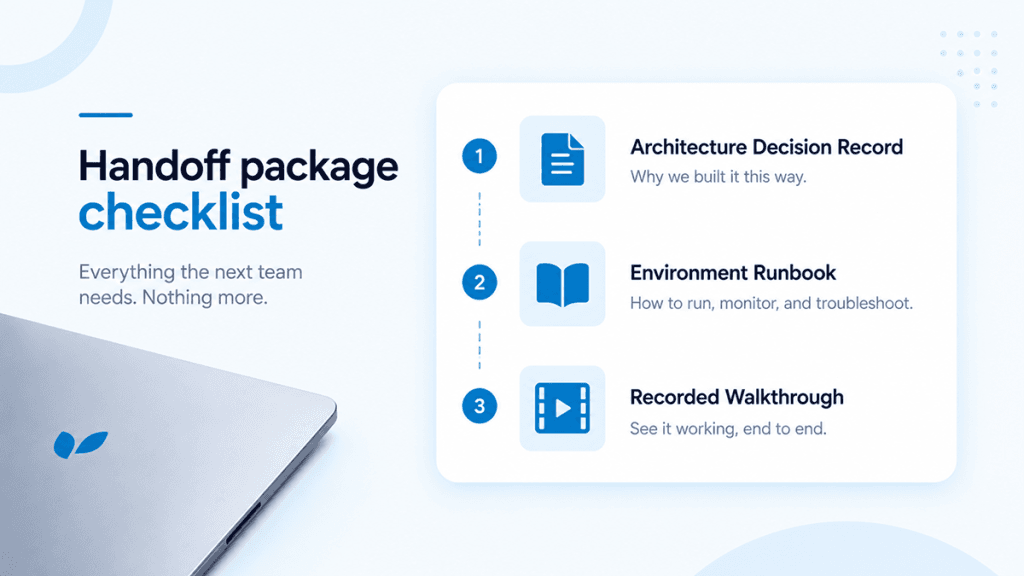
These aren’t documents created just to tick a box at the end of the project. They are there to give the next person enough context to work with the codebase without having to go back to the original team for every question. The architecture record explains the decisions behind the system. The environment runbook covers the practical details of deploying and managing it. The recorded walkthrough gives the next team a quick way to understand how everything fits together.
That makes the post mvp support agency handoff much easier for everyone involved. The founder gets the codebase, the documentation, and the context needed to take it forward.
The Support Window and What’s Inside It
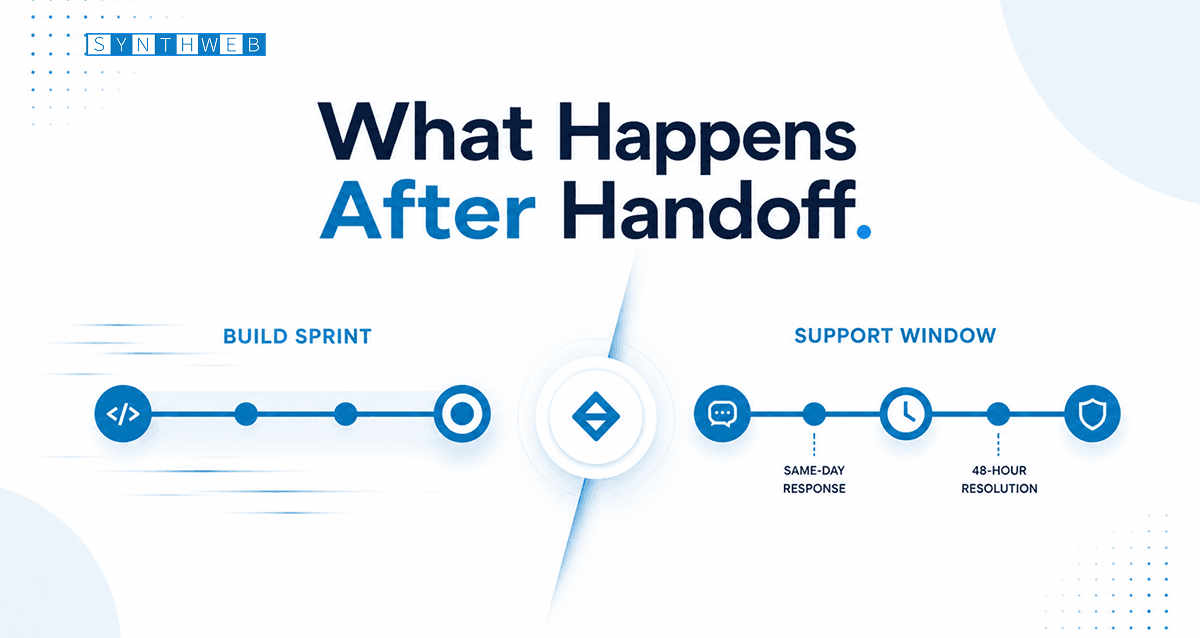
We run a fixed post-launch support window — typically 30 days — where critical bugs get a same-day response and non-critical issues get triaged within 48 hours. This isn’t a soft promise; it’s written into the statement of work with response-time commitments attached, the same way we scope the build itself.
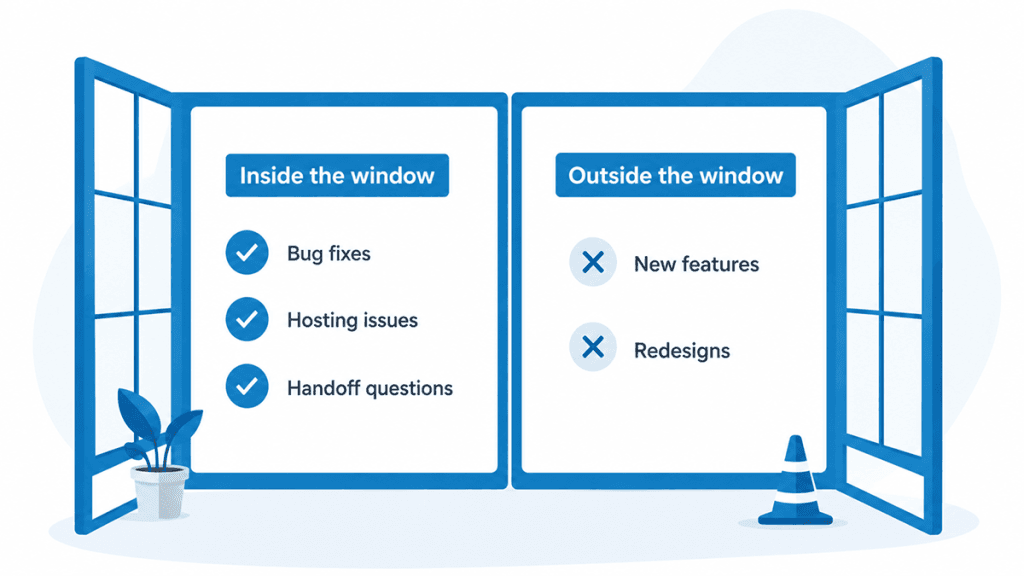
What’s inside that window: production bug fixes, hosting and deployment issues, and clarifying questions from whoever inherits the codebase next. What’s outside it: new features, which get scoped as a separate engagement — Engineering Pods, if the founder wants continuity with the same team, or a clean handoff to an in-house hire.
Keeping that boundary clear matters. A bug in the product after launch is different from asking the team to build a new feature. The support window is there to help stabilize what has already shipped, not to turn post-launch support into an open-ended development contract.
Why We Structure It This Way
Agencies that don’t define a support window tend to do one of two things: disappear the day after launch, or stay attached indefinitely because the handoff was never clean enough to let go of. Neither serves the founder.
A defined window with a real SLA gives the founder a clear runway to stabilize the product and decide what comes next — hire in-house, extend with an Engineering Pod, or bring in a different partner. It also keeps expectations clear on both sides about what post-launch support covers.
Post mvp support agency handoff works best when there is a clear point where the original engagement ends and the founder takes the next step. The codebase and documentation should give the next team enough context to take over without starting from zero.
We’d rather lose a client to a clean handoff than keep one through a messy dependency..
FAQ
How long is SynthWeb’s post-launch support window?
Typically 30 days from launch, with response-time SLAs written into the statement of work. Exact terms vary by engagement — confirm with your project lead.
What happens after the support window ends?
You can extend with an Engineering Pod for continuity, hire in-house using our handoff docs, or bring in a different partner — the codebase and documentation are yours either way.
Does the support window cover new features?
No — new feature work is scoped as a separate engagement, not covered under the post mvp support agency handoff bug-fix SLA .
Also Read: The First 90 Days After Your MVP Ships: What Post-Launch Engineering Actually Looks Like