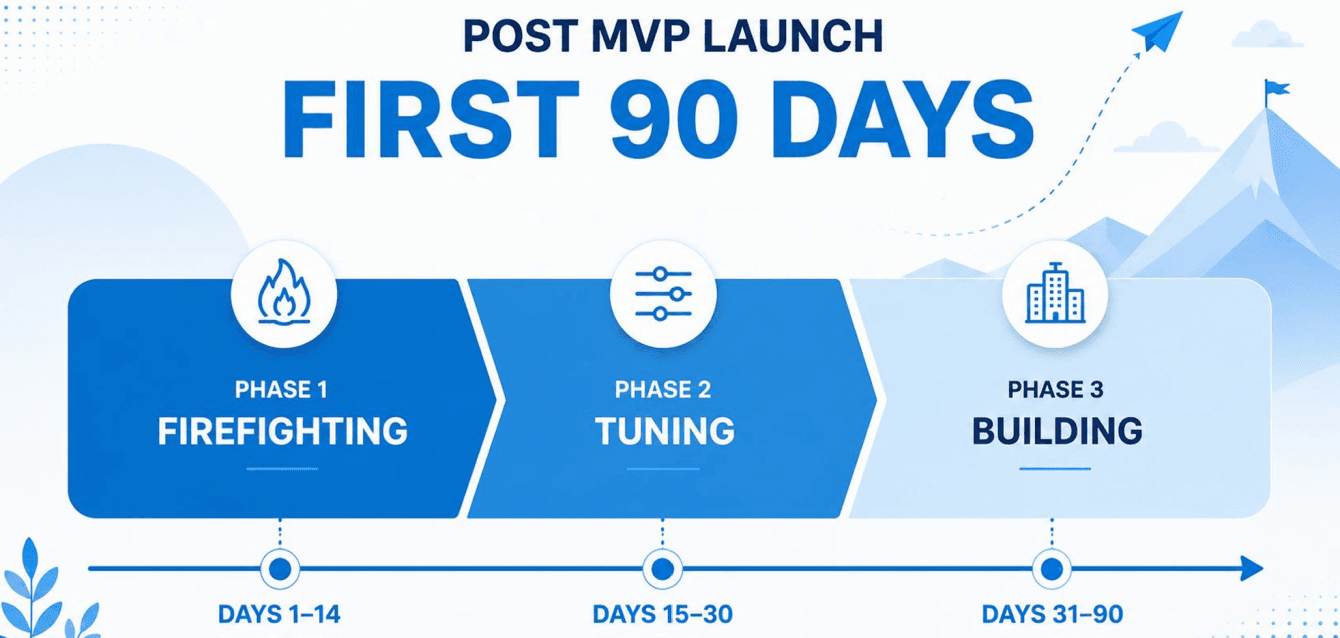
Post MVP launch engineering first 90 days is rarely what founders expect. Most teams assume the weeks after shipping an MVP will be spent building new features, but the reality is very different. During the first two weeks after launch, engineering teams typically spend most of their time fixing production issues, improving stability, and responding to real user behaviour. This is not a sign of poor development—it is a normal stage in the software lifecycle. Understanding what happens during the first 90 days helps founders plan resources, budgets, and product roadmaps more effectively.
Post MVP Launch Engineering First 90 Days: Days 1–14: Firefighting and Stabilisation
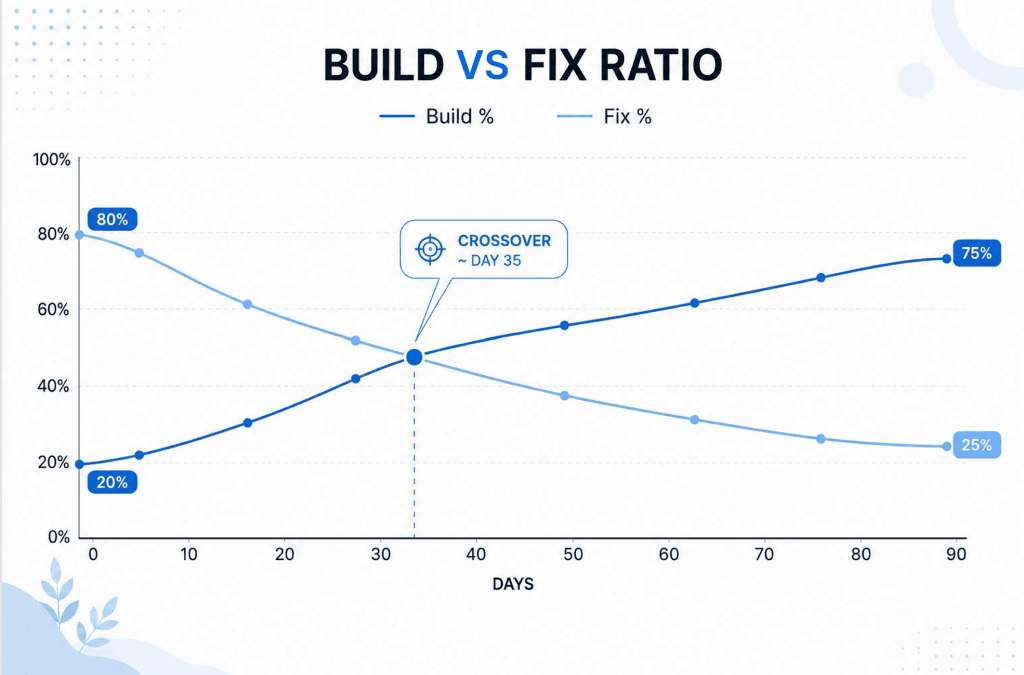
The build-to-fix ratio in the first two weeks is approximately 20/80 — 20 percent of engineering time on new work, 80 percent on production issues. The most common categories: authentication edge cases that worked on test accounts but fail on specific OAuth providers or email formats; payment webhook failures that occur in specific transaction sequences that QA did not cover; mobile-specific bugs on Android versions or screen sizes not in the test matrix; performance problems that staging did not predict because staging had no load.
SynthWeb’s MVP Sprint includes five days of post-launch engineering support at no additional cost. These five days almost always go entirely to the stabilisation phase — paying down the inevitable production debt that appears in the first two weeks. If your vendor does not include post-launch support, negotiate it into the contract before signing. The alternative is absorbing these five days at an hourly rate.
Days 15–30: Performance tuning and first real feedback
By week three, the most critical bugs are resolved and the product is stable enough for users to form opinions. At this stage of the post MVP launch engineering first 90 days, real user feedback begins to replace assumptions made during development—not the polished responses from beta testers who are trying to be helpful, but the actual patterns of what people use, what they avoid, and where they stop. The build-to-fix ratio shifts toward 50/50. Performance optimisation also becomes a priority, with any page that loads in over two seconds receiving attention, database queries that were fast in testing but slow under load being indexed, and the mobile experience on lower-end devices being carefully audited
This is also the period where you learn what your actual retention problem is. Early retention data — what percentage of users return after day one, day seven, day 14 — tells you more about your product-market fit than any pre-launch user interview. Build the analytics to capture this data before launch, not after.
Days 31–60: The sprint cadence establishes
By month two, the build-to-fix ratio has inverted. Engineering time is roughly 60/40 in favour of new development. A sprint cadence has established — two-week sprints with a weekly written update, a backlog of prioritised features, and a clear owner for each ticket. This is the period when most MVP Sprint clients at SynthWeb convert to an Engineering Pod. The product is stable, the scope is understood, and what is needed now is not a burst of fixed-scope engineering but an ongoing development partnership.
The conversion rate is 40 to 50 percent. Of the half that do not convert, roughly half are building an in-house team (see Blog 3 on the transition process) and half are pausing engineering to focus on user acquisition.
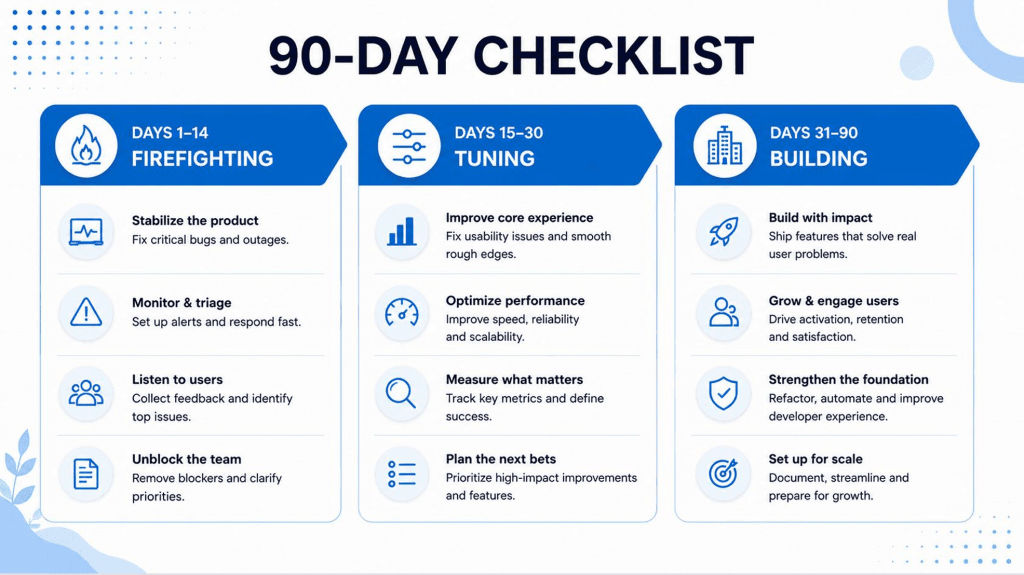
Days 61–90: Infrastructure hardening and the retention question
By the end of month three, the product is in a steady state and the retention question is answerable. This stage of the post MVP launch engineering first 90 days is where founders can confidently evaluate long-term product performance. If day-14 retention is above 30 percent, you have something worth accelerating. If it is below 20 percent, the next engineering sprint should be focused on retention mechanics—onboarding improvements, notification systems, and re-engagement flows—before adding any net-new features. Infrastructure hardening also becomes a priority during this period, including CloudWatch alerts, automated backup verification, incident response runbooks, and load testing at 10× current traffic to understand where the system’s limits are.
FAQ
Should we plan new features for the first 30 days?
Plan them, prioritise them, but expect to ship approximately 20 percent of the list. The rest is stabilisation and feedback-driven iteration.
How much does post-launch engineering typically cost?
$8,000 to $15,000 per month for a two to three person team at SynthWeb’s Engineering Pod rates. See /engineering-pods.
When should we start marketing in earnest?
After day 30. Before that, the product is likely to disappoint the users you acquire. After day 30, the stability and user experience are reliable enough to convert paid traffic.
Also Read: 10-Week MVP Build Process: What Actually Happens, Week by Week