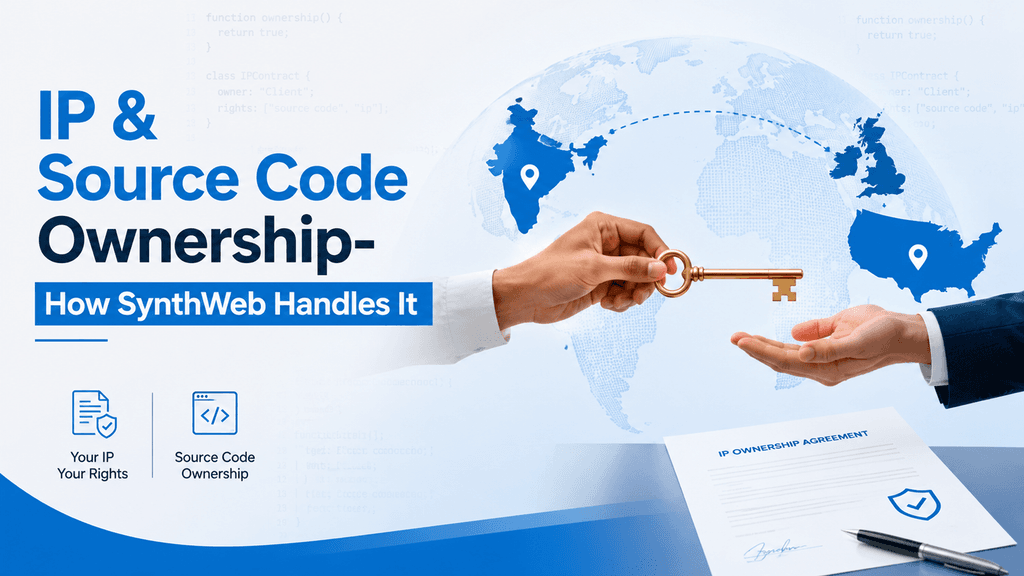
IP Ownership offshore development team: IP and Source Code Ownership is the most important legal issue for UK and US founders considering an India-based engineering team. Before signing any agreement, you need to know exactly who owns the code, intellectual property, and derivative works created during development. At SynthWeb, the answer is simple and contractually clear: you own 100% of the source code, 100% of the IP, and 100% of any derivative works from day one. This guide explains how our contracts, repositories, and legal safeguards ensure complete IP and Source Code Ownership for every client.
The reason this question matters more for offshore engagements than local ones is jurisdictional. If you hire a developer in Manchester and there is a dispute, English contract law applies. If you engage an India-based firm, there is a real question of which jurisdiction governs the contract, who owns the work product under that jurisdiction’s default rules, and how you enforce a judgment. Get this wrong, and you can end up with a competitor having a legal claim to code you paid to build.
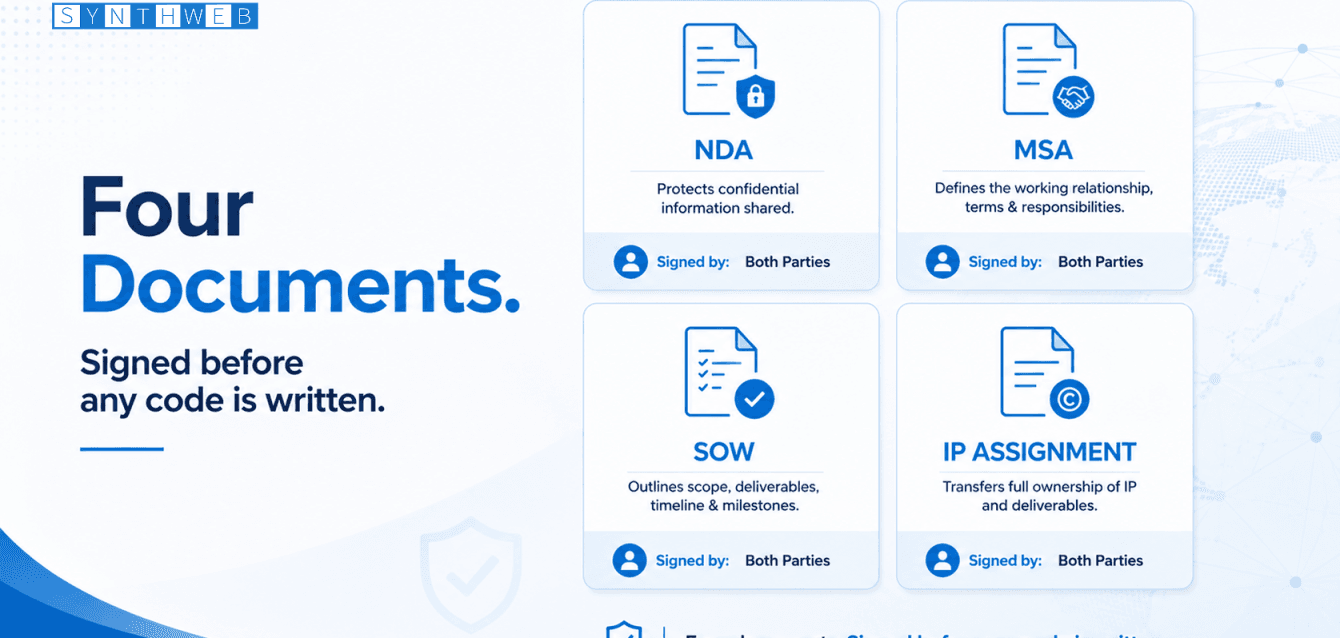
The Four Legal Documents That Secure IP and Source Code Ownership
NDA and IP Protection and Source Code Ownership Protection
Document one is a mutual NDA. While an NDA does not transfer ownership rights, it plays an important role in protecting IP and Source Code Ownership by ensuring confidential business information, product plans, and technical documentation remain secure throughout the engagement. This protects both parties and us from sharing your business plan or unreleased product details, and you from sharing our engineering processes or pricing structure. Standard 3-year term, survives termination, signed by an authorised director of each entity.
Master Services Agreement and Source Code Ownership Rights
Document two is the Master Services Agreement. This is the umbrella contract governing the commercial relationship payment terms, currency, billing cycle, dispute resolution clause, and the choice-of-law and jurisdiction clauses. We default to English law and English courts for UK clients, Delaware for US clients, and Singapore International Arbitration Centre for everything else. We do not propose Indian jurisdiction for foreign clients because cross-border enforcement adds friction you do not want to manage. The Master Services Agreement also establishes the legal framework for IP and Source Code Ownership, ensuring there is no ambiguity regarding ownership rights across jurisdictions.
Statement of Work and IP Ownership Terms
Document three is the Statement of Work. Project-specific. Defines the exact scope, deliverables, timeline, price, and acceptance criteria. The SOW further reinforces IP and Source Code Ownership by clearly defining which deliverables, codebases, and assets are included within the scope of the engagement.
The SOW references the MSA so the IP and confidentiality terms apply to the specific deliverables.
IP Assignment Agreement for Complete Source Code Ownership
Document four is the IP Assignment Agreement. This is the document that actually transfers ownership. It says, in plain language, that all source code, designs, documentation, and other deliverables created under this engagement are work-made-for-hire and assigned to the client at the moment of creation. This agreement is the cornerstone of our IP and Source Code Ownership framework because it legally transfers all project-related intellectual property to the client.We countersign assignments from each individual engineer who works on the project, not just at the company level — this matters because Indian copyright law vests ownership in the human author by default, and the company-to-company assignment alone is not enough to transfer rights cleanly across jurisdictions.
Repository Control and IP and Source Code Ownership
The simplest proof of ownership is who controls the repository. Our standard practice is that the client creates the GitHub or GitLab organization and adds our engineers as members. The repository lives under your account. Your billing pays for the repository plan. If we ever stopped working together tomorrow, you remove our access and the code is yours — we have nothing to hand over because nothing was ever ours to hold. Client-controlled repositories provide clear evidence of IP and Source Code Ownership and eliminate disputes regarding access or ownership after project completion.
Background IP vs Client IP: Understanding IP and Source Code Ownership
Understanding the distinction between background IP and client deliverables is essential for maintaining clear IP and Source Code Ownership rights. Pre-existing tools, libraries, and frameworks that we developed before your project — what lawyers call “background IP” — remain ours. If we use a SynthWeb-built admin scaffold or deployment pipeline tool, you get a perpetual royalty-free licence to use it as part of your product, but you do not own the underlying tool. We disclose any background IP we plan to use in the SOW so there are no surprises. This is industry standard and exists in every reputable agency contract worldwide.
What Happens to IP and Source Code Ownership When a Project Ends
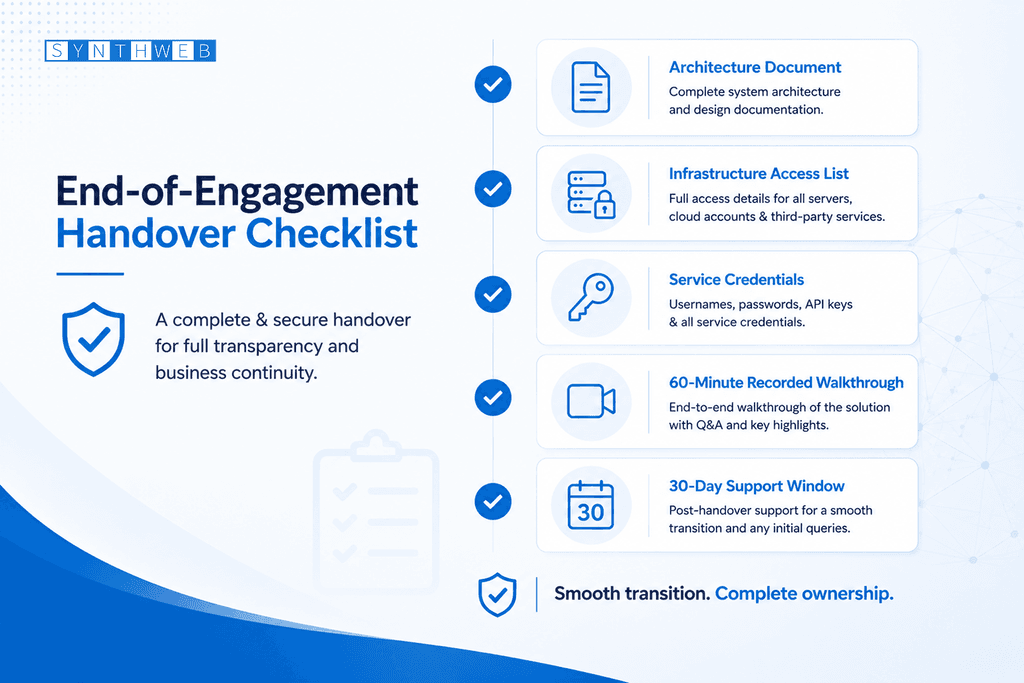
Knowledge transfer. Our offboarding process ensures IP and Source Code Ownership remains fully with the client after the engagement concludes. We hand over a written architecture document, infrastructure access list, third-party service credentials, and a 60-minute recorded walkthrough with whichever engineer or technical lead you nominate to inherit the codebase. We are also available for 30 days after the engagement closes for clarification questions at no charge
Conclusion
Strong IP and Source Code Ownership protections are essential when working with offshore engineering teams. By combining NDAs, Master Services Agreements, Statements of Work, IP Assignment Agreements, and client-controlled repositories, businesses can maintain complete ownership of their code and intellectual property. At SynthWeb, our approach to IP and Source Code Ownership ensures clients retain full legal rights from day one through project completion and beyond.
Common Questions About IP and Source Code Ownership
These are the most common questions clients ask about IP and Source Code Ownership before engaging an offshore engineering partner.
Can we get a copy of your standard NDA, MSA, and IP Assignment templates before booking a discovery call? Yes — request them at contact and we will send them over within one business day.
What if a SynthWeb engineer leaves mid-project? Their individual IP assignment to the project survives termination of their employment with SynthWeb. The client is not affected.
Do you sign client-supplied agreements instead of yours? Yes, frequently. Our legal team reviews, redlines if needed, and signs.
How long does the contracting process take? Typically 5–10 business days from first call to signed SOW.