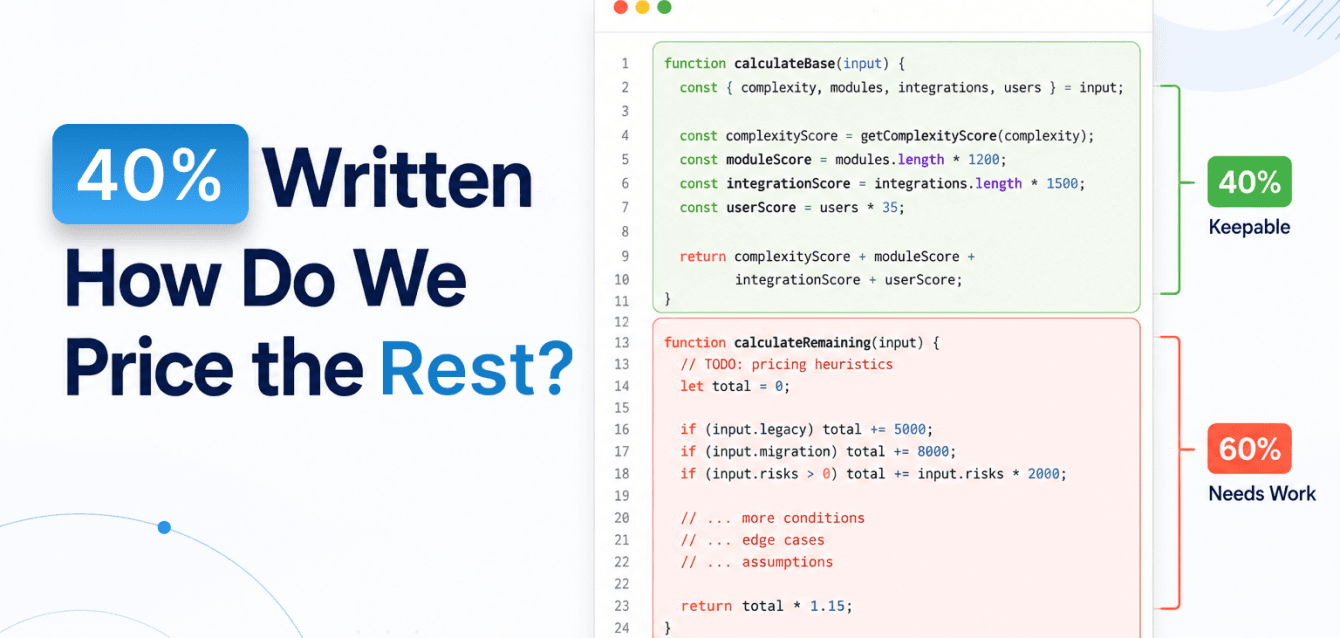
How we price a project with an existing codebase starts with understanding what has already been built. Approximately 25 to 30 percent of SynthWeb‘s engineering enquiries are what we internally call rescue projects: a founder who started a build with a freelancer or another agency, reached 30 to 50 percent completion, and now needs someone to finish it. Sometimes the original team ran out of capacity. Sometimes the relationship broke down. Sometimes the founder looked at a missed deadline and decided to find a different partner. Whatever the reason, the situation is common, not embarrassing, and how we price a project with existing code requires a different approach from a greenfield build.
The core problem is uncertainty. Existing code is either an asset (well-structured, documented, testable, and ready to build on) or a liability (tangled, undocumented, dependent on abandoned packages, and slower to work with than starting over). You cannot tell from the outside which one it is. The quote has to reflect this uncertainty, which means the first step is always a codebase audit. This is also why accurate software scoping matters before a project quote is finalized.
Step 1: The codebase audit
The audit is a standalone engagement, separate from the build quote. It costs $2,000 to $4,000 depending on codebase size, and takes two to three days. What it produces: a written assessment of code quality, architecture soundness, security posture, deployment configuration, and technical debt level. Every assessment reaches one of three conclusions.
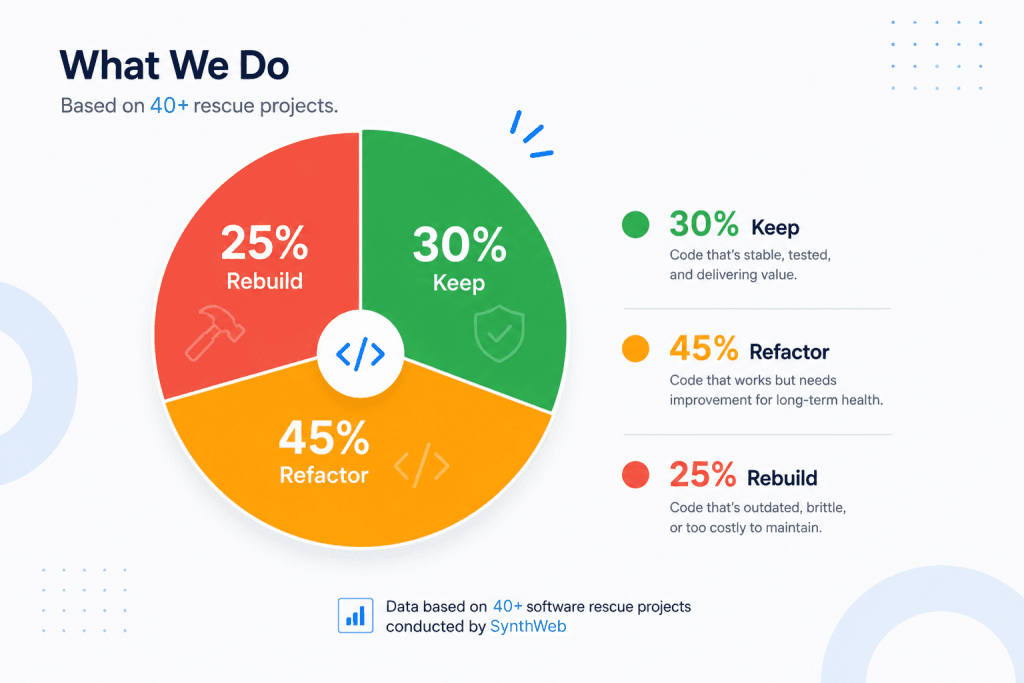
Keep: The codebase is sound. The architecture is maintainable. The code quality is high enough that building on top of it is clearly faster than replacing it. This happens in approximately 30 percent of rescue audits.
Refactor: The codebase has structural problems — poor separation of concerns, missing tests, and inconsistent patterns — that require refactoring before new features can be built reliably. The refactor phase adds two to four weeks before the build proper begins. This happens in approximately 45 percent of rescue audits.
Rebuild: The codebase is more liability than asset. Schema problems, framework mismatches, security vulnerabilities that are structural rather than patchable. Rebuilding from the existing code as a detailed spec is faster than inheriting the code itself. This happens in approximately 25 percent of rescue audits.
Roughly 20 percent of clients who commission an audit take it to a different vendor — they want the independent assessment regardless of who does the subsequent build. We are fine with this. The audit is valuable as a standalone, and a client who trusts the assessment enough to act on it is the right kind of client.
Step 2: How We Price a Project After the Audit
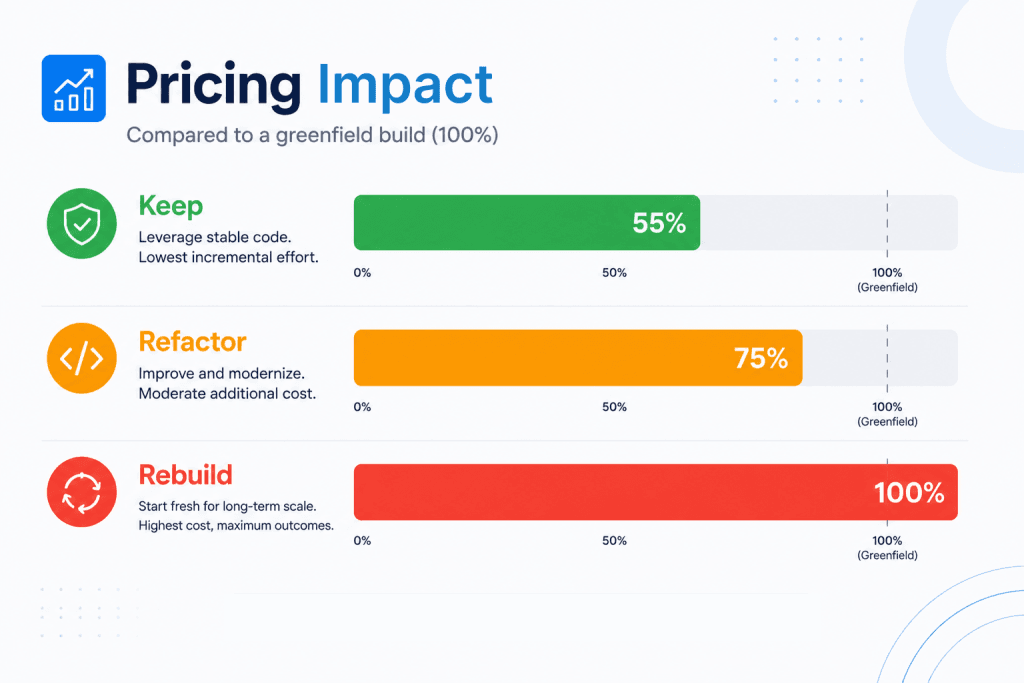
Keep (30%): Building on existing code costs approximately 55 percent of an equivalent greenfield build. You are saving the time it takes to design and build the existing parts, offset by the overhead of reading someone else’s code before modifying it.
Refactor (45%): 75 percent of greenfield cost plus a separate refactor phase at a day rate. The refactor phase typically takes two to four weeks and is scoped based on the specific issues the audit identified.
Rebuild (25%): 100 percent of greenfield cost. The existing code becomes the most detailed specification we have ever received. We know exactly what the product is supposed to do. We do not inherit the code itself.
The honest note about rescue project speed
Working with someone else’s code is structurally slower than writing new code. Every function requires reading before modifying. Every change requires testing against existing undocumented behaviour. Every deployment requires verifying that the existing infrastructure still works with the new code. On a rescue project where the audit recommends “keep,” budget an additional 30 to 50 percent time per feature compared to a greenfield equivalent scope.
This is not a reason to avoid rescue projects. It is a reason to price them accurately.
FAQ
Can we commission the audit as a standalone without committing to the build? Yes. This is a separate engagement. We provide the written assessment and you decide what to do next.
What if the audit says rebuild but our budget is tight? Partial rebuild — keep the database schema and core business logic, rewrite the problematic presentation and API layers. We scope this case-by-case based on what the audit finds.
How quickly can the audit happen after we provide repository access? Within one week of access, for codebases up to approximately 100,000 lines. Larger codebases require two weeks.