Post MVP engineering problems rarely appear all at once. The first few weeks after an MVP launch are usually about fixing production bugs, addressing user feedback and dealing with unexpected traffic. But the real engineering challenges often emerge later, when the product starts growing and people begin using it in ways the original development team did not anticipate.
In our previous article about the first 90 days after an MVP launch, we covered the obvious problems: production bugs, unexpected load and user experience issues.
This time, we’re looking at what happens next.
At SynthWeb, we believe launching an MVP is only the beginning of the engineering journey. The months that follow reveal whether the technical decisions made during development can support a growing product.
Here are seven important post MVP engineering problems that startups should understand before they become expensive to fix.
1. Month 3: Data Model Assumptions Start Breaking
One of the earliest post MVP engineering problems is discovering that the original data model does not support every real-world scenario.
During development, teams often design databases around the expected user journey. However, actual users do not always follow that journey.
For example:
- Users may need additional account permissions.
- Businesses may require multiple users under one organisation.
- Soft-delete functionality may not work consistently across database tables.
- New workflows may require relationships that were never included in the original database design.
These issues are not always simple bugs. They can be structural limitations that require changes to the database and existing application logic.
The longer these problems remain unresolved, the more difficult migration becomes because additional production data is being stored against the original structure.
How to prevent it: Plan for realistic data relationships, document architectural assumptions and consider future requirements without overengineering the initial MVP.
2. Month 4: Technical Debt Starts Slowing Development
During an MVP sprint, speed is important. Developers often make practical compromises to get essential features working and deliver the product on time.
However, temporary solutions can become permanent if nobody revisits them.
Common examples include duplicated code, tightly connected modules, missing automated tests and undocumented business logic.
As new features are introduced, developers spend more time understanding existing code and working around earlier decisions.
This is one of the most overlooked post MVP engineering problems because the product may still function perfectly well for users while development becomes increasingly difficult.
How to prevent it: Schedule regular code reviews, document important technical decisions and reserve development time for refactoring.
3. Month 5: Security and Permission Gaps Become Visible
An MVP may initially have a small user base, but growth introduces more accounts, roles, permissions and sensitive information.
A system that was originally designed around a few trusted users may not have sufficient access controls for a larger customer base.
For example, one organisation’s users might accidentally access information belonging to another organisation if tenant-level permissions are not properly enforced.
How to prevent it: Review authentication, authorisation, data access and permission boundaries before introducing more complex user roles. Security should be reviewed continuously rather than treated as a one-time launch checklist.
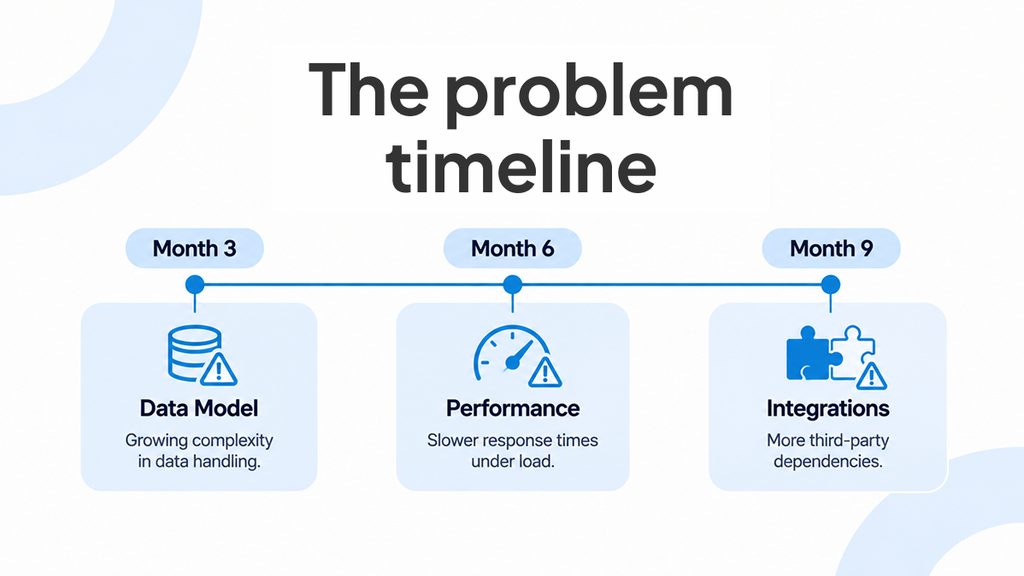
4. Month 6: Performance Assumptions No Longer Hold
A system that handles 500 concurrent users comfortably during testing may start struggling when usage reaches 2,000.
Similarly, a database query that takes 40 milliseconds against 10,000 rows might take 900 milliseconds when the table grows to 400,000 rows.
These are illustrative scenarios, but they demonstrate why performance testing against realistic data volumes matters.
Common causes include:
- Missing database indexes.
- Inefficient queries.
- N+1 query problems.
- Poor caching strategies.
- Insufficient infrastructure capacity.
These post MVP engineering problems can affect the experience of every user, particularly when performance issues appear during peak usage.
How to prevent it: Monitor application performance, review query execution and conduct load testing against realistic production-like data.
The PostgreSQL indexing documentation explains how indexes improve data retrieval, while the AWS Well-Architected load testing guidance explains how realistic testing helps identify bottlenecks before they affect users.
5. Month 7: Integrations Become Difficult to Maintain
An MVP might launch with two or three third-party integrations. Six months later, the product may depend on payment gateways, CRM platforms, authentication providers and external APIs.
Every integration introduces another dependency.
For example, a payment provider might change its webhook payload structure, or an authentication provider might introduce changes that affect token handling.
Without proper monitoring and version management, these changes can interrupt important product functionality.
How to prevent it: Use a structured integration layer, handle API versions carefully, validate incoming webhook events and monitor integration failures.
For payment integrations, Stripe’s API versioning documentation provides useful guidance on managing changes safely.
6. Month 8: Testing Cannot Keep Up With New Features
As a product grows, every new feature can affect something that already works.
A change to user permissions might affect account management. A new payment workflow might interfere with an existing subscription process.
Without adequate automated testing, developers may discover these problems only after deployment.
How to prevent it: Introduce automated regression tests, maintain integration tests and include testing in the regular development process.
Testing should evolve alongside the product rather than remain limited to the original MVP requirements.
7. Month 9: The Original Architecture Needs a Review
By month nine, the product may look very different from the one originally launched.
There may be additional users, new integrations, more complicated workflows and growing database requirements.
The original architecture may still work, but some decisions might need revisiting.
This does not mean rebuilding the entire application. It means identifying which parts need improvement before they become major bottlenecks.
How to prevent it: Conduct an architecture review, examine technical debt, assess scalability and prioritise improvements based on actual product usage.
This is where ongoing engineering support becomes particularly valuable.
How SynthWeb Helps Prevent Post-MVP Engineering Problems
At SynthWeb, we believe successful software development should not end when an MVP goes live.
During our MVP Sprint process, we document important assumptions around data structure, scalability, integrations and technical decisions. This gives the team a clearer understanding of what may need attention as the product grows.
After launch, our Engineering Pods provide ongoing development support to help businesses maintain, improve and scale their software.
For clients continuing with an Engineering Pod, we also use a six-month architecture review as a checkpoint to assess technical debt, performance and changing product requirements.
The goal is simple: identify potential problems early instead of waiting until they affect customers or slow down development.
Frequently Asked Questions?
What are the most common post MVP engineering problems?
The most common post MVP engineering problems include database limitations, technical debt, security gaps, performance degradation, integration failures and insufficient automated testing. These issues often become more visible between months three and nine as user activity and product complexity increase.
Why do software problems appear six months after an MVP launch?
Many MVPs are initially built around a limited set of features and expected user behaviours. As real users interact with the product, new requirements, larger data volumes and additional integrations expose weaknesses in the original architecture.
How does SynthWeb prevent post-launch software issues?
During MVP Sprint, SynthWeb documents important technical assumptions and identifies decisions that may need revisiting as the product grows. Through Engineering Pods, we provide continued engineering support, code maintenance, performance improvements and architecture reviews.
When should a startup move to an Engineering Pod after an MVP launch?
A startup should consider ongoing engineering support soon after its MVP launches, particularly when the product is expected to grow quickly or requires regular feature development. Early involvement helps teams monitor technical debt, maintain the codebase and address potential scaling issues before they become urgent.
Final Thoughts
Launching an MVP is an important milestone, but keeping it reliable as the business grows is an entirely different challenge.
The first few months reveal how users interact with the product. The months that follow reveal whether the engineering decisions behind it can support those changing needs.
The biggest post MVP engineering problems are often not the ones that cause an immediate failure. They are the small architectural compromises, performance limitations and integration dependencies that gradually become harder to manage.
Planning for them early makes the difference between a product that simply launches and one that is ready to grow.