GDPR doesn’t stop at UK borders, and it doesn’t care whether your engineering team is in London or Guwahati. What matters is how personal data is handled, where it’s processed, and what contractual commitments are in place between you (the controller) and the offshore team (the processor). Most UK startups commissioning offshore development don’t have this in order. When working with a GDPR offshore development team UK founders can trust, here’s what needs to be established before you can assume compliance.
For early-stage and scaling companies across the United Kingdom, partnering with an external engineering team is one of the most effective ways to accelerate product delivery while managing burn rate. However, regulatory responsibility never transfers away from your business simply because code is written in another jurisdiction. Choosing a GDPR offshore development team UK startups rely on means treating data protection as an architectural and contractual foundation from day one rather than an afterthought before a funding round or enterprise security audit.
The controller-processor relationship must be documented
Under UK GDPR, you are the controller. Your offshore engineering team is a processor. When partnering with a GDPR offshore development team UK founders must ensure this relationship is defined in a Data Processing Agreement (DPA) that specifies: what categories of personal data will be processed, the purpose of the processing, the retention and deletion schedule, the technical and organisational security measures in place, the sub-processors (cloud providers, CI/CD tools) and how they’re managed, and the process for handling data subject requests. Without a signed DPA, you’re operating outside the regulatory framework regardless of how trustworthy the offshore team actually is.
Many founders assume a standard Master Services Agreement (MSA) or Non-Disclosure Agreement (NDA) is sufficient. While an NDA protects confidential commercial information and intellectual property, it does not satisfy the statutory obligations required under UK GDPR and the Data Protection Act. When engaging a GDPR offshore development team UK regulators expect a binding written contract that explicitly governs how personal data is accessed, stored, transmitted, and deleted throughout the software development lifecycle.
In practice, a thorough Data Processing Agreement for software engineering should clearly document the following operational details:
- Subject matter and duration of processing: Defining whether the engineering team is building a short-term prototype or maintaining long-term production infrastructure.
- Nature and purpose of processing: Specifying activities such as software development, quality assurance testing, database migration, application monitoring, and bug resolution.
- Categories of data subjects and personal data: Identifying whether user names, email addresses, billing records, IP addresses, or special category data could be encountered.
- Technical and organisational measures (TOMs): Mandating multi-factor authentication, encrypted devices, role-based access control, and secure VPN or zero-trust network access.
- Return or deletion of data: Ensuring all local copies, credentials, and temporary logs are permanently revoked and erased when the engagement concludes.
Putting these terms in writing protects both sides. It gives the startup clear audit readiness for investors and enterprise clients, and it gives your GDPR offshore development team UK clear operational rules to follow during every sprint.
Data transfer mechanism — this is the one most startups miss
If your offshore team is based outside the UK and EEA, personal data transfers to them require a legal mechanism. The primary options are Standard Contractual Clauses (SCCs), a UK Adequacy Decision for the country in question, or Binding Corporate Rules (for large organisations). India, where many offshore teams are based, doesn’t have a UK adequacy decision. When managing a GDPR offshore development team UK founders must ensure that SCCs or a functionally equivalent transfer mechanism are in place before personal data is shared with the team — including shared development environments, testing databases with real user data, and logging systems that capture PII.
One of the most frequent misconceptions among founders is that a “data transfer” only happens when someone downloads a CSV file of customer records and emails it overseas. Under UK data protection law, remote access from a third country constitutes a restricted international transfer. Even if your database remains hosted on AWS London (`eu-west-2`), the moment an engineer located outside the UK views personal data on their screen in Guwahati, Bangalore, or Manila, an international data transfer has occurred.
According to the Information Commissioner’s Office (ICO) guidance on international data transfers, UK businesses must implement either the UK International Data Transfer Agreement (IDTA) or the UK Addendum to the EU Standard Contractual Clauses, alongside a Transfer Risk Assessment (TRA). A compliant GDPR offshore development team UK startups partner with will already have these templates prepared as part of their standard legal onboarding.
Founders should also look closely at indirect data exposure across engineering tools. Personal data frequently leaks into non-production workflows through three common channels:
- Staging and QA databases: Cloning production databases into staging environments without anonymising or pseudonymising customer records first.
- Application logs and error tracking: Sending unredacted request payloads, email addresses, or session tokens into shared observability tools like Sentry, Datadog, or CloudWatch.
- Support tickets and screen recordings: Sharing screenshots of live customer accounts in Slack channels or Jira tickets during bug investigations.
Addressing these pathways early ensures that your GDPR offshore development team UK can build, test, and deploy features rapidly without unnecessary exposure to real customer PII.
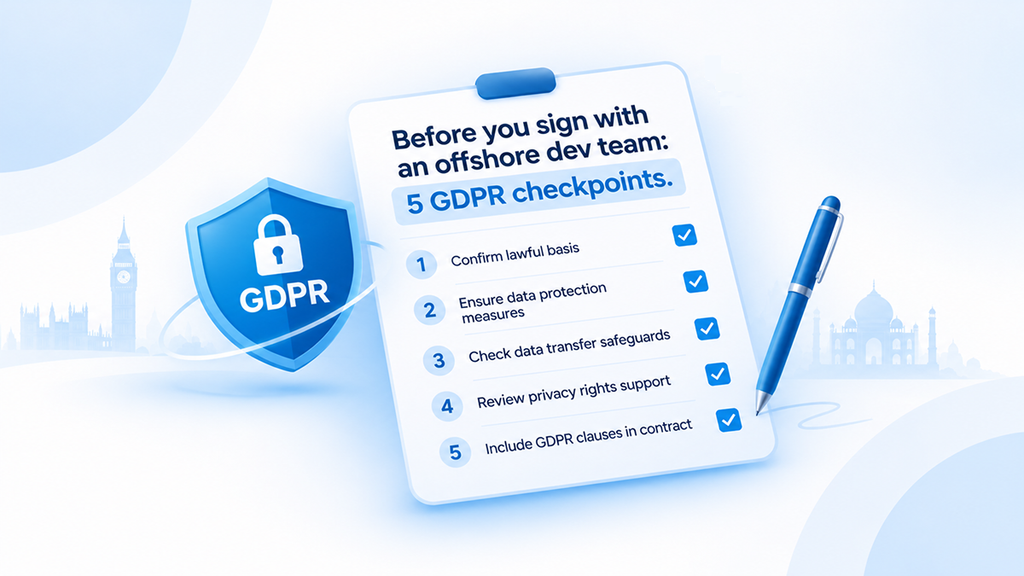
Five things to check before commissioning offshore development work
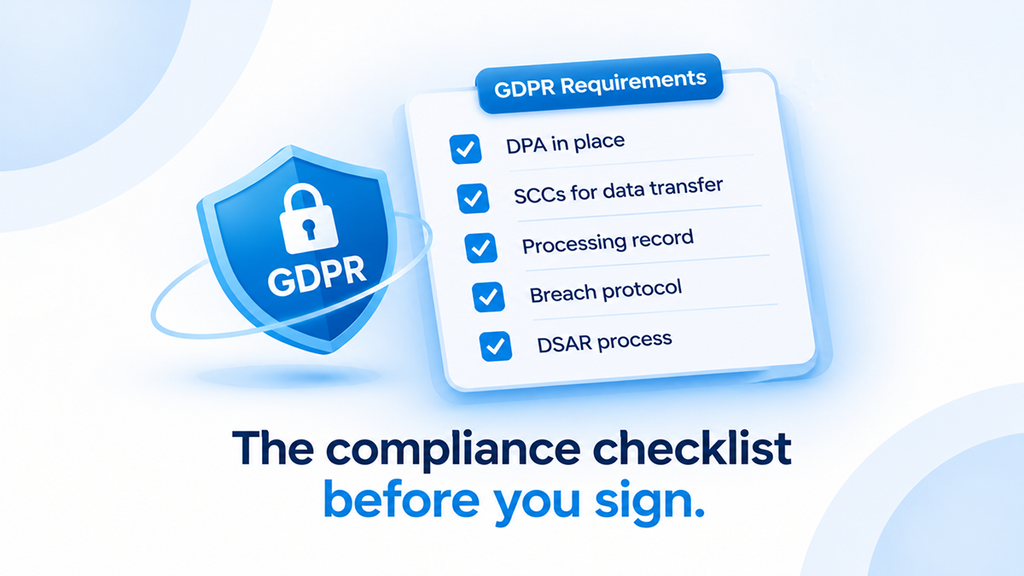
1. Signed DPA with the offshore partner, naming you as controller. 2. Data transfer mechanism documented — UK SCCs or equivalent. 3. Sub-processor list reviewed and approved (AWS Mumbai, GitHub, Slack all count). 4. Development environment access controls documented — no developer should have access to production personal data for debugging without a formal, logged process. 5. Incident response protocol established — if there’s a breach, you have 72 hours to notify the ICO. Your GDPR offshore development team UK needs to know their role in that 72-hour window.
How to verify each checkpoint with your GDPR offshore development team UK
Before handing over repository access or cloud credentials, walk through each of the five checkpoints above and verify how they work in day-to-day engineering practice. A reliable GDPR offshore development team UK will treat these checks as standard engineering hygiene rather than bureaucratic friction.
| GDPR Checkpoint | What UK Startups Must Establish | Operational Standard |
|---|---|---|
| 1. Data Processing Agreement (DPA) | Signed agreement naming the UK startup as Controller and offshore partner as Processor | Executed prior to sharing any repository, cloud, or user data access |
| 2. Data Transfer Mechanism | UK SCCs, UK Addendum, or International Data Transfer Agreement (IDTA) | Covers remote engineering access from India or other non-adequacy regions |
| 3. Sub-Processor Approval | Documented inventory of cloud, code, and communication tools | Includes AWS regions, GitHub/GitLab, CI/CD pipelines, Slack, and monitoring tools |
| 4. Environment Access Controls | Strict separation between development, staging, and production data | Synthetic test data in staging; logged, time-bound approval for production debugging |
| 5. 72-Hour Incident Protocol | Clear escalation path from offshore tech lead to UK data controller | Immediate notification, containment steps, and audit logs within the 72-hour ICO window |
When reviewing sub-processors in checkpoint three, remember that infrastructure location matters just as much as team location. If your users are in the UK, your production database should remain in a UK or EEA cloud region unless you have a specific, documented reason to replicate data elsewhere. Meanwhile, your GDPR offshore development team UK should work primarily against local development containers and staging environments populated with synthetic seed data.
Similarly, checkpoint four—environment access control—aligns with the UK National Cyber Security Centre (NCSC) cloud security principles, where good security architecture simplifies compliance. When developers do not have standing access to production personal data, the surface area for accidental data exposure drops dramatically. If a production issue ever requires live inspection, access should be granted temporarily through an audited bastion host or role-assumption workflow, reviewed by the technical lead, and revoked immediately afterward.
How SynthWeb Structures Compliant Delivery for UK Startups
At SynthWeb, we work with UK founders who want the speed and cost efficiency of an offshore engineering team in Guwahati without compromising on UK regulatory standards or enterprise due diligence. Whether a client starts with an MVP Sprint to launch a new product or scales ongoing delivery with dedicated Engineering Pods, data protection is built into our onboarding checklist before the first line of code is written.
Every engagement with our GDPR offshore development team UK includes a pre-configured compliance baseline:
- Standard contractual readiness: Our client agreement includes a UK GDPR Data Processing Agreement and UK international data transfer clauses out of the box.
- Synthetic staging environments: During both MVP Sprint builds and long-term Engineering Pods retainers, we generate realistic synthetic datasets for development and QA so engineers never need real customer PII to test features.
- Least-privilege infrastructure: Production databases stay inside your UK or EU cloud accounts under your ownership, with strict role-based access control, encrypted secrets management, and automated audit logging.
- Direct lead engineer accountability: Your lead engineer owns technical security hygiene, code review standards, and incident escalation directly alongside your founding team.
This structure means that when your startup faces investor technical due diligence or an enterprise customer security questionnaire, you can point to a documented, verifiable framework governing your GDPR offshore development team UK from day one.
FAQ
Does GDPR apply to offshore development teams?
Yes. If the offshore team processes personal data on your behalf — including accessing production databases, receiving test data with real user records, or logging systems that capture PII — they are a processor under UK GDPR and the Data Processing Agreement requirement applies.
Even when an offshore engineer only views personal data remotely during debugging, deployment verification, or customer support troubleshooting, UK GDPR treats that access as data processing. Because the UK startup determines why and how user data is collected, the startup remains the data controller and is legally responsible for ensuring that its GDPR offshore development team UK operates under a compliant DPA and appropriate security controls.
What is a Standard Contractual Clause for data transfer to India?
SCCs are pre-approved contract terms from the ICO that create the legal basis for transferring personal data from the UK to a country without an adequacy decision. They’re not difficult to implement — the ICO publishes approved templates. The mistake is assuming you don’t need them because you trust the offshore team.
In the UK context, startups can use either the ICO’s standalone International Data Transfer Agreement (IDTA) or the UK Addendum attached to the European Commission’s Standard Contractual Clauses. These clauses legally bind the data importer—your GDPR offshore development team UK partner in India—to uphold data protection safeguards equivalent to UK standards, including encryption, access restrictions, and prompt breach notification.
Does SynthWeb have GDPR data processing agreements in place?
Yes. We operate as a data processor for clients handling UK personal data. Our DPA covers the controller-processor relationship, UK SCCs for the India-to-UK transfer mechanism, sub-processor list, and incident response protocol. It’s a standard part of our client agreement for any engagement involving personal data.
Whether we are scoping a rapid build through our MVP Sprint or embedding a long-term team via Engineering Pods, our legal and technical onboarding establishes these agreements upfront so UK founders never have to piece together compliance templates from scratch.
Final Thoughts: Establish Compliance Before You Share Access
Working with a GDPR offshore development team UK startups can scale with is neither legally complicated nor prohibitive—provided you put the right structure in place before personal data is ever touched. The vast majority of compliance risks with a GDPR offshore development team UK arise not from malicious intent, but from informal habits: unsigned DPAs, unrecorded sub-processors, or production database dumps copied into staging environments for convenience.
By establishing the five checkpoints covered in this guide—a signed DPA naming you as controller, documented UK SCCs or IDTA transfer clauses, an approved sub-processor list, strict development environment access controls, and a rehearsed 72-hour ICO incident response protocol—you remove the compliance objection entirely. Whether you are onboarding your first GDPR offshore development team UK for an initial product build or expanding an established GDPR offshore development team UK across multiple workstreams, these safeguards ensure your GDPR offshore development team UK engagement stays audit-ready so you can focus on shipping reliable, secure software.