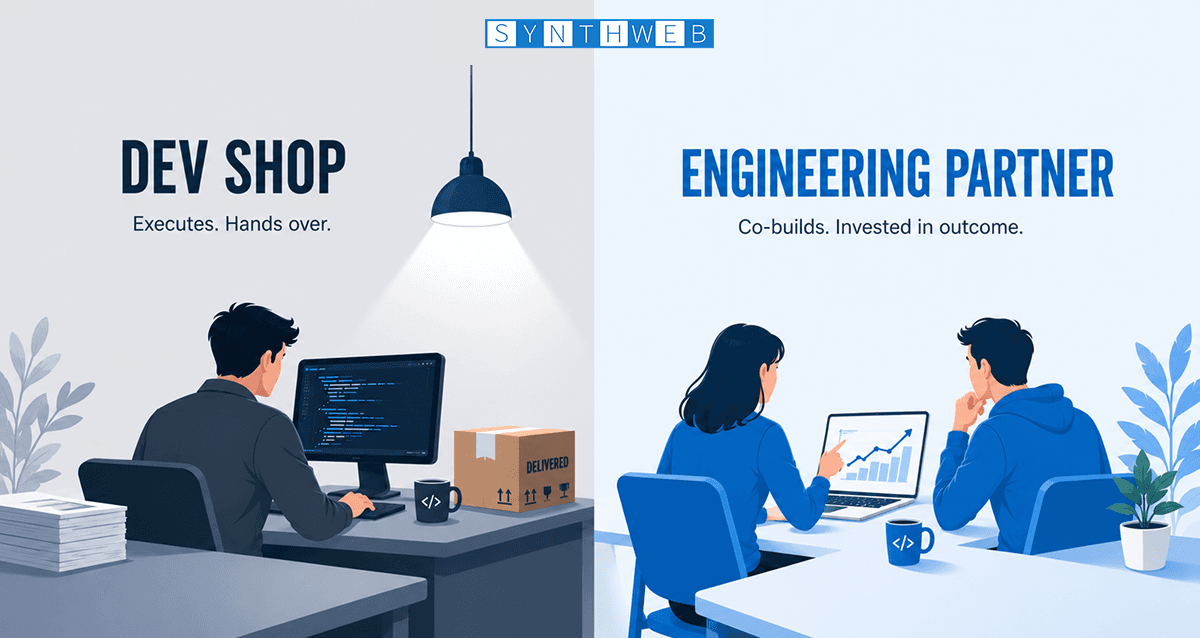
Dev shop vs product engineering partner is a distinction that comes down to who simply executes the work and who takes responsibility for the product outcome. A dev shop executes a spec. A product engineering partner co-develops it. The distinction sounds subtle. In practice, it determines who is thinking about your product during the build — and whether the engineering work you pay for moves the product forward or just moves the sprint backlog forward.
This is not a SynthWeb-first distinction. The industry category exists. The question is how to identify which one you are talking to before signing a contract.
1. Incentive structure
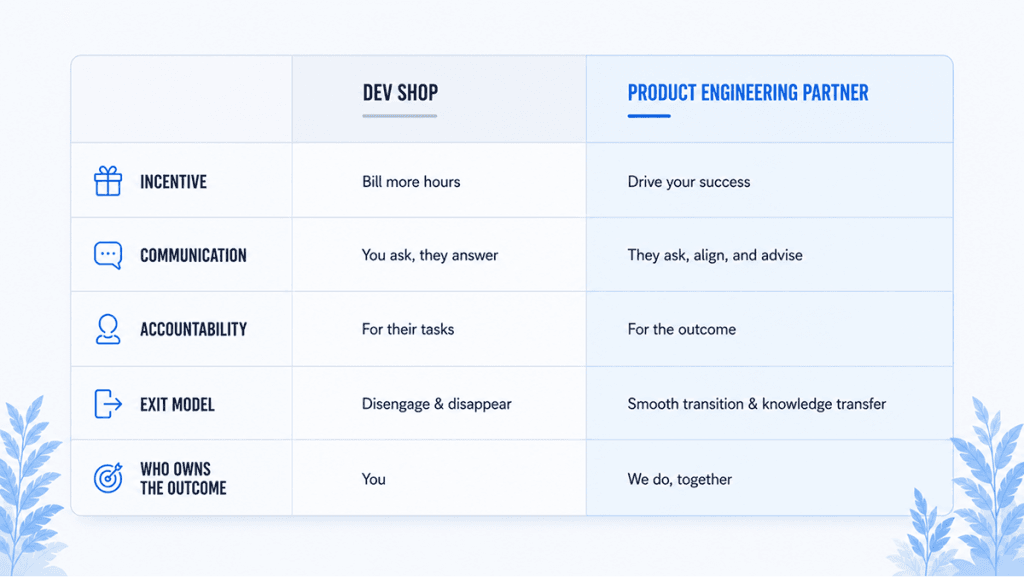
A dev shop’s incentive is to bill hours and extend the engagement. Scope expansion is revenue. Ambiguity in requirements is revenue. A vendor with a time-and-material contract and no fixed deliverables has a financial incentive to keep the project running, not to ship it efficiently.
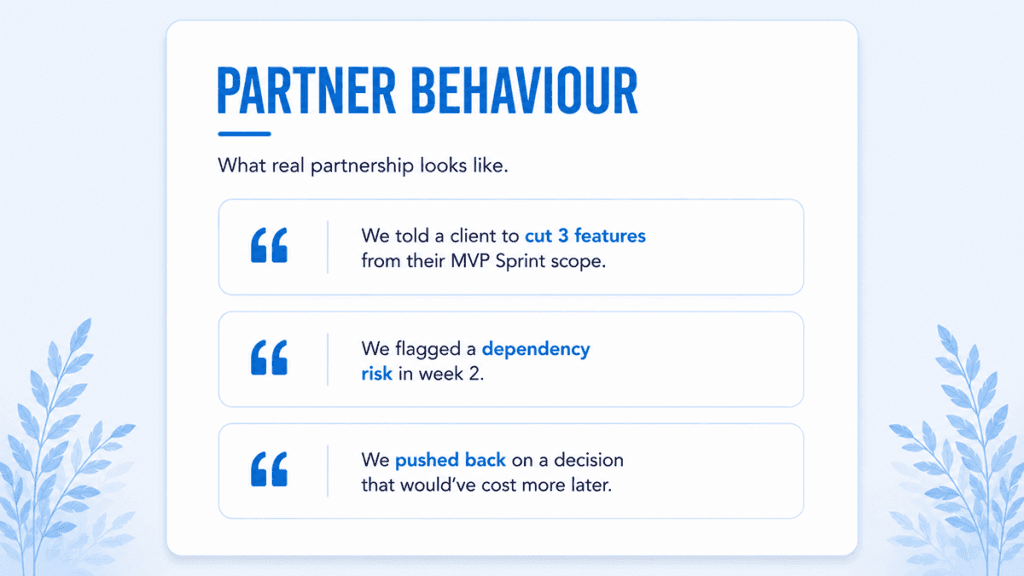
A product engineering partner’s incentive is to ship value and protect the client’s runway. This sometimes means telling a client that a planned feature is not worth building, that the scope should be cut before launch, or that a different architecture will cost more now but save significantly more in three months. We have told clients to cut features from their MVP Sprint. We have told clients that their planned technical approach would create a rewrite in 18 months. Neither of those conversations makes the immediate engagement larger. Both of them make the client’s product better.
2. Communication model
A dev shop runs weekly status updates. The client receives a report on what was completed this week, what is planned for next week, and any blockers. The client drives decisions.
A product engineering partner proactively surfaces risks, flags dependencies, and raises architecture questions before they become delays. Strong engineering leadership also means surfacing technical risks early and making architecture decisions in the context of the company’s broader goals. The communication is not reporting — it is a shared decision-making process. When a third-party API changes its authentication model in week four, a dev shop reports it in the weekly update. A product engineering partner raises it on the day of discovery with a recommendation on how to handle it.
3. Accountability
A dev shop is accountable for delivering the code that was specified. If the specified code does not produce the user outcome the founder expected, the vendor has fulfilled their obligation.
A product engineering partner is accountable for outcomes: does the product convert? Is the uptime acceptable? Is the architecture maintainable by the team that takes it over? These questions are not in a contract — they are in the way a partner team engages with the work. SynthWeb engineers have raised concerns about launch readiness that delayed launch dates. That is the accountable behaviour — not signing off on a build that will break at scale.
4. Exit model
A dev shop delivers the project and ends the relationship. The handover is an administrative task, not an investment.
A product engineering partner plans the exit from the start of the engagement. The architecture document, the infrastructure access list, the recorded walkthrough, the 30-day support window — these are not afterthoughts. They are part of the deliverable. The test of an exit is whether the next engineering team can take over without losing momentum. Dev shops do not usually set that as their success metric.
5. Dev Shop vs Product Engineering Partner: Where SynthWeb Fits
SynthWeb operates as a product engineering partner. All four offers — MVP Sprint, Engineering Pod, Ecom Sprint, CTO-as-a-Service — are structured around outcomes, not outputs. We have fixed-price contracts that transfer risk to us. We have handover packages built into every engagement exit. We push back on scope when scope is wrong.
An honest note: for a well-defined, scope-locked build where the client has a strong technical lead internally and just needs execution capacity — a dev shop is often the right choice and may be more cost-efficient. We say this because credibility comes from telling founders what is true, not what makes us sound uniquely necessary.
FAQ
How do you tell which model a vendor is before signing? Ask them: “What would you change about our spec?” A product engineering partner answers the question. A dev shop deflects it or says the spec looks good.
Does SynthWeb always operate as a partner? Yes — all four offers are structured around outcomes, not just output delivery.
Is the partner model more expensive? Higher day rate on a per-hour basis, lower total cost because scope is better managed and the exit is clean. The comparison is not hourly rate — it is total project cost including overruns.