Headless commerce has become a standard recommendation in many ecommerce pitch decks, usually before anyone asks whether the store actually needs it. The honest answer for most early-stage ecommerce brands is simple: not yet, and possibly never, unless a specific condition is met. That should be the starting point for deciding whether headless commerce worth it is a question the business actually needs to solve right now.
The Mistake: Treating Headless as a Maturity Signal
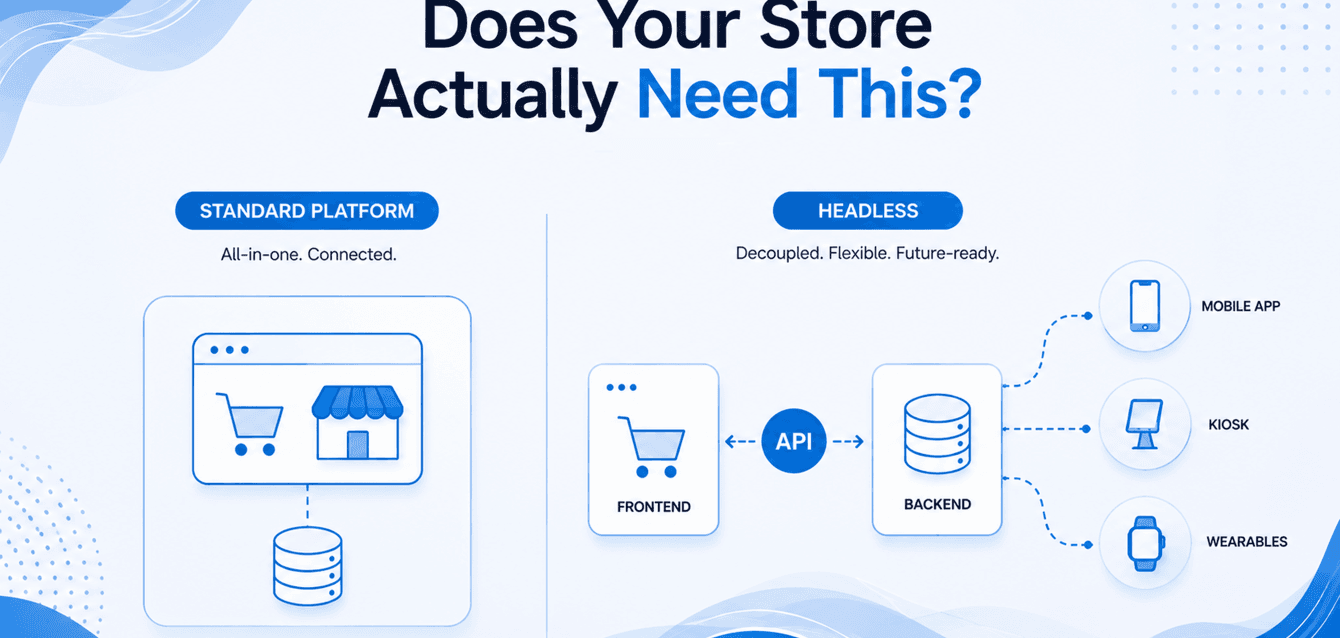
Founders often reach for headless because it looks technically advanced, not because a concrete requirement demands it. That approach puts the cart before the horse. Headless architecture, which decouples the storefront frontend from the commerce backend, solves specific problems such as needing the same product catalog to power a website, a native mobile app, and an in-store kiosk simultaneously. It is also meant for brands that need frontend performance and design control that a platform’s native theme system cannot deliver, or those that need content and commerce to live in entirely different systems for editorial reasons.
If none of those apply to your business yet, headless adds significant engineering overhead. You have a custom frontend to build and maintain, extra CMS or storefront layers to manage, and more moving parts to deploy and monitor. All of this extra work goes toward solving a problem your store does not actually have. For founders asking whether headless commerce is worth it for their current stage, the answer should come directly from business requirements rather than a desire to look advanced.
When Headless Commerce Is Actually Worth It
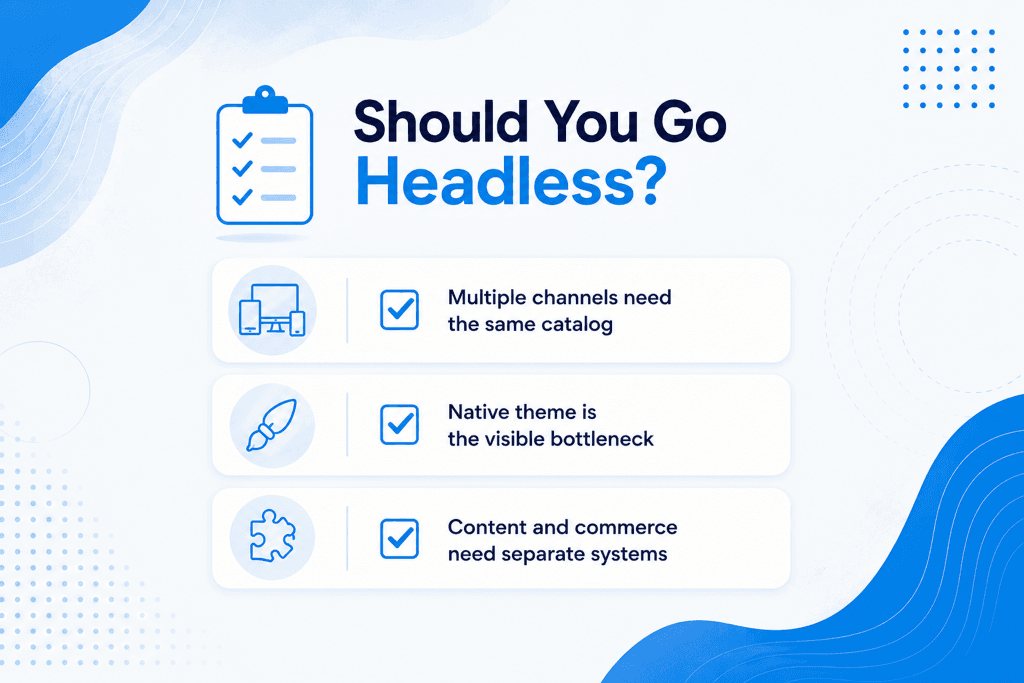
Headless makes sense when a brand already has traction across multiple channels and the platform’s native theme system is visibly slowing the site down or limiting design choices. In short, switching architecture is easy to justify when your existing platform creates a measurable constraint, not when you simply want generic flexibility.
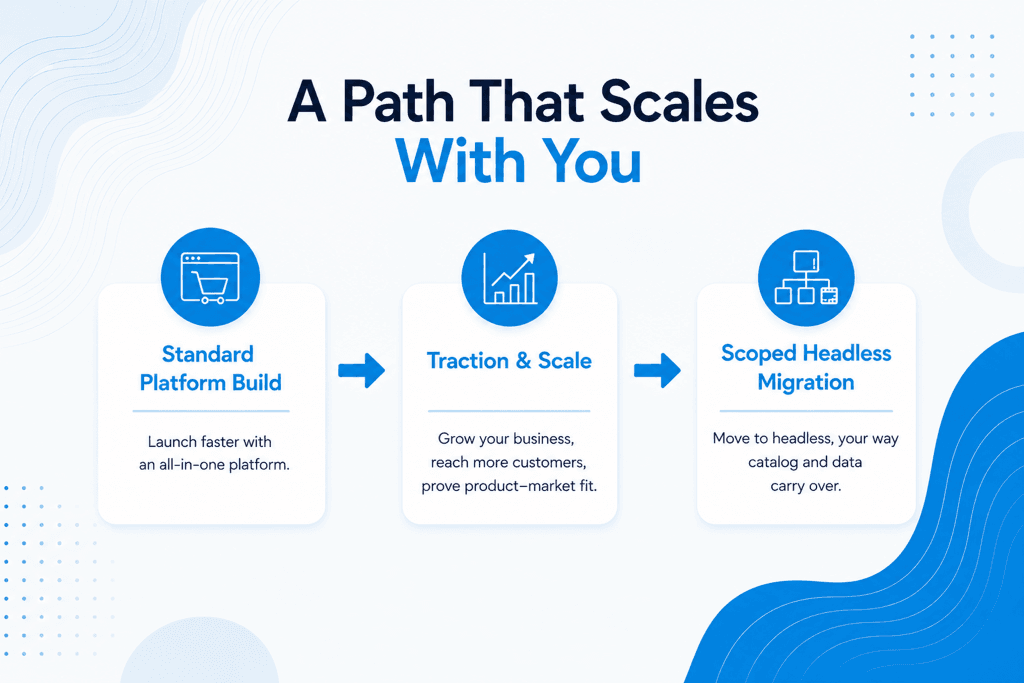
Headless is rarely a good pre-emptive architecture for a brand processing its first hundred orders. A well-configured Shopify or WooCommerce build reaches launch faster, costs less, and can be migrated later without throwing away your catalog or customer data.
This is why deciding whether headless commerce worth it should always be evaluated against actual store requirements, rather than treated as a mandatory milestone that every growing ecommerce business must reach.
What to Build Instead for Most Early-Stage Stores
A standard platform build with targeted customization at the theme and app layer covers the vast majority of store setups. It ships faster, costs less to maintain, and does not require an in-house frontend engineering team to keep running. For founders evaluating whether headless commerce worth it, an early-stage store without complex needs can benefit from keeping the architecture straightforward, leaving more room to focus on making sales and growing the business.
When a brand eventually hits clear operational limits, migrating to headless becomes a standard, well-defined project. It is not a complete redo of everything that came before, provided your initial catalog and order data were structured properly. At that point, evaluating headless commerce comes down to concrete business and technical context, rather than the assumption that headless is always better.
Frequently Asked Questions
Is headless commerce worth it for a small ecommerce brand?
Usually not at first. Headless adds extra engineering overhead that is only justified once a brand has multi-channel traction or runs into hard technical limits with a native theme system. For a smaller store, a standard platform is the most practical starting point.
When should an ecommerce brand switch to headless?
Switch when the exact same catalog needs to power multiple channels such as web, mobile apps, and kiosks simultaneously, or when native theme performance limits are directly hurting your conversion rate.
Does switching to headless commerce later mean rebuilding everything from scratch?
No. If your initial store is built correctly from the start, catalog and customer data carry over smoothly into a scoped headless migration.
Also Read:
Shopify Checkout Optimization: 7 Fixes That Lifted Conversion 30% on a £1.2M Store