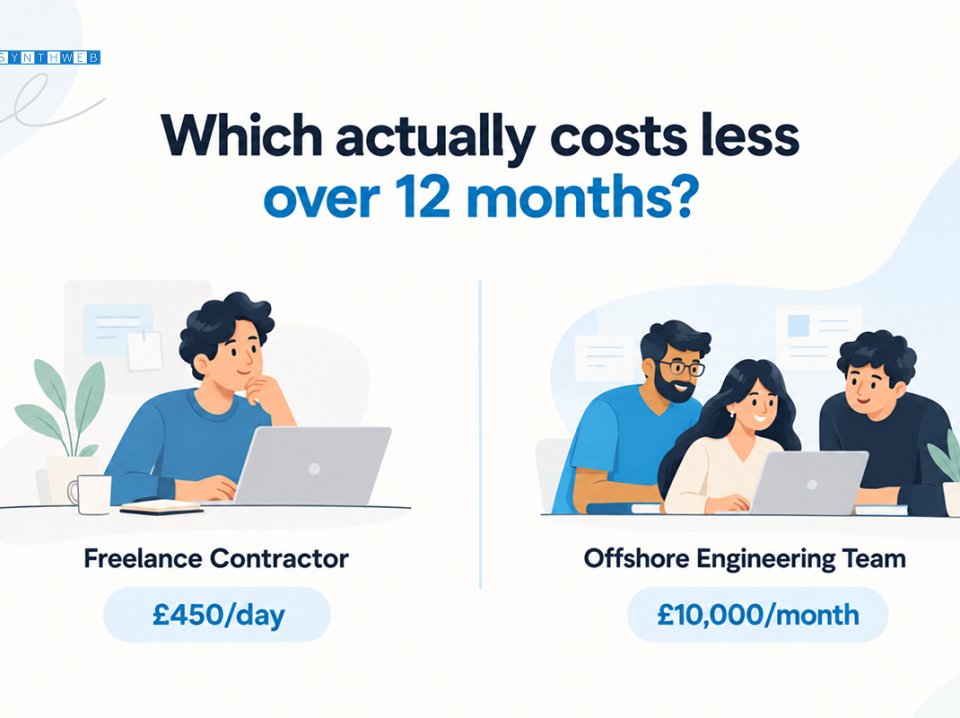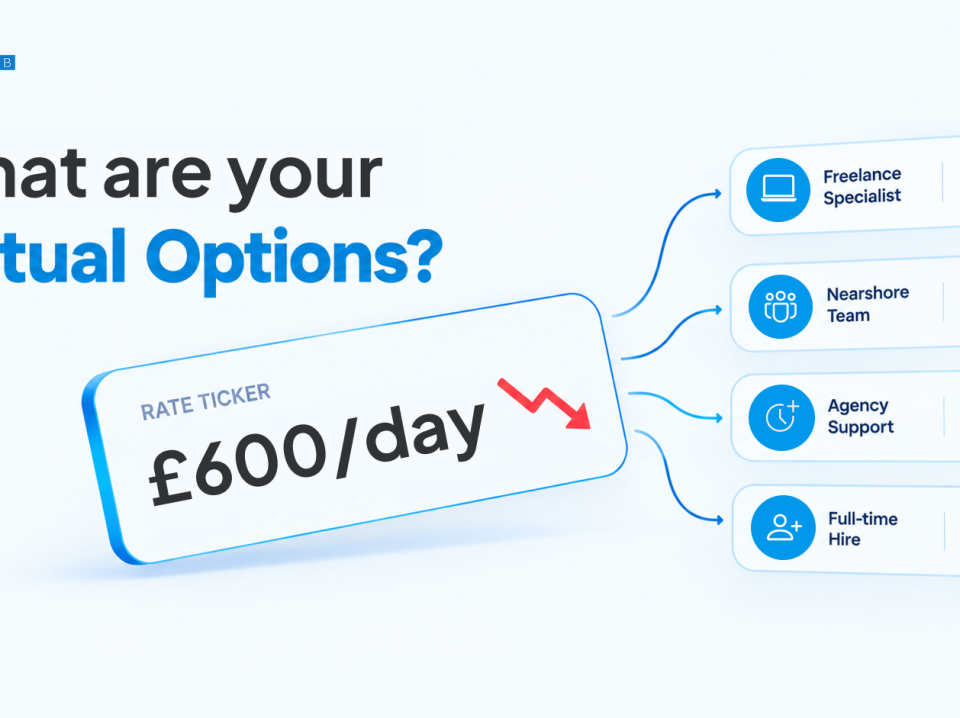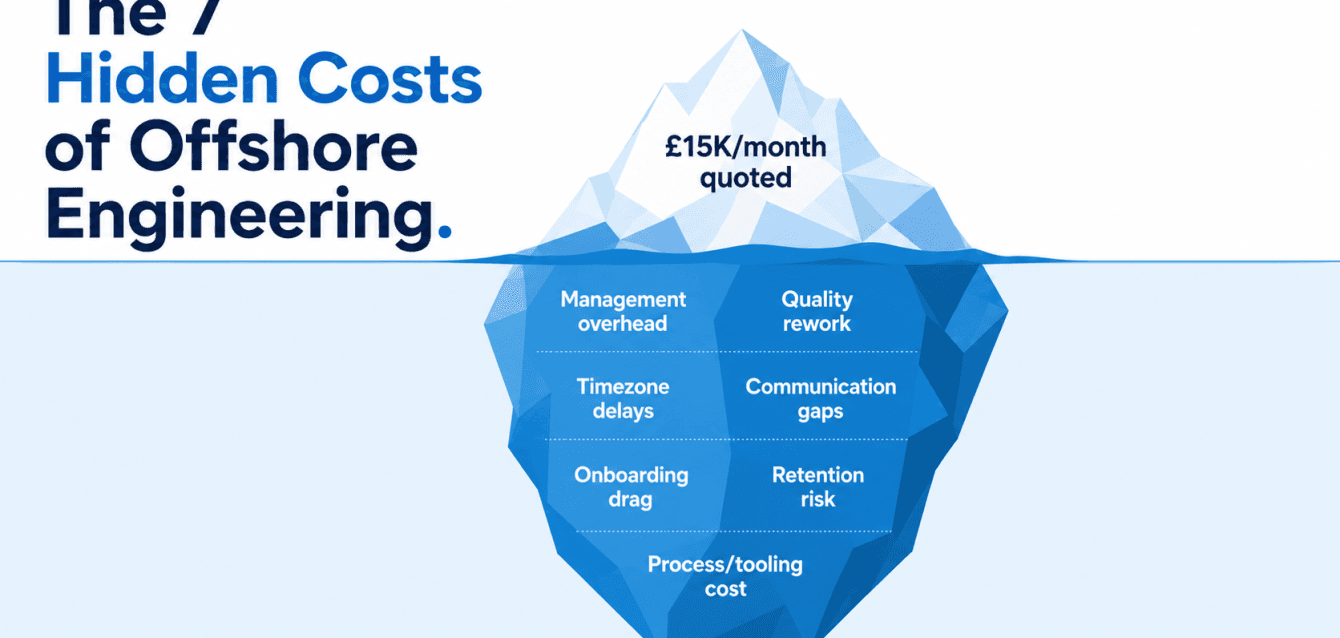
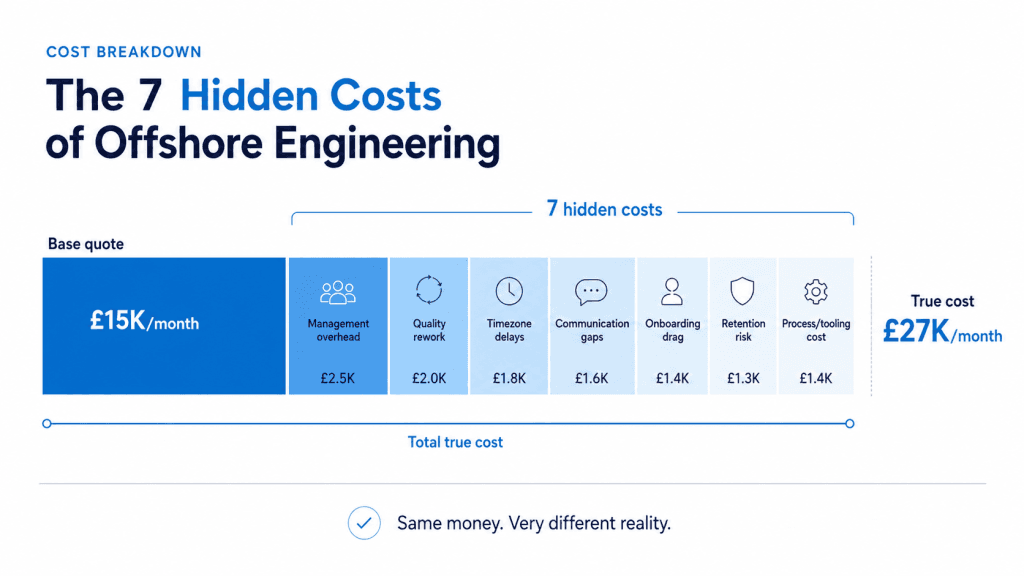
The hidden costs offshore engineering team vendors charge are never disclosed upfront. When an offshore agency quotes you £15,000 per month, that number is real. It is also incomplete. After 50+ engineering engagements at SynthWeb, we have mapped every cost that appears between the proposal and the final invoice- and the gap between the two is consistently 30 to 50 percent wider than founders expect. According to the Deloitte Global Outsourcing Survey 2024, cost unpredictability remains the top complaint among companies that offshore engineering work. This post lists all seven costs so you can budget accurately before signing anything.
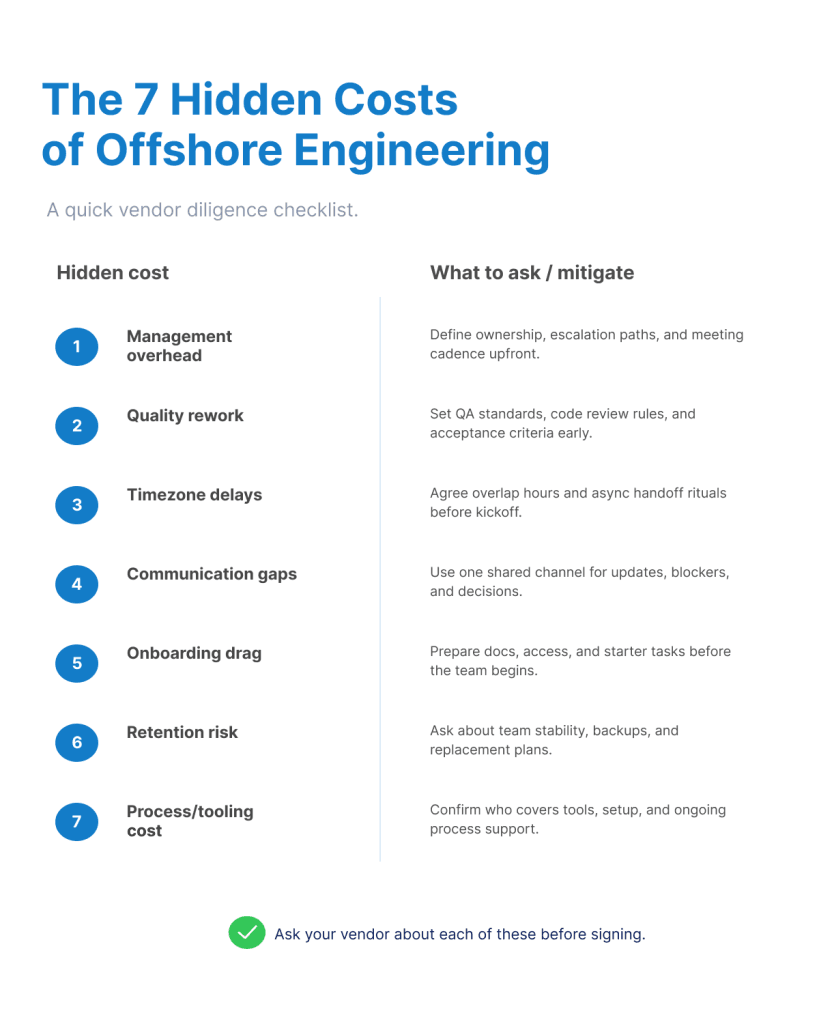
1. Onboarding Drag – Hidden Cost Offshore Engineering Team Vendors Never Mention
Onboarding drag is the first hidden costs offshore engineering team vendors never disclose. The first two to four weeks of any offshore engagement are slower than the rate card suggests. Engineers need access to your codebase, your staging environment, your communication channels, your third-party API credentials, and your architecture documentation. If any of those are incomplete or missing, the clock runs without output. SynthWeb bakes onboarding into the fixed price on every engagement. Ask any vendor whether onboarding is included or billed. If they pause, it is billed
2.Timezone Management Overhead -A Hidden Cost Offshore Engineering Team Projects Face
Four to six hours of daily overlap sounds like enough. It is, until a blocker lands at 3 PM UK time and the first response arrives at 10 AM the next day. That single 19-hour delay on a decision that takes three minutes to make costs roughly 0.4 days of engineering time per occurrence. On a project with 10 blockers a month, that is four lost engineering days, silently, without appearing on any invoice.
3.Integration Testing Scope Creep – Hidden Cost Offshore Engineering Team Quotes Miss
A quote that covers development does not always cover integration testing. When your new build connects to your existing CRM, your payment provider, and your logistics API, each integration requires test cases, edge case handling, and regression coverage. If the quote line says “development and unit testing,” integration testing is out of scope and it will surface as a change request in week six.
4. DevOps and Infrastructure -The Hidden Cost Offshore Engineering Team Proposals Skip
DevOps and infrastructure gaps are hidden costs offshore engineering team proposals consistently skip over. “We will set up your AWS environment” is a sentence that can mean anything from two hours of configuration to three weeks of architecture work. SynthWeb’s MVP Sprint includes a complete AWS deployment with ECS Fargate, RDS, S3, CloudFront, and Route 53. Many vendors quote code delivery and treat deployment as a separate workstream. Clarify this before signing.
5. Scope-Clarification Meetings – Hidden Cost Offshore Engineering Team T&M Contracts Create
Uncontrolled meeting overhead is a hidden cost offshore engineering team T&M contracts quietly generate. On a T&M engagement, every meeting is billed. Every Slack thread that turns into a video call is billed. Every review session that runs over is billed. This is not dishonest ,it is how T&M works. The cost is that a team which communicates well and asks good questions can generate £2,000 to £5,000 per month in meeting overhead that does not appear in the headline rate. Fixed-price engagements remove this category of cost entirely.
6. Post-Launch Support Tail -Hidden Cost Offshore Engineering Team Agencies Never Quote
Post-launch support is a hidden cost offshore engineering team agencies rarely include in their initial quote. Most vendors write a go-live date and stop there. What happens on day two when a payment webhook fails in production? When a mobile-specific bug appears on an Android device you did not test? SynthWeb includes five days of post-launch engineering support in every MVP Sprint at no additional charge. Most agencies do not post-launch support is either billed hourly or requires a separate retainer. Ask for this in writing before the build starts
7. Knowledge Transfer – The Final Hidden Cost Offshore Engineering Team Engagements Hide
Knowledge transfer gaps are the final and most expensive of the hidden costs offshore engineering team engagements produce. When an engagement ends and a new engineering team takes over whether in-house or another vendor knowledge transfer is a significant cost. SynthWeb delivers a written architecture document, an infrastructure access list, and a 60-minute recorded walkthrough on every engagement exit. This typically represents 40 to 80 engineering hours. Many vendors do not include this, and founders discover the gap only when they try to hand the codebase to the next team.
The Fix: How to Control Hidden Costs Offshore Engineering Team Vendors Create
The cleanest way to contain all seven of these costs is to use a fixed-price contract for any well-scoped build. Fixed-price puts costs 1 through 7 on the vendor, not the client. SynthWeb’s MVP Sprint is fixed-price for exactly this reason. For ongoing work, the Engineering Pod model uses monthly T&M but with a structured sprint cadence, a weekly written update, and a defined scope of work per sprint, which eliminates most of the scope-clarification and meeting overhead.
The day rate is the starting point. The true cost is what arrives six months later on the invoice.
FAQ
What is the typical true cost multiplier on an offshore engagement? Based on our data across 50+ projects, founders who go in expecting a 1.0x on the quoted rate should budget for a 1.3x to 1.5x total cost when onboarding, integration testing, DevOps, and post-launch support are included.
Does a fixed-price contract actually protect against all seven? Yes for items 1, 4, 5, and 7. Items 2 and 3 are reduced by good process regardless of contract type. Item 6 (post-launch support) needs to be explicitly named in the scope, check the contract for this specifically.
How does SynthWeb handle these costs? Onboarding, DevOps, post-launch support, and knowledge transfer are included in every MVP Sprint. Engineering Pod engagements have a structured sprint model that eliminates uncontrolled meeting overhead.
Also Read:
Why We Don’t Take Engineering Projects Under $20K (And What to Do If That’s Your Budget)