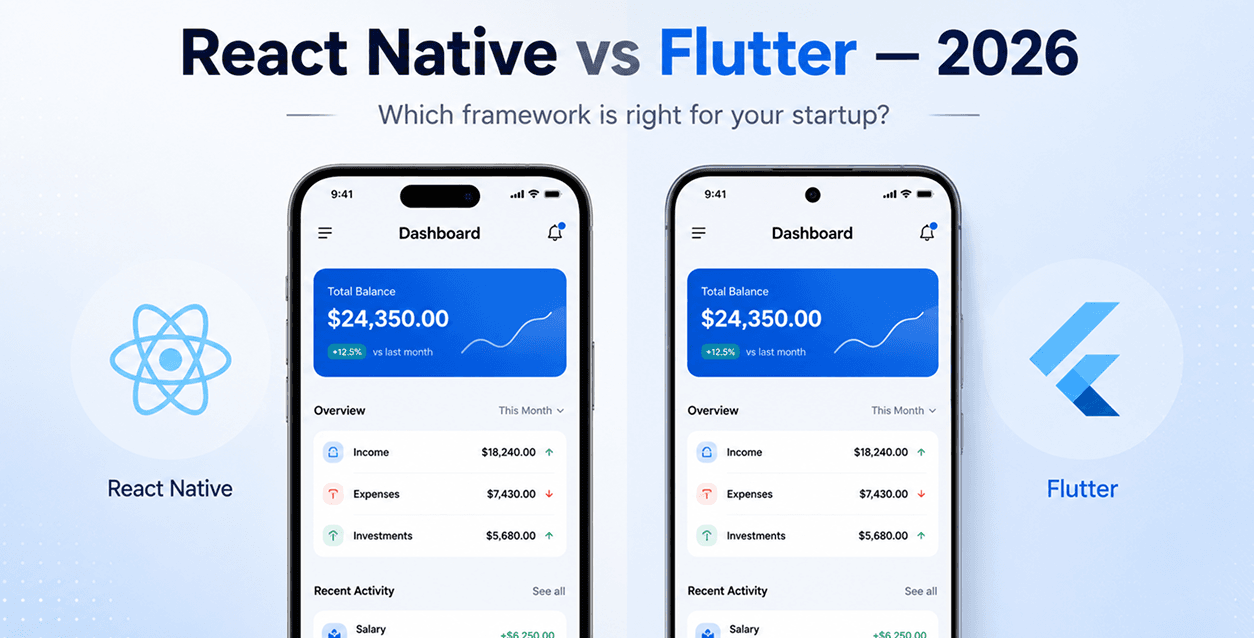
React Native vs Flutter for Funded Startups in 2026 is one of the most important framework decisions founders face when building a mobile MVP. If you are a funded founder picking the cross-platform framework for your first mobile MVP in 2026, you are choosing between React Native and Flutter. There are other options — native iOS plus native Android, Kotlin Multiplatform, Capacitor — but for a funded MVP that needs to ship in 10 weeks across both stores, the choice realistically narrows to those two. We have shipped production apps in both, including AIJAVAN on React Native (4 years in production) and three smaller Flutter projects, and the answer for most funded startups is clearer than the framework debate online suggests.
The short version: pick React Native if your team has any JavaScript or TypeScript experience or if you plan to share code with a web product. Pick Flutter if you are starting from zero and your app is graphics-heavy or animation-heavy, or if you have a Dart-experienced engineer already in-house. Everything else is detail.
Hiring is the hidden tiebreaker
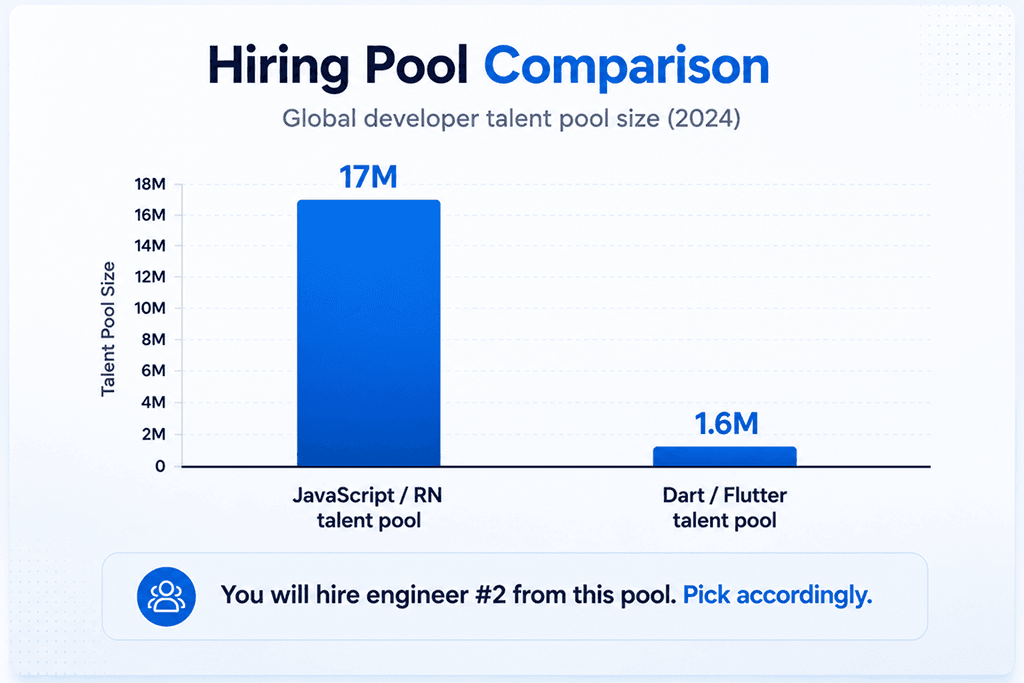
A 2026 funded MVP fails more often from inability to hire the next engineer than from framework limitations. React Native draws from the global JavaScript talent pool — roughly 17 million developers globally according to the most recent Stack Overflow survey. Flutter draws from the Dart talent pool — roughly 1.6 million globally, most of them concentrated in a few specific markets. When you need to hire engineer two and engineer three after the MVP ships, the React Native pool is wider, faster to hire from, and cheaper at most experience levels.
The exception: if you are hiring in markets where Flutter has a strong local ecosystem — Bangalore, parts of Eastern Europe, certain Southeast Asian markets — Flutter hiring is competitive. Outside those markets, React Native wins on availability.
This is one reason why React Native vs Flutter for Funded Startups in 2026 remains a practical business decision rather than just a technical one.
Performance is no longer a meaningful gap
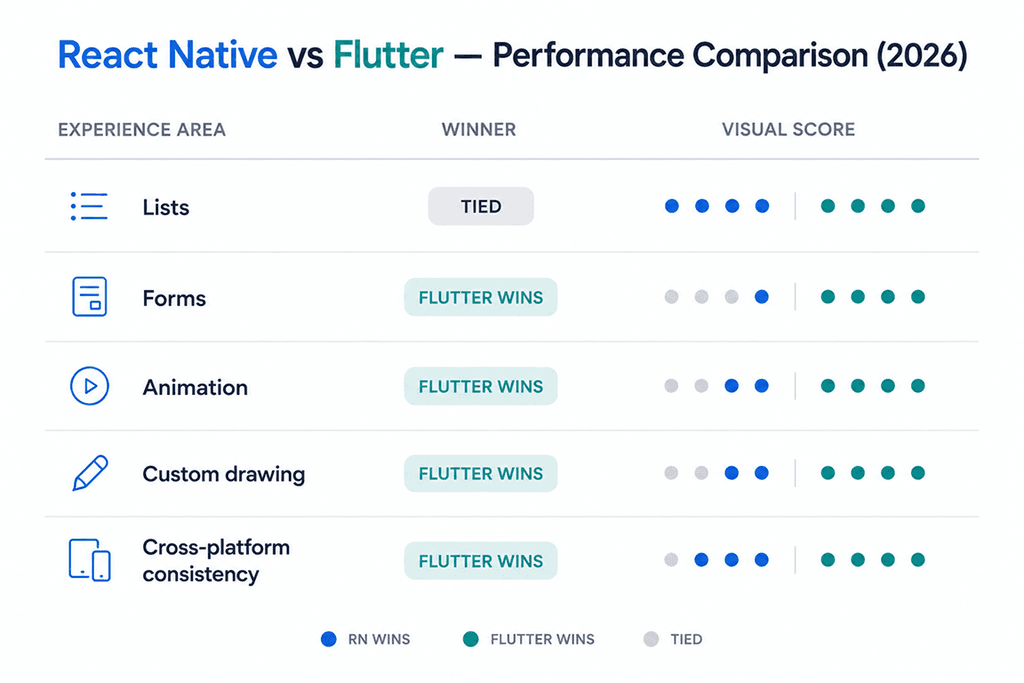
The 2020-era argument that Flutter is meaningfully faster than React Native does not hold in 2026. React Native’s New Architecture (Fabric and TurboModules), now stable and default in React Native 0.74+, closed most of the perceived performance gap. For 95% of consumer app workloads — lists, forms, navigation, image grids, video players — both frameworks render at 60fps on hardware released in the last 4 years.
The remaining 5% of workloads where Flutter pulls ahead: heavily animated interfaces (think duolingo-style or game-like UI), complex custom drawing on canvas, and apps that need pixel-perfect identical rendering across iOS and Android. If your app is not in that 5%, the performance argument is not a deciding factor.
When evaluating React Native vs Flutter for Funded Startups in 2026, performance alone is rarely the deciding factor.
Ecosystem and library availability
React Native has a deeper, broader third-party library ecosystem in 2026, but with a quality dispersion problem — many React Native libraries are unmaintained or incompatible with the New Architecture. Flutter has a smaller library ecosystem but tighter quality control and stronger first-party packages from the Flutter team itself. For an MVP, both ecosystems contain everything you need (auth, payments, push notifications, maps, camera, biometrics). For a v3 of a complex product, React Native gives you more options at the cost of more curation work.
Web and code-sharing considerations
If you have or plan to have a web product, React Native gives you meaningful code-sharing through React Native Web — share components, utilities, business logic, and even some UI between native and web. Flutter Web exists but is not credible for a production-grade web product in 2026. If web matters, this single fact decides the choice.
What the AIJAVAN team picked, and why
AIJAVAN runs on React Native and has since v1 in 2022. The decisive factors at the time were: the founding engineer’s existing React experience, the planned web companion (which shipped 18 months later sharing 40% of code), and the larger pool of React Native engineers we could hire from. None of those factors have weakened in 2026. We would pick React Native again today for the same project.
For one of our smaller Flutter projects — a graphics-heavy creative tool that did not need a web version — Flutter was unambiguously the right call. The animation tooling and stateful widget model fit the workload better.
For teams evaluating React Native vs Flutter for Funded Startups in 2026, our experience shows that hiring availability and long-term maintainability often matter more than theoretical performance differences.
React Native vs Flutter for Funded Startups in 2026: The Decision in Three Questions
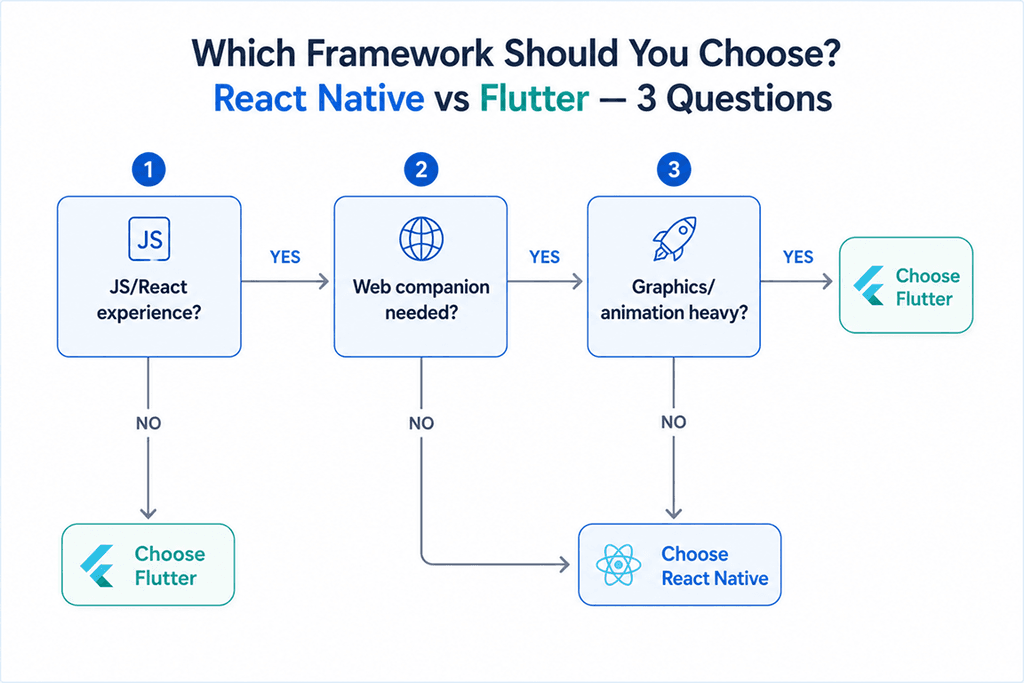
First: do you or your existing engineers have JavaScript or React experience? If yes, React Native. Second: will this product have a web companion within 24 months? If yes, React Native. Third: is the app graphics-heavy or animation-heavy enough that 60fps is table stakes? If yes, Flutter is worth the deeper evaluation.
FAQ
Can SynthWeb build in either framework? Yes — we run engineers experienced in both, with React Native as our default for funded MVPs.
What is the cost difference? Roughly equivalent in build hours for an MVP. Hiring downstream is where the cost gap appears.
What about Kotlin Multiplatform? Mature for Android-leaning apps but not yet at parity for iOS-first products in our experience. Worth a conversation if your team is Kotlin-native.
Should we go fully native (Swift + Kotlin) instead? Only if your roadmap absolutely requires it and your funding supports double the engineering cost. For most funded MVPs the answer is no.
Many founders researching React Native vs Flutter for Funded Startups in 2026 ultimately choose based on hiring needs and future scalability.