EU AI Act hiring: August 2026 was always going to be an important milestone for organisations using AI across their operations. In hiring, however, it is easy to interpret the date too simply.
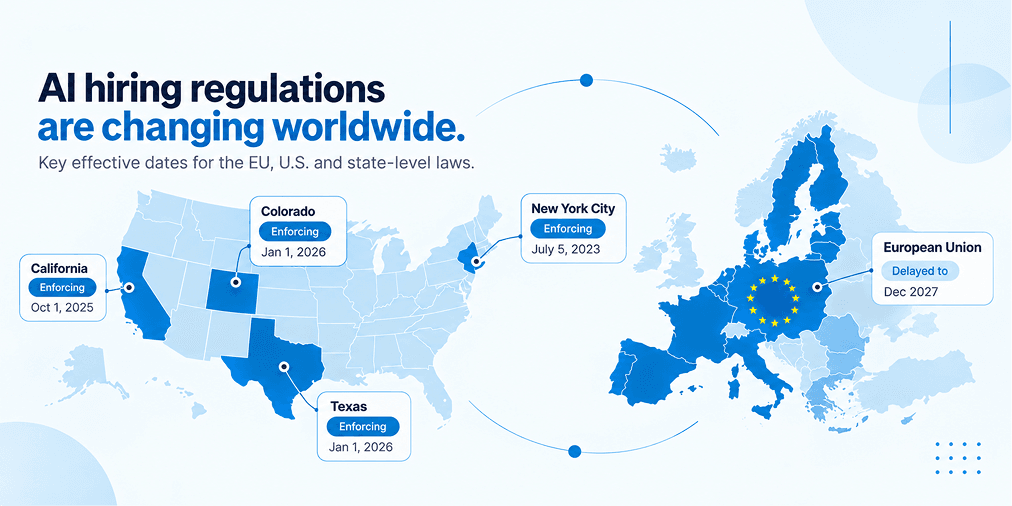
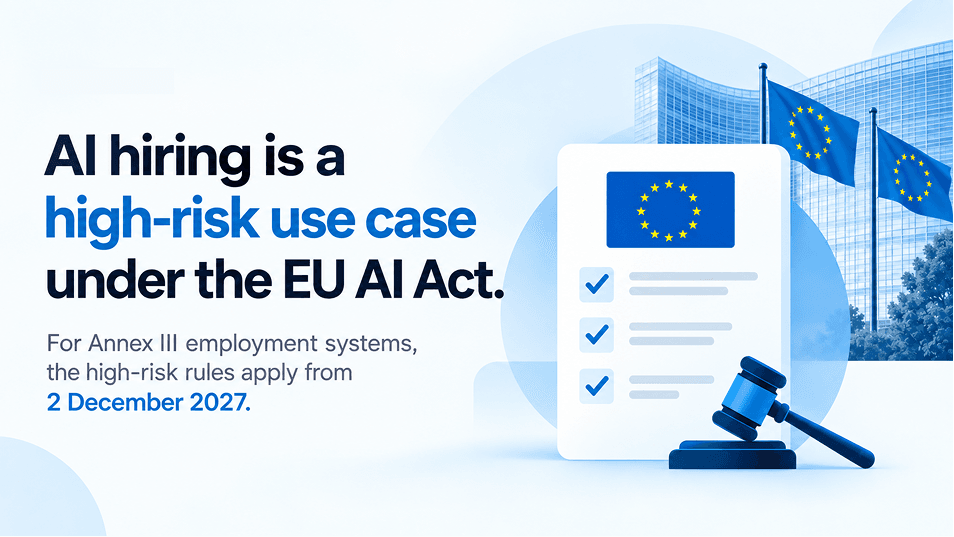
The EU AI Act became generally applicable on 2 August 2026, but its obligations do not all begin at the same time. For relevant high-risk AI systems in employment and recruitment covered by Annex III, the current application date is 2 December 2027 following the AI Omnibus. That distinction matters for anyone trying to understand what the August deadline actually requires from hiring tools.
The practical question is therefore not simply whether an organisation is “compliant” by August 2026. It is whether the organisation knows which AI systems it uses, what those systems do, how they influence employment decisions, and what responsibilities will apply to the provider and the organisation deploying them.That is the foundation of sensible EU AI Act hiring preparation.
What August 2026 actually means
The AI Act has always been designed around a phased implementation timeline. Prohibited AI practices and AI literacy obligations began applying earlier, while the Act’s broader application began on 2 August 2026. Some obligations, however, have different application dates and transition periods.
For hiring technology, the important distinction is the treatment of high-risk systems under Annex III.
The AI Omnibus entered into force on 27 July 2026 and extended the application of the high-risk rules for systems used in certain areas, including employment, to 2 December 2027. High-risk AI embedded in regulated products covered by Annex I has a separate transition period until 2 August 2028.
So August 2026 should not be presented as the final deadline by which every high-risk recruitment system must already satisfy the full set of applicable high-risk obligations.It is still a useful compliance milestone. Organisations now have a clearer reason to examine the AI already operating inside recruitment and workforce processes rather than waiting until the 2027 deadline approaches.
This is particularly relevant to AI hiring compliance 2026 because older articles, vendor materials and internal policies may still reflect the original implementation timeline.
When does an AI hiring system become high-risk?
The classification should begin with what the system actually does, rather than what the vendor calls it.
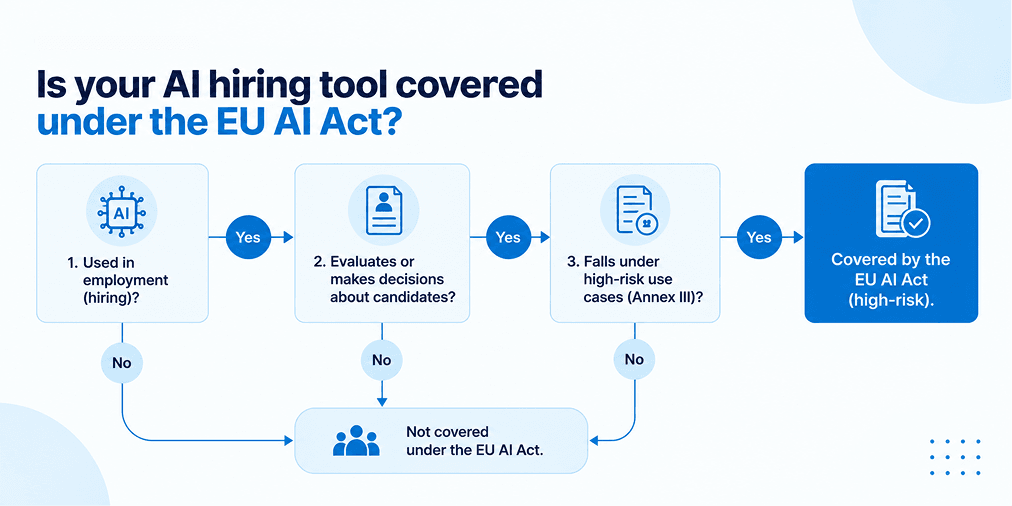
Annex III covers AI systems used for employment, workers’ management and access to self-employment. This includes systems intended for recruitment or selection, such as tools used for targeted job advertising, analysing and filtering applications, and evaluating candidates. That means an AI system does not necessarily have to make the final hiring decision to be relevant to EU AI Act hiring.
A tool that filters applications before a recruiter sees them can influence who progresses through the process. A system that evaluates candidates against certain criteria can influence an employment decision even if a human recruiter formally makes the final choice.
The Act also contains an important qualification. Certain Annex III systems may fall outside the high-risk classification where they do not pose a significant risk of harm and do not materially influence decision-making, provided the conditions in Article 6(3) are met. These include certain narrow procedural, preparatory or supportive functions. However, an Annex III system that performs profiling of natural persons is always considered high-risk under the Act.
Getting this classification right is the starting point for any serious EU AI Act hiring assessment.
The useful questions are straightforward. What does the system do? Where is it used in the recruitment process? Does it filter, rank, evaluate or profile candidates? Does its output materially influence an employment decision? What human review follows?
A system described as an “AI recruiting assistant” can therefore require a much closer examination than the label suggests.
What high-risk classification actually triggers
High-risk classification is not simply a label that appears in a compliance register. Once the applicable rules take effect, it brings a wider set of requirements.
For providers, the AI Act establishes requirements around risk management, data and data governance, technical documentation, record-keeping and logging, transparency, human oversight, accuracy, robustness and cybersecurity. The requirements are intended to address the risks created by systems that can significantly affect people’s health, safety or fundamental rights. For EU AI Act hiring, these requirements become particularly relevant when AI is used in processes that can influence employment decisions.There are responsibilities on the deployer side as well
Organisations using high-risk AI systems must follow the provider’s instructions, assign appropriate human oversight and monitor the system’s operation. The Act also sets out requirements concerning logging, workplace information and other deployer responsibilities in relevant circumstances.That distinction is important in HR.
Buying an AI hiring tool does not mean that every responsibility moves to the vendor. The provider has obligations concerning the system, while the organisation deploying it remains responsible for how that system is used within its own process.
That is where EU AI Act hiring compliance becomes an operational issue rather than simply a procurement exercise.
Human oversight cannot be a checkbox
Recruitment is one area where “human in the loop” can become an overly simple description of a much more important control.
A recruiter reviewing an AI-generated ranking does not automatically mean that meaningful human oversight exists. The AI Act’s framework expects human oversight measures to enable people responsible for oversight to understand a system’s capabilities and limitations, identify undesirable outcomes and take appropriate action. It also recognises the risk of automation bias. For EU AI Act hiring, this makes the quality of human oversight an important part of how the system is governed.
For an HR team, this creates practical questions.Who reviews the output? What are they expected to check? Can they challenge or override the system? Do they understand its limitations? What happens when an output appears inconsistent with the candidate’s information?
A policy stating that “a human makes the final decision” does not answer these questions by itself.
Meaningful oversight depends on whether the person responsible has enough information, authority and understanding to question the system rather than simply approve its recommendation.
Documentation matters before the deadline
One of the most useful steps an organisation can take now is to build an inventory of the AI systems involved in recruitment.This does not need to begin as a large compliance programme. It begins with visibility.
For each system, the organisation should know its intended purpose, where it is used in the hiring process, what information it processes, what decisions it influences, who provides it and who deploys it.
The organisation should also understand what documentation the provider supplies, what limitations have been identified, what human oversight exists and how unexpected outputs are handled.This matters because the high-risk framework places significant emphasis on documentation, traceability and information provided to deployers.The objective is not paperwork for its own sake. It is to create a reliable record of where AI sits in the decision-making process.
For anyone working through EU AI Act hiring requirements, that visibility provides a much more useful starting point than a generic responsible-AI statement.
Explainability in recruitment has a practical meaning
Explainability is often discussed as though HR teams need to understand every technical detail of an AI model.That is not the most useful way to approach it.
The practical question is whether the people responsible for a recruitment process have enough information to understand what the system is intended to do, interpret its output and recognise when that output should not be relied upon.
Consider an AI system that ranks candidates. A recruiter does not necessarily need to understand the mathematical architecture behind the model. They do need to understand what the system evaluates, what information it relies on, what its limitations are and how its output should be used.
That is where explainable AI recruitment becomes a practical governance issue rather than simply a technical concept.
Documentation, transparency and human oversight work together. If an organisation cannot explain the role an AI system plays in its hiring process, meaningful oversight becomes much harder.
The Digital Omnibus changed the timeline
The revised timeline matters because much of the earlier discussion around the EU AI Act was based on the assumption that the high-risk rules for employment AI would apply from August 2026.
That is no longer the current position.
The AI Omnibus entered into force on 27 July 2026, with the high-risk rules for relevant Annex III systems in employment now applying from 2 December 2027.
The change gives organisations additional preparation time. It does not remove the underlying requirements.
The regulatory picture is also still developing. The European Commission has published draft guidelines on the classification of high-risk AI systems and says the final guidelines will be adopted by the end of 2026. This means organisations should be careful when relying on older articles, checklists or vendor explanations that may reflect an earlier interpretation or timeline.
For this reason, an AI hiring law tracker should record not only the rule itself, but also its status, application date and the source on which the interpretation is based.
What organisations should do now
The practical starting point is an inventory. Organisations should identify the AI systems being used across recruitment and workforce management and document where each system operates in the process. The next step is to understand whether a system filters, ranks, evaluates or profiles candidates and whether its output influences an employment decision.
From there, the organisation can examine the relevant classification, provider documentation and deployer responsibilities.
Governance should then be mapped around each system. Who is responsible for human oversight? What information does the recruiter receive? Can the output be challenged or overridden? What happens when the system produces an unexpected result?
The regulatory timeline should be recorded alongside these details. A compliance register that connects each system with its relevant provision, application date, responsible parties and outstanding evidence is more useful than a broad statement that the organisation is “AI compliant.”
There is another consideration for organisations hiring across markets: the EU AI Act is not the only framework that may matter.
New York City’s Local Law 144, for example, requires covered employers and employment agencies using an automated employment decision tool to satisfy requirements including a bias audit, public availability of audit information and required notices.
Colorado’s current framework is also evolving. Senate Bill 26-189 repealed and reenacted provisions governing automated decision-making technology in consequential decisions, with the new provisions taking effect on 1 January 2027. The Colorado Attorney General’s Office is developing implementing rules.
Texas and California also form part of a changing state-level landscape, with different laws, proposals and regulatory developments addressing AI and employment-related decision-making.
The point is not that these jurisdictions follow the same model as the EU. They do not. The point is that a company operating across jurisdictions needs a way to see those differences together, alongside its EU AI Act hiring requirements.
The AI Hiring Compliance Checklist
That is why we are putting together an AI Hiring Compliance Checklist as a practical reference resource.
The checklist cross-references the EU AI Act, NYC Local Law 144, Colorado, Texas and California, with the aim of helping teams organise the questions they need to ask about AI systems used in hiring.
It is not intended to suggest that these jurisdictions impose identical requirements. Instead, it provides a starting framework for reviewing where a system is used, what obligations may apply, what documentation should be available and which regulatory developments need to be monitored.
For teams managing hiring across multiple markets, this kind of reference can be more useful than keeping separate notes every time a new rule, amendment or implementation date changes.
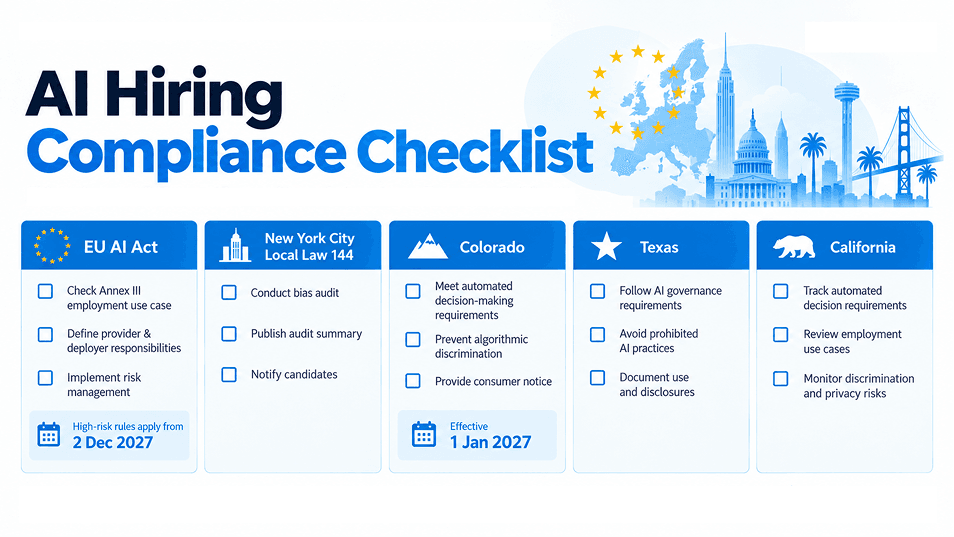
The checklist is designed as a reference resource, not a substitute for legal advice and not a product signup.
Why we are building this in public
Cairn is a platform we are building in public around this problem: making the practical picture of AI hiring compliance easier to follow as regulations, implementation dates and guidance develop.
The difficult part of AI hiring compliance is not simply reading one regulation. It is keeping the practical picture current across changing rules and jurisdictions.
That means following regulatory developments, tracking implementation changes and translating them into questions that HR, compliance and technology teams can actually use.
The August deadline is not the whole story
August 2026 should therefore not be treated as the final high-risk compliance deadline for recruitment AI. For relevant Annex III high-risk systems in employment, the current application date is 2 December 2027. But additional preparation time is not the same thing as a reason to postpone work on EU AI Act hiring requirements.
Organisations can use this period to identify their systems, understand how those systems influence hiring, review provider documentation, establish meaningful human oversight and map the jurisdictions in which they operate.
For organisations working through EU AI Act hiring requirements, the timeline has changed. The need for visibility has not.
If your team is building that view across jurisdictions, get the AI Hiring Compliance Checklist as a practical reference for reviewing the EU AI Act alongside NYC Local Law 144, Colorado, Texas and California.
It is designed to help organise the compliance questions before they become deadline questions.
Also Read:
The 11PM Enquiry Problem: What India’s Solo Creators Are Actually Losing