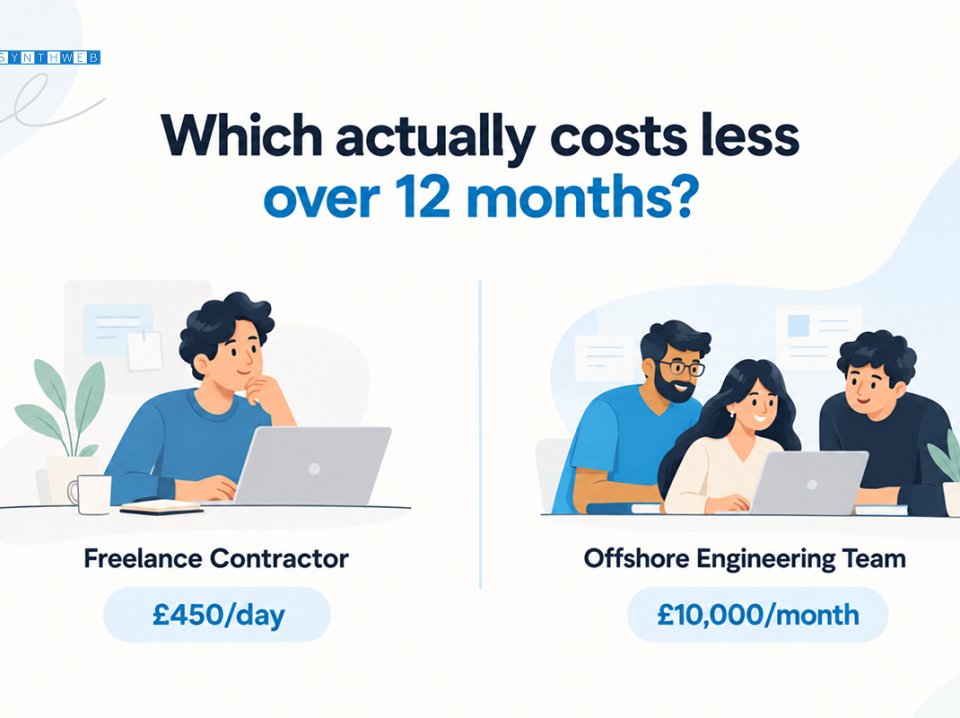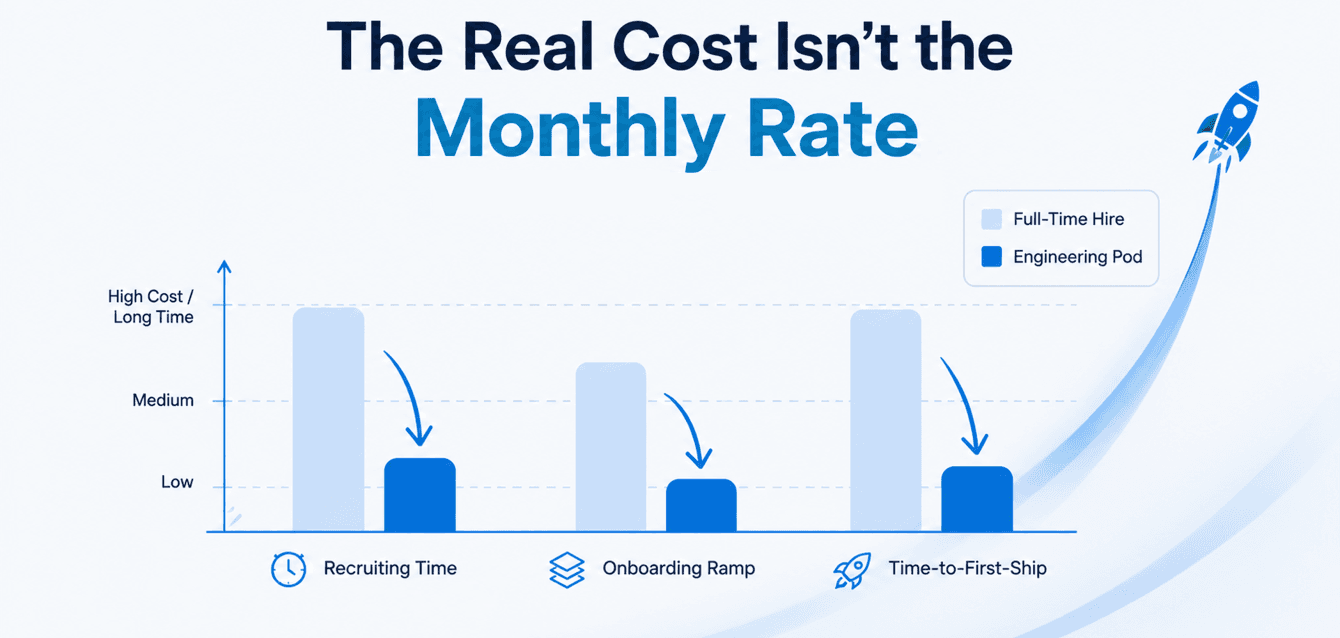
Series A founders ask us this question almost every time: is it cheaper to hire, or to keep an Engineering Pod attached? The honest answer is it depends on what “cheaper” is measured against salary alone makes hiring look better; total cost of a working engineer on your roadmap tells a different story. That is the real question behind engineering pod vs full time hire cost.
What a full-time hire actually costs?
A senior engineer hire in the UK or US market carries salary plus benefits, plus recruiting cost and time-to-hire (often 8–12 weeks for a senior role in a competitive market), plus onboarding time before they’re shipping independently — typically 4–8 weeks depending on codebase complexity. During that ramp-up period, the company is already paying the full employment cost while the engineer is not yet delivering at full capacity. None of that time is zero-cost; it’s roadmap time the founder isn’t getting back.
When comparing engineering pod vs full time hire cost, this ramp-up period is part of the real cost of hiring, even though it does not appear on a salary line.
What an Engineering Pod costs instead
A Pod is priced as a fixed monthly rate for a defined team — typically 2–4 engineers plus a lead — with no recruiting cost, no onboarding ramp beyond the first sprint or two, and no benefits or infrastructure overhead on the founder’s side. The model gives the startup additional engineering capacity without making a permanent hiring decision before the roadmap requires it.
The team is already shipping together, which matters more than it sounds: a Pod that’s worked as a unit for months has fewer coordination costs than four individually-hired engineers who started on different weeks. The engineers already understand how to coordinate delivery, review work, and divide responsibilities, reducing the coordination involved in getting a new team moving.
For engineering pod vs full time hire cost, that ability to start shipping quickly is an important part of the comparison.
Where hiring wins anyway
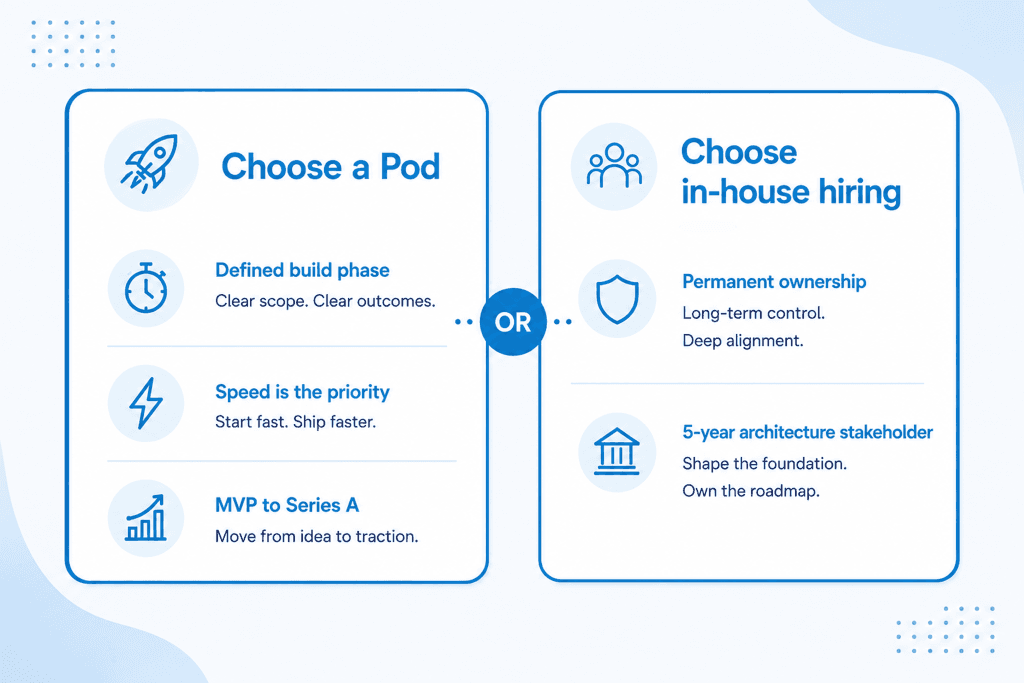
This isn’t a blanket case for Pods. Once a startup needs deep, permanent institutional knowledge sitting inside the company — someone who’ll be there for the next five years shaping architecture decisions personally — in-house hiring is the right call, and a Pod is the wrong tool for that job. Permanent ownership becomes more valuable when the company needs someone to build deep product knowledge and influence architecture decisions over several years.
The honest use case for a Pod is velocity during a defined build phase: MVP to Series A, or a specific roadmap push where speed matters more than permanence. In those situations, the objective is to increase delivery capacity quickly rather than make a permanent engineering commitment.
The number that actually matters
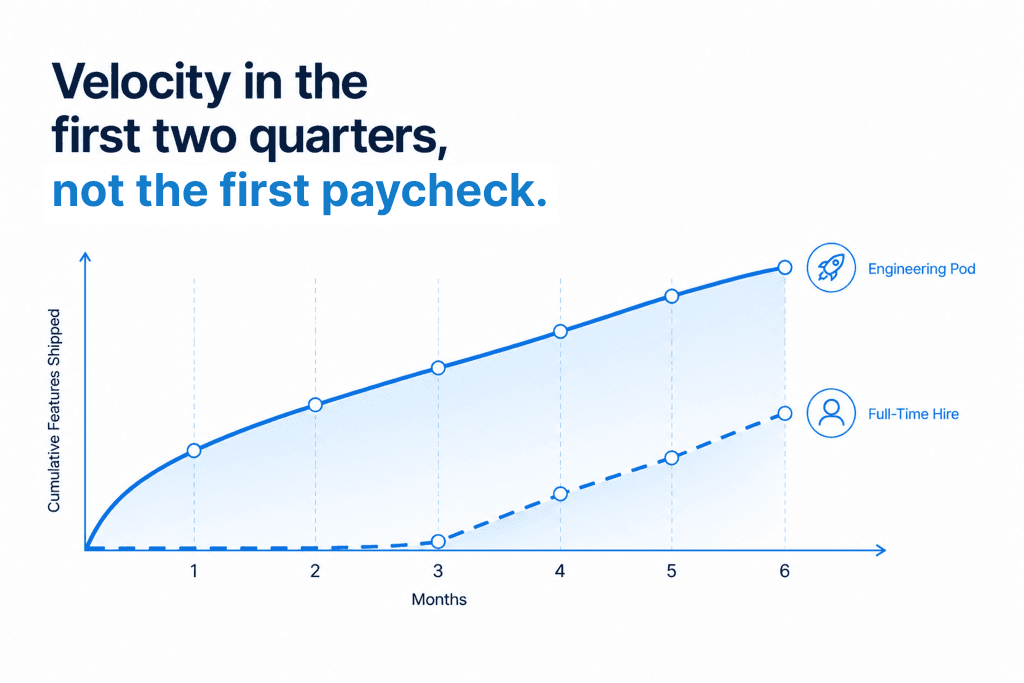
Compare cost-per-shipped-feature over the first two quarters, not cost-per-month. A Pod that ships in week one because there’s no onboarding ramp, against a hire who’s still ramping in month two, usually wins that comparison even at a higher headline monthly rate — because the startup is paying for engineering output sooner rather than waiting for the new hire to reach full productivity.
The gap narrows or reverses the longer the horizon runs past the first year, which is exactly when in-house ownership starts to matter more than raw velocity. That makes the length of the engineering requirement just as important as the monthly price when evaluating engineering pod vs full time hire cost.
FAQ
Is an Engineering Pod cheaper than hiring full-time?
Often yes in the first 6–12 months when you compare total cos- recruiting, onboarding ramp, and time-to-ship, not just headline salary vs monthly rate. Beyond that horizon, in-house hiring usually wins on long-term value.
How long does it take to onboard a new engineering hire vs an Engineering Pod?
A senior hire typically takes 4–8 weeks to ship independently after an 8–12 week hiring process. A Pod is usually shipping within the first sprint since the team already works together.
When should a startup hire in-house instead of using a Pod?
When the need is permanent institutional ownership — someone shaping architecture and staying with the company for years — rather than velocity during a defined build phase.
Also Read:
Engineering Pod vs Staff Augmentation vs Freelancers: Which Model Fits Your Stage