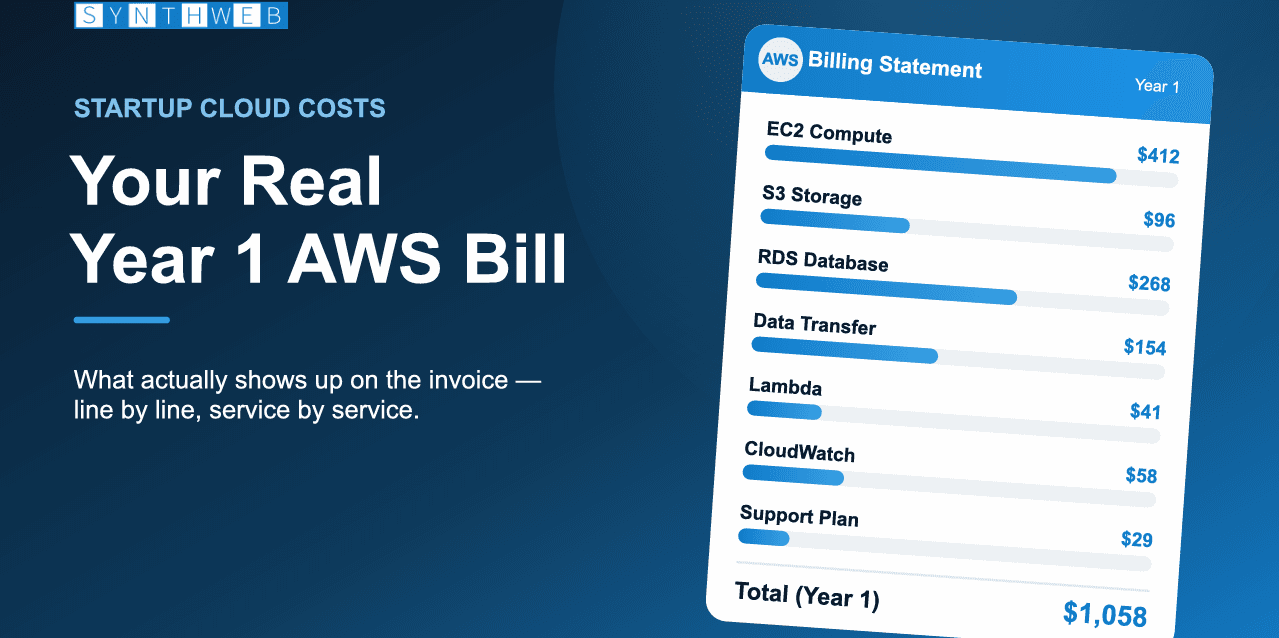
AWS costs startup year 1 planning breaks down at the same point almost every time: a founder allocates $40,000 for the build and $0 for the server it runs on. Cloud infrastructure is treated as a cost to figure out later. Later arrives, the AWS bill comes in, and a line item nobody planned for is now consuming three to five percent of monthly runway.
The expected range for a production-ready post-MVP AWS stack at 1,000 to 10,000 monthly active users is $350 to $600 per month. This is not the Heroku hobby plan number, it is a real, production-grade setup with managed database, CDN, SSL, and monitoring. Here is what it contains and where the surprises are.
The standard SynthWeb MVP stack on AWS
Every MVP Sprint deploys to the same baseline architecture: ECS Fargate for application hosting, RDS PostgreSQL for the managed database, ElastiCache Redis for session and cache, S3 plus CloudFront for file storage and CDN, Route 53 for DNS, ACM for SSL certificates (free), and CloudWatch for logs and monitoring.
At MVP traffic levels (1,000 to 10,000 MAU), the monthly cost breakdown is approximately: ECS Fargate $40–$80, RDS PostgreSQL db.t3.medium Multi-AZ $120–$180, ElastiCache Redis cache.t3.micro $25–$40, S3 plus CloudFront $20–$50, Route 53 $1, NAT Gateway $45–$80, CloudWatch $15–$30. Total: $350–$600 per month.
The three line items that consistently surprise founders
RDS PostgreSQL Multi-AZ.
The most common surprise on a first AWS bill. Founders who have used Heroku Postgres expect to pay $9 to $25 per month for a managed database. The db.t3.medium instance with Multi-AZ enabled, which is the minimum acceptable configuration for a production application that cannot afford a database outage, costs $120 to $180 per month. That is 6 to 9 times the Heroku hobby plan price, and it is the right choice for a production product.
Data transfer out.
AWS charges $0.09 per GB for data transferred out to the internet, after the first 100 GB per month. A product that serves images, video, or document downloads can generate 200 to 500 GB per month in outbound transfer fairly quickly. At 300 GB per month, that is an additional $18 per month that does not appear in any estimate. Over a year, $216 in extra data transfer is manageable. At 5,000 GB per month (a product with significant video content), it is $441 per month in transfer costs alone.
NAT Gateway.
A NAT Gateway allows your private subnet resources (the database, the cache) to access the internet for updates and outbound API calls. Cost: $0.045 per hour ($32 per month) plus $0.045 per GB of data processed. A typical MVP generates $40 to $80 per month in NAT Gateway costs. Most founders have never heard of a NAT Gateway and do not budget for it.
How costs scale with traffic
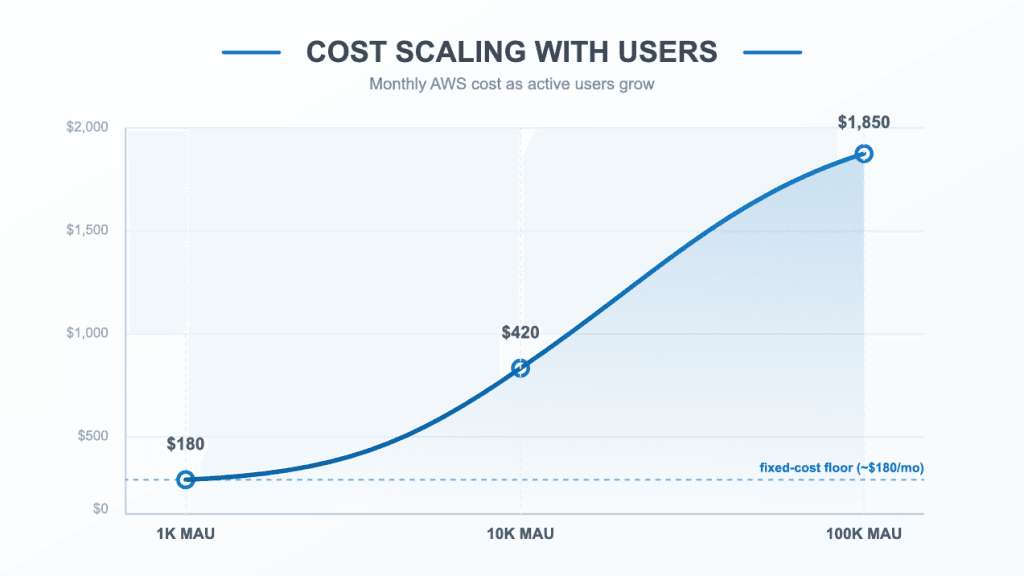
AWS costs startup year 1 scale predictably with traffic: at 1,000 MAU, expect $350–$600 per month. At 10,000 MAU: $600–$1,200 per month. At 100,000 MAU: $1,500–$4,000 per month. Scaling is sub-linear because most costs are fixed, the database instance, the NAT Gateway, the monitoring, and only compute and data transfer scale with traffic. The inflection point is usually the RDS instance: when the db.t3.medium reaches CPU saturation (typically around 50,000 to 100,000 MAU depending on query patterns), upgrading to db.t3.large adds $200 to $400 per month.
The AWS Costs Startup Year 1 Budgeting Framework
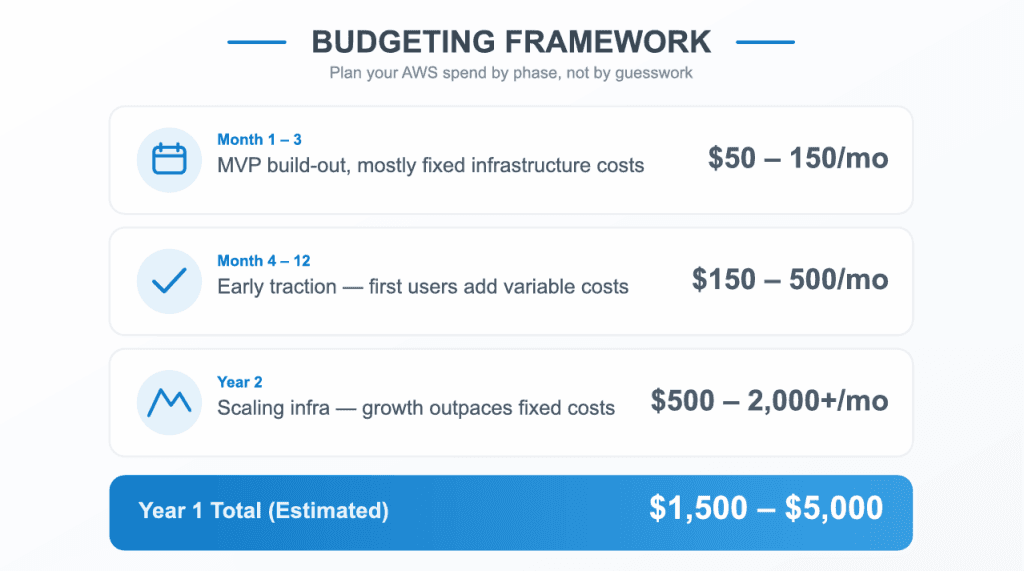
Month 1–3: $300–$500 per month (MVP just launched, low traffic, stabilisation phase). Month 4–12: $500–$1,500 per month (growth phase, traffic increasing, possible database upgrade). Year 2: $1,500–$5,000 per month (scale phase, data transfer and compute scaling with users). Total Year 1: approximately $6,000 to $18,000 in cloud infrastructure costs. Set up AWS Cost Explorer alerts from day one — a 20 percent month-on-month increase alert is a reasonable threshold for a growing product. Before locking in an architecture, run your expected service mix through the AWS Pricing Calculator to sanity-check these AWS costs startup year 1 numbers against your specific setup.
FAQ
Why AWS and not DigitalOcean or Railway?
DigitalOcean and Railway are excellent for early development and pre-launch prototypes. AWS is the enterprise expectation: Fortune 500 security reviews, SOC 2 audit trails, and scaling paths that do not require re-platforming at 100,000 users. Enterprise B2B clients increasingly ask which cloud provider you use.
Does SynthWeb include cloud costs in the project price?
No. AWS is billed directly to the client’s AWS account. We set it up, we configure it, but the billing relationship is between the client and AWS.
Can you reduce an existing AWS bill?
Usually 20 to 40 percent with a one-sprint audit. The most common savings are rightsizing over-provisioned instances and eliminating unused resources from a prior development phase. For ongoing visibility once the audit is done, tools like Vantage give teams a live dashboard of cost by service instead of waiting to discover AWS costs startup year 1 surprises on the monthly bill.
Also Read: The 7 Costs Nobody Tells You About When You Hire an Offshore Engineering Team