Finding affordable developers UK startups and growing businesses can depend on involves more than comparing hourly rates. Businesses need to consider technical expertise, communication, project management, and long-term maintenance costs. Choosing the right development partner can help reduce expenses while ensuring software projects meet business goals.
When comparing affordable developers UK companies offer, consider whether you need a single freelancer, a dedicated development team, or a hybrid arrangement. Regional developers may provide easier collaboration, while offshore teams can offer access to a broader talent pool at competitive rates. The best option depends on your budget, project complexity, and expected delivery timeline.
For businesses seeking affordable developers UK founders can trust, reviewing previous projects, checking code quality, understanding the development process, and confirming intellectual property ownership are essential steps. A reliable development partner should provide transparent pricing, regular progress updates, and clear documentation rather than simply promising the lowest rates.
Ultimately, affordable developers UK businesses choose should deliver value beyond the initial price. Strong engineering practices, consistent communication, and dependable ongoing support can help startups control development costs while building software that grows alongside their business.
Option 1: Affordable developers UK (Manchester, Leeds, Bristol, Edinburgh)
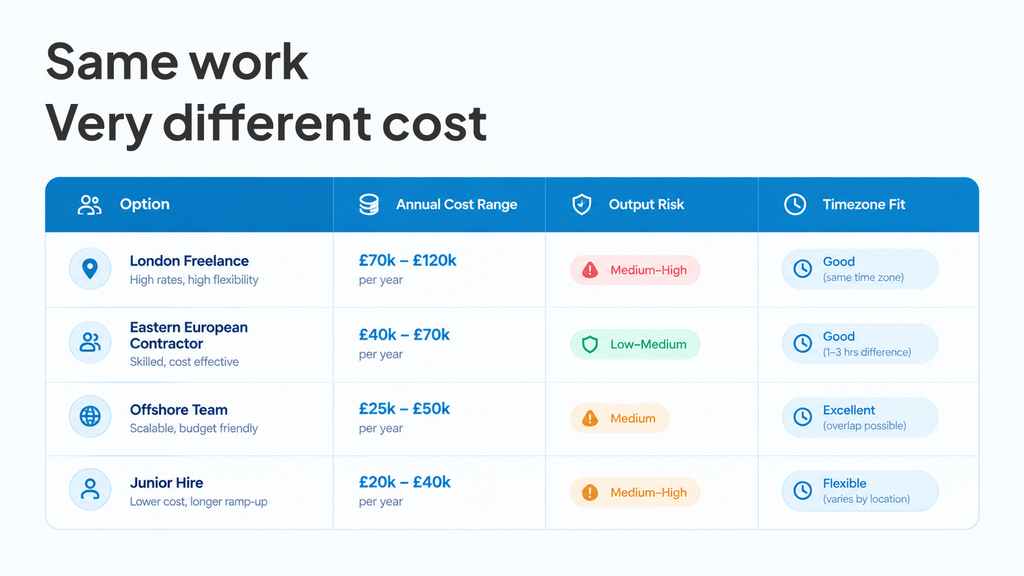
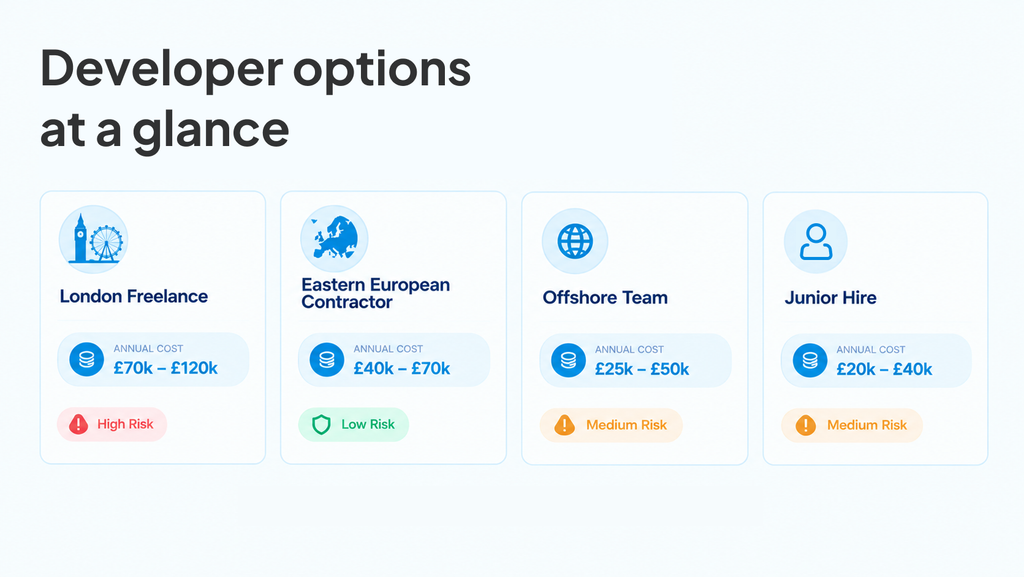
The UK tech talent pool doesn’t start and end in London. Manchester, Leeds, Bristol, Edinburgh, and Birmingham all have strong engineering communities — and rates that run 30–40% below London for equivalent seniority.
A senior React developer in Manchester: £280–£380/day. The same profile in London: £450–£550/day. For a six-month engagement, that’s £30,000–£40,000 saved before you’ve made any other changes.
What works: Same timezone. Same legal jurisdiction. Strong alignment on working norms. Most communication happens over Slack and video — the “we need to be in the same building” argument is rarely true for software projects.
What doesn’t work: The talent pool is smaller. For specialist skills — iOS native development, ML engineering, embedded systems — regional rates are often at London parity because there are fewer people. And “remote UK” still means UK employment law, IR35 implications if contracting, and UK day rates when many founders were hoping for dramatically lower costs.
Our honest assessment: A 30–40% saving matters. But if your constraint is cash and you need a full team, regional UK still may not move the needle enough.
Option 2: European Nearshore Development (Poland, Romania, Czech Republic, Portugal)
European nearshore became the default ‘offshore without the headaches’ option through the 2010s. Poland in particular built a genuine engineering excellence reputation — Warsaw and Kraków produce consistently strong full-stack developers, and Portuguese developers in Lisbon and Porto have risen sharply in the last five years.
Rates: £60–£120 per hour for mid-to-senior engineers depending on country and agency margin. For a dedicated team of three, you’re looking at £15,000–£25,000/month versus £45,000–£60,000/month for equivalent London contractors.
What works: Timezone overlap is real (typically 0–2 hours from the UK). English proficiency is strong. EU data protection law (GDPR) aligns with UK GDPR post-Brexit, simplifying data processing agreements. Many European agencies have worked with UK clients extensively and understand British business communication norms. For businesses comparing affordable developers UK options, European nearshore teams can offer a balance between competitive costs and convenient collaboration.
What doesn’t work: You’re often buying agency overhead, not direct engineering talent. Margins on European nearshore agency models can be substantial, meaning a significant portion of the day rate goes to the agency rather than the developer. Quality is highly variable, and ‘senior’ means different things in different markets.
Due diligence required: Ask for GitHub profiles or code samples. Talk to the engineers, not just the account manager. Understand who specifically will work on your project — not which agency has the best pitch deck. When evaluating affordable developers UK businesses can work with, prioritise technical expertise, transparent pricing, and proven delivery over the lowest quoted rate.
Option 3: Affordable Developers UK — South Asia / South-East Asia Offshore
This is where the economics shift most dramatically. A senior full-stack engineer in Guwahati, Bangalore, Colombo, or Ho Chi Minh City: £20–£45/hour. A well-structured team of four: £12,000–£20,000/month all-in.
This is where SynthWeb operates. We’re headquartered in Guwahati, Assam — Tier 2 India, which means lower cost of living than Bangalore or Hyderabad, strong engineering output, and a team that stays (attrition in Tier 2 cities is significantly lower than in metro tech hubs where engineers job-hop aggressively).
What works: The economics are transformative for cash-constrained businesses. With the right team structure — dedicated senior engineers, not a revolving door of juniors — quality is comparable to UK market. SynthWeb’s engineering process includes full code review protocols, CI/CD pipelines on every project, and documentation standards that UK clients can audit directly.
What doesn’t work: Timezone management requires deliberate structure. You need clear async communication protocols, not ad-hoc Slack pings at 9pm UK time. IP agreements must be explicit in the contract. And vetting matters enormously — the offshore market contains both excellent and genuinely poor-quality providers, often presenting identically in sales conversations.
The GitHub question: Technical founders from the US and UK increasingly ask to see public code before signing. This is the right instinct. SynthWeb maintains public repositories demonstrating code quality, architectural decisions, and our CI/CD setup — because clean code is a claim anyone can make, but a public repo is evidence.
Option 4: Hybrid Model — Part In-House, Part Offshore
Many of the best outcomes we see aren’t pure offshore — they’re hybrid. A UK-based technical lead (CTO, senior engineer, or technical product manager) who manages and reviews work from an offshore team. The UK resource provides context, communication bridging, and quality gate. The offshore team provides velocity and cost efficiency.
This works especially well when:
– You have a non-technical founder who needs someone in their timezone to translate between business and engineering
– You’re in a regulated industry (financial services, healthcare) where some oversight needs to be onshore
– You’re scaling a product that already exists and need sustained development capacity rather than greenfield build
Cost structure: One senior UK contractor at £400/day (approximately £8,500/month) plus offshore team of three at £15,000/month = £23,500/month total. Comparable to two London contractors, with four times the engineering headcount.
What to Look for Before You Sign Anything
Whichever route you choose, these questions apply:
Code quality signals. Can you see their work? GitHub profiles, live products, code samples, or technical architecture documentation tells you more than any sales call. A development team that has nothing public to show has either never produced anything worth showing, or treats their process as a black box — neither is reassuring.
Communication process. How do they handle async? What’s their escalation path when something blocks progress? What does a handover look like at the end of a sprint? These questions reveal whether they’ve actually worked with overseas clients or whether they’re pitching a process they don’t have.
IP and data agreements. Your code is your asset. Make sure the contract is unambiguous about IP ownership, data handling (especially under UK GDPR), and what happens to source code if the engagement ends. This is not boilerplate — get it reviewed.
Who actually works on your project. Not the senior partner who ran the pitch call. Not an account manager. The engineers who will write your code. Talk to them. Run a small paid discovery or scoping sprint before committing to a full engagement.
Frequently Asked Questions
Q: Is offshore development reliable for UK startups?
A: Reliability depends on the provider, not the geography. The best offshore teams have lower attrition, more stable team composition, and often better documentation discipline than agencies with high contractor churn. Geography is a proxy — process discipline is the actual variable.
Q: What timezone issues should I expect with Indian offshore teams?
A: India Standard Time is 4.5 hours ahead of UK (5.5 hours in summer). With deliberate scheduling — a daily 9am UK standup, afternoon delivery, async review — this works well. The teams that struggle are the ones who try to work synchronously across time zones rather than designing for async.
Q: How do I protect my IP when working with an offshore team?
A: Explicit IP assignment clause in the contract (not just ‘work for hire’), NDA, and clear scope of what materials are shared. Ensure the agreement specifies UK or English law as governing law. We advise all SynthWeb clients to have this reviewed by a UK commercial solicitor before signing.
Q: Should I hire a freelancer or an agency?
A: Freelancers are cheaper for single-discipline work (one developer for six months). Agencies provide team coverage, backup when someone is ill, and broader skill sets. For anything requiring more than one discipline simultaneously, a small agency or structured team is usually more reliable than assembling freelancers independently.
Next Steps
SynthWeb is a full-stack engineering team based in Guwahati, India — working with UK startups and growing businesses.
We’re not the cheapest option in the market. We are the option where you get senior engineers, documented processes, and code you can audit. That’s a different value proposition than hourly rate arbitrage.
→ See how SynthWeb structures offshore engagements (/services/engineering-pods)
→ Read how we scope and price a typical build (/blog/how-we-scope-software-projects)