The choice between an API first vs monolith MVP comes up frequently when we work with funded startups. Founders often approach us with a strong opinion on architecture before we’ve scoped a single feature—usually pushing for “microservices from day one” because that’s what they read scales. Our answer for a first build is almost always the opposite: start with a well-structured monolith, and only split out separate services when there’s a concrete technical reason to do so.
Your early architecture should solve the operational problems you face today, not the hypothetical ones you hope to encounter three years down the road. An MVP’s primary job is to validate the core product idea, test essential workflows, and get functional software into the hands of real users as quickly as possible.
Jumping straight into a distributed system before those actual usage patterns are understood introduces complex deployment pipelines, end-to-end debugging headaches, and heavy cross-service overhead—all of which steal valuable engineering time away from building core features, without solving a single immediate technical problem.
Start with a Modular Monolith
A modular monolith, one deployable application organized internally with clear domain boundaries — gives an early-stage product the structure it needs without the operational overhead of managing multiple services.
You end up with one deployment pipeline, one place to debug requests end-to-end, and simple function calls instead of network calls across services. Most importantly, your code still maintains clean boundaries.
Amuthi, our own internal booking and CRM product, was built this way. Auth, Orgs, Billing, QR, Pages, Bookings, CRM, and Integrations are all distinct modules living inside a single NestJS app.

A modular monolith also gives your team room to adapt. Early product requirements change fast once real people start using the system. Keeping domains organized inside one application makes those boundaries much easier to shift without locking yourself into distributed infrastructure too early.
When API-First Actually Makes Sense
There are real cases in the API first vs monolith MVP debate where splitting out a service early is the right decision, and they are usually specific and easy to identify. It makes sense when a component needs to scale independently and predictably faster than the rest of the application—such as a high-volume webhook ingestion layer for a logistics platform. It is also necessary when an external third party must consume a clean, stable API surface from day one, or when two separate engineering teams need to build and own distinct parts of the system in parallel without stepping on each other’s toes.
For Freight Alliances, a B2B logistics platform we built, introducing an API-first layer early was critical because carrier integrations were the core product itself, rather than just a supporting feature.
The key is distinguishing between an immediate operational requirement and a hypothetical future need. While almost any application could eventually benefit from independently scalable microservices, that alone is not a reason to build them on day one. When a clear, immediate bottleneck or structural boundary exists today, isolating that service makes complete sense; otherwise, keeping the system unified is usually the smarter move.
The Question That Settles API First vs. Monolith MVP
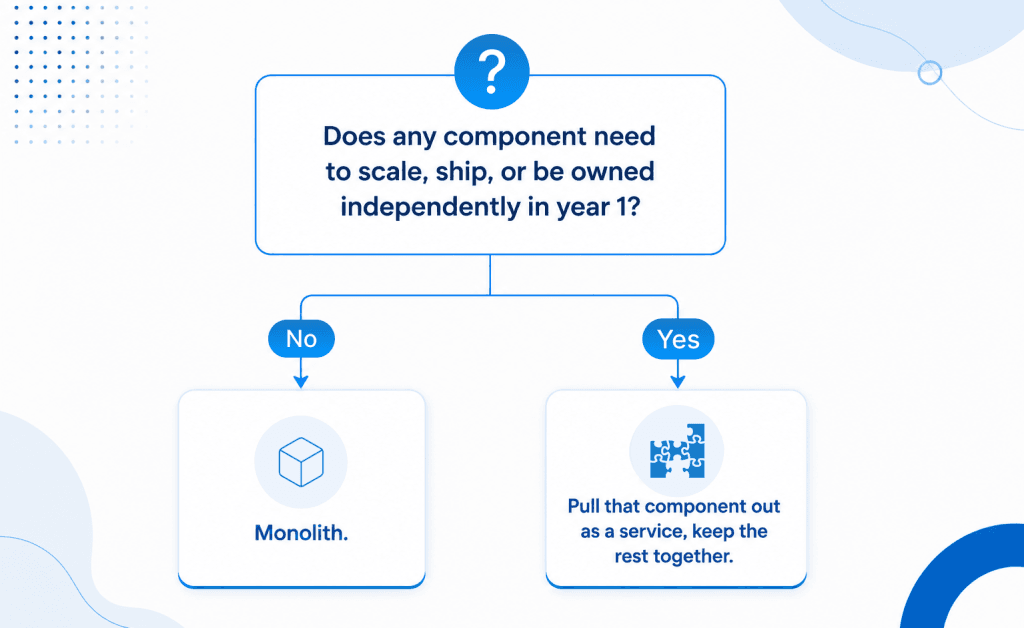
We ask one question before any other to settle the API first vs monolith MVP decision: what part of this system, if any, will need to scale, ship, or be owned independently of everything else in the first 12 months?
If the honest answer is “none of it, we just need to prove the product works,” the monolith wins. That isn’t a compromise—it’s simply the faster path to a product real users can react to. If the answer names a specific component, that component gets pulled out as a service and the rest stays together.
The mistake we see most often isn’t picking the wrong architecture; it’s picking an architecture before the product’s actual usage pattern is known. We’d rather ship a monolith in ten weeks and split it deliberately at Series A than spend six of those weeks building service boundaries for load that hasn’t arrived yet.
FAQ
Should a startup MVP use microservices?
Usually not on day one. A modular monolith provides clear internal boundaries without the deployment and debugging overhead that comes with managing multiple services.
What is a modular monolith?
It’s a single deployable application organized internally into clear domain modules — like authentication, billing, bookings, and CRM.
When does SynthWeb recommend an API-first architecture for an MVP?
When a specific component needs to scale independently, an external partner needs to consume a clean API right away, or separate engineering teams need to own different parts of the system.
Also Read: Inside Amuthi: Why We Built Booking, CRM, and Links as One Platform Instead of Three Tools