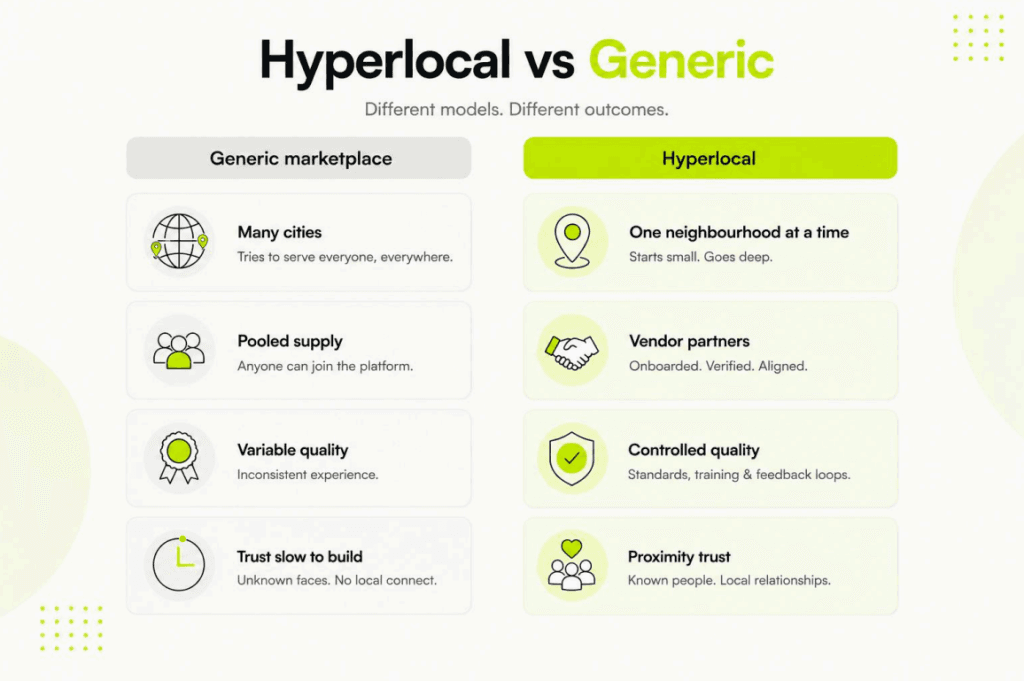
Hyperlocal app architecture vs generic marketplace was one of the first product decisions we faced when we started building Dhobi. We had two product models on the table. Model one: a generic service marketplace. One app, multiple cities, many service types, asset-light, grow fast. Customers search for a service, the marketplace matches them to the nearest available provider, the transaction happens, and the marketplace takes a cut. This is the Dunzo model, the Urban Company model, and the model that every VC-backed marketplace playbook recommends.
Model two: a hyperlocal operator network. One neighbourhood at a time. Deep relationships with a small number of local dhobi operators. Operations-first, quality-controlled, trust-first. Customers in a two-kilometer radius see only the operators in their area. The marketplace is small by design, at least initially.
We chose model two. This post explains why.
Hyperlocal App Architecture vs Generic Marketplace: Three Reasons We Chose Hyperlocal
Trust requires proximity.
Laundry is a high-trust service. Customers hand over clothes that are sometimes expensive, sometimes irreplaceable, sometimes sentimental. A generic marketplace where the assigned vendor changes with every order does not allow trust to accumulate, the customer never builds a relationship with the operator. A hyperlocal model, where a customer consistently uses the same operator in their neighbourhood, allows trust to develop over repeated interactions. The Dhobi user who has had three good experiences with the same operator is a retained customer. The user who had one transaction with three different operators is not.
Quality is controllable at small scale.
In a generic marketplace, quality is a lowest-common-denominator problem. If you have 500 vendors across 20 cities, you cannot onboard, train, and quality-control each one without a large operations team. The hyperlocal app architecture vs generic marketplace decision became especially important for Dhobi because it directly affected how consistently we could deliver service quality.
In a hyperlocal model, Dhobi can onboard five vendors in one neighbourhood, train them personally, quality-check their work, and expand to the next neighbourhood only when the first is running cleanly. This approach produces higher average quality at the cost of slower geographic expansion—and for a service that depends on repeat use, quality beats scale in the early stages..
Supply is localisable.
Local dhobi operators do not operate across the city. They operate in a two to five kilometer radius, have relationships with specific customers, and have capacity constraints that are neighbourhood-scale. A city-wide supply matching system tries to optimize something that is not a city-level problem. Hyperlocal supply matching reflects how the supply actually behaves.
The architecture implications
Geofenced supply.
Each customer sees only vendors within a configurable radius — currently two kilometers. The vendor-selection query filters by geographic proximity using PostGIS on the PostgreSQL database, not by city-wide availability. This is a different query architecture from a generic marketplace: the relevant unit of analysis is the neighbourhood, not the city.
Time-slot allocation per vendor.
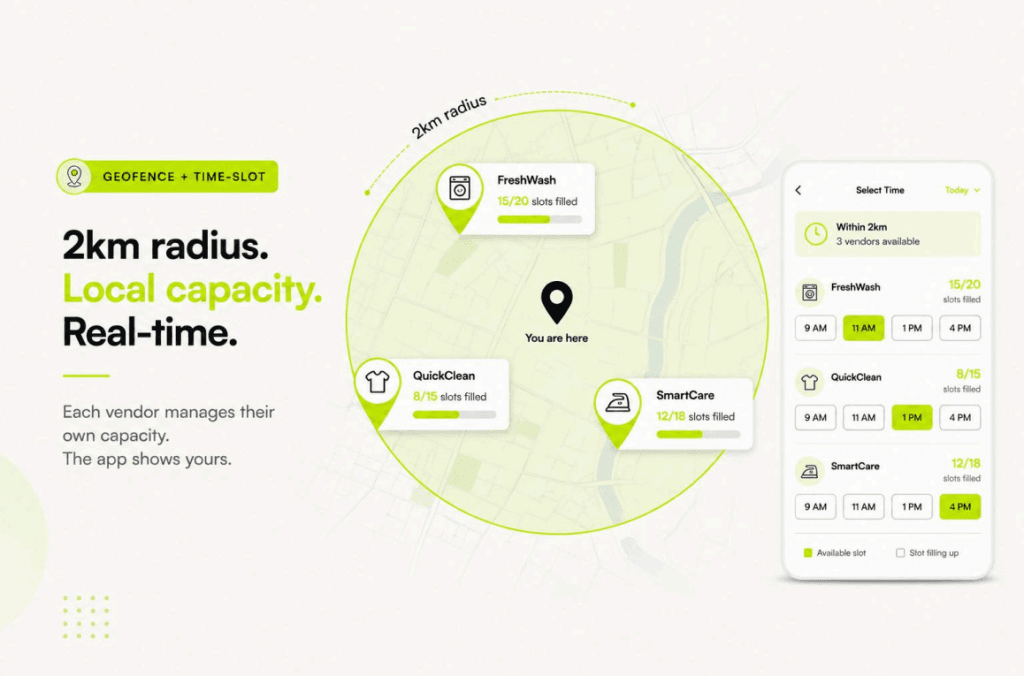
In a generic marketplace, capacity is pooled—the system assigns the next available provider regardless of which provider the customer had last time. The hyperlocal app architecture vs generic marketplace approach changes this logic entirely. In Dhobi, each vendor manages their own capacity: a maximum number of pickups per day, a schedule of available time slots, and the ability to block days. The time-slot allocation system is vendor-level, not platform-level.
A vendor with a capacity of 20 pickups per day and 18 slots already filled is shown as having “limited availability.” A vendor that has reached full capacity is marked as “unavailable.” Customers can only view and book vendors within their designated geofence, ensuring that capacity is managed at the neighbourhood level rather than across the entire platform.
Neighbourhood-scale order tracking.
Real-time order tracking in a two-kilometre radius means “your clothes are 400 metres away, arriving in 8 minutes.” The same tracking in a city-wide model means “your order is in transit, estimated delivery 2 hours.” The first is useful. The second is not. The tracking granularity that makes sense for hyperlocal does not make sense for generic.
FAQ
Is Dhobi available to use now?
Check current availability with our Growth Executive for the latest active areas and service status.
Can SynthWeb build hyperlocal apps for other service categories?
Yes, the hyperlocal architecture patterns (geofenced supply, vendor-level capacity, neighbourhood-scale tracking) transfer to any local service category. See /mvp-sprint for the starting point.
What cities and neighbourhood is Dhobi currently active in?
Confirm current coverage with our Growth Executive.
Also Read: What Investors Actually Look for in Your Engineering Velocity Before a Series A