Why software estimates go wrong is one of the biggest questions businesses ask before starting a development project. The average software project overruns its estimate by 50 to 80 percent on time and 30 to 60 percent on cost. The cause is not bad engineers—it is bad inputs. Estimates built on the wrong data produce the wrong numbers with high confidence. Over the last two years, 85 percent of SynthWeb’s fixed-price engagements delivered within the quoted range. The remaining 15 percent overran by one to two weeks, with the additional effort absorbed by SynthWeb. The difference is a structured scoping process that we run before every quote.
The 5 failure modes behind why software estimates go wrong
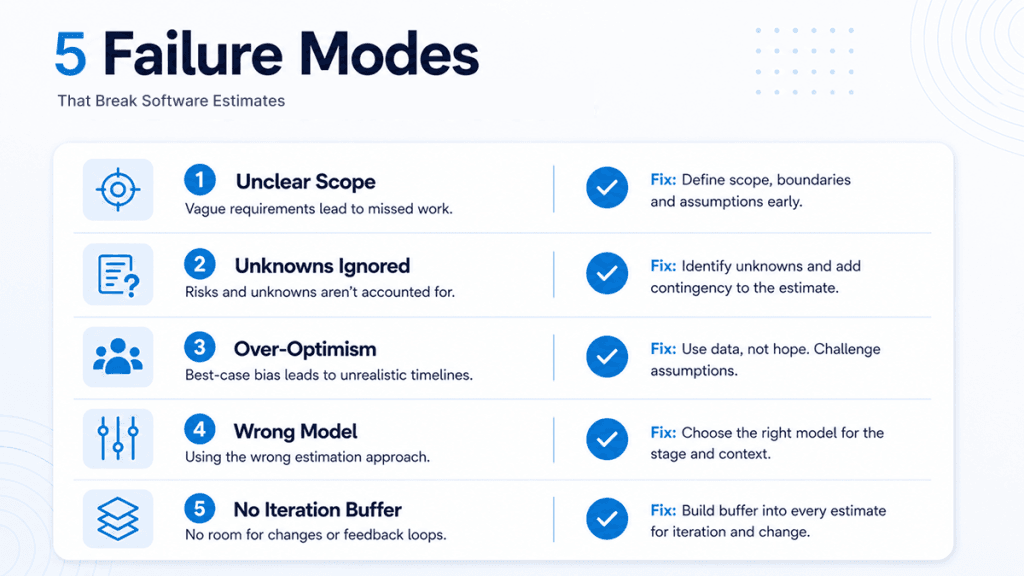
1. Estimating from a feature list instead of user flows.
“User authentication” is one feature on a list. It is also nine to twelve discrete engineering tasks: registration form, email verification flow, login form, password reset flow, OAuth integration, session management, token refresh logic, logout handling, and rate limiting on login attempts. A feature list generates estimates on the surface area. A user flow decomposition generates estimates on the actual work. This task-by-task estimation approach is also recommended in Software Estimation: Demystifying the Black Art by Steve McConnell, which emphasizes breaking large features into smaller, measurable units before estimating effort. We never quote from a feature list.
2. Ignoring integration edge cases.
The happy path of an integration—the API call that works, the webhook that fires, the payment that succeeds—is fast to build. The edge cases are slow: the API that times out after 3 seconds, the webhook that arrives twice, the payment that fails mid-flow and leaves the user in an ambiguous state. Every integration requires a list of edge cases before it can be estimated. Ignoring these scenarios is one of the biggest reasons why software estimates go wrong. A quote that covers only the happy path and ignores the edge cases is a quote that will almost certainly overrun.
3. Assuming requirements are clear from day one.
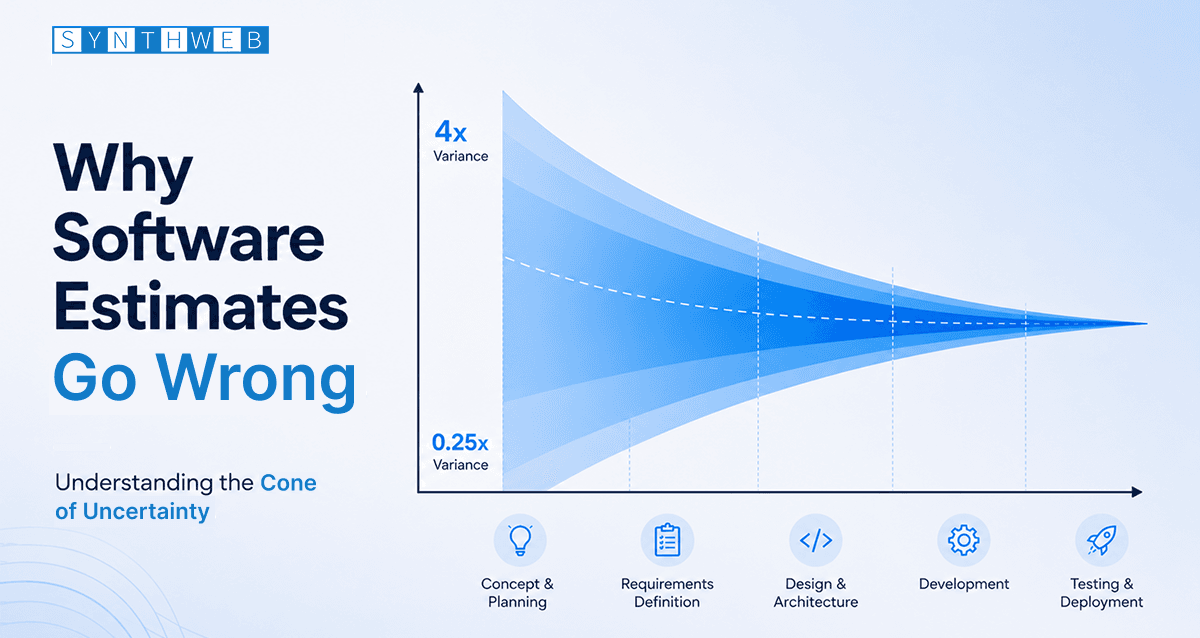
Steve McConnell’s Cone of Uncertainty shows that early-stage estimates have a four times variance—an estimate of $40,000 at the requirements-gathering stage has a realistic range of $20,000 to $80,000. This uncertainty is one of the primary reasons why software estimates go wrong when teams commit to fixed budgets before the scope is fully understood. SynthWeb quotes in phases to reflect this: the discovery phase is fixed-price (we know exactly what it costs to understand the scope). The build phase is quoted after discovery, when the scope is understood, with a plus or minus 20 percent band. The launch phase is quoted after the build. Each phase reduces the uncertainty before the next commitment.
4. Testing not in the budget.
Testing consistently represents 20 to 30 percent of total engineering effort on a well-built product. Junior engineers and vendors under cost pressure consistently underestimate or exclude this. An MVP Sprint estimate at SynthWeb has testing built into every feature estimate — not as a separate line item but as part of the effort for that feature. This is why SynthWeb estimates look higher than some vendors and deliver within range while lower estimates overrun.
5. Optimism bias.
Engineers estimate the happy path, the familiar technology, and the straightforward implementation. Anything unfamiliar often gets estimated as if it were familiar. SynthWeb applies a 1.3× multiplier to effort estimates for familiar technologies and a 1.5× multiplier for new frameworks, unfamiliar integrations, or regulatory compliance work. Understanding why software estimates go wrong requires recognizing optimism bias, which causes teams to underestimate real-world complexity during planning. This is not contingency—it is a calibration of what experience says the work actually takes versus what engineers initially estimate.
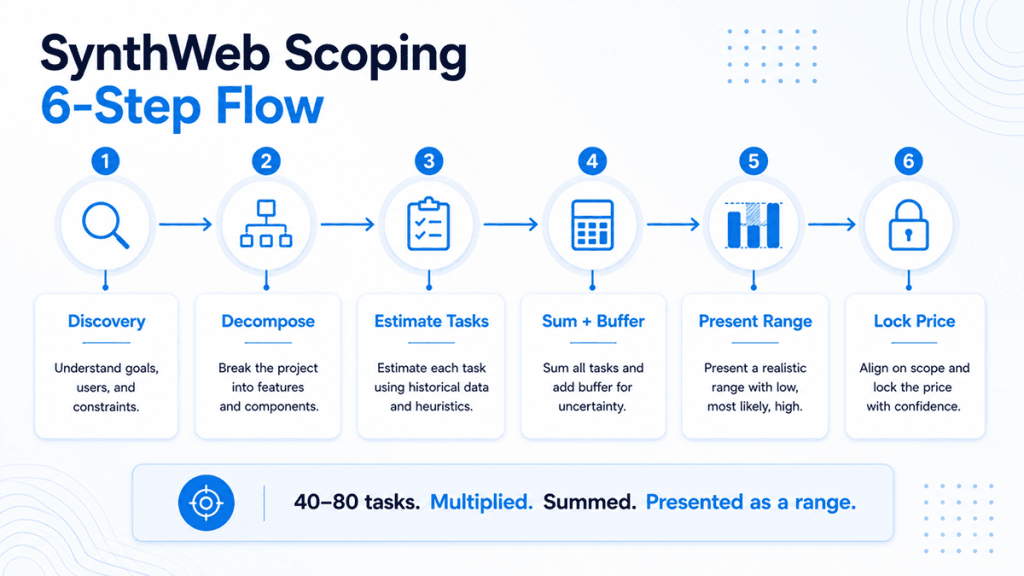
The SynthWeb Scoping Process: 6 Steps
Step 1:
Discovery sessions, 3 to 4 hours total. We map user flows, not features. Every user type, every journey, every decision point.
Step 2:
Decompose each user flow into discrete engineering tasks. A typical MVP produces 40 to 80 tasks.
Step 3:
Estimate each task individually, applying the appropriate multiplier (1.0x for standard patterns, 1.3x for familiar but non-trivial work, 1.5x for integrations and compliance).
Step 4:
Sum tasks, add integration estimates, add testing budget (25 percent of build effort).
Step 5:
Present as a range (e.g., $35,000 to $42,000) with a written scope document. The range reflects the remaining uncertainty after discovery.
Step 6:
On fixed-price engagements, lock the price at the top of the range. The margin in the top of the range is SynthWeb’s insurance on the remaining uncertainty, not additional profit.
FAQ
Why a range instead of a single number?
A single number is a lie that sounds confident. A range is the honest answer, and it tells you what the vendor is and is not certain about.
What if the project comes in under the estimate?
On fixed-price, SynthWeb keeps the margin — this is the contract. On T&M, the client pays actuals.
How do you verify the 85% on-time delivery claim?
Our delivery team tracks this per engagement. If you want to verify, ask for references from recent engagements — we will provide them.
Also Read:
Cloud Costs Nobody Budgets For: What a Real AWS Bill Looks Like in Year 1