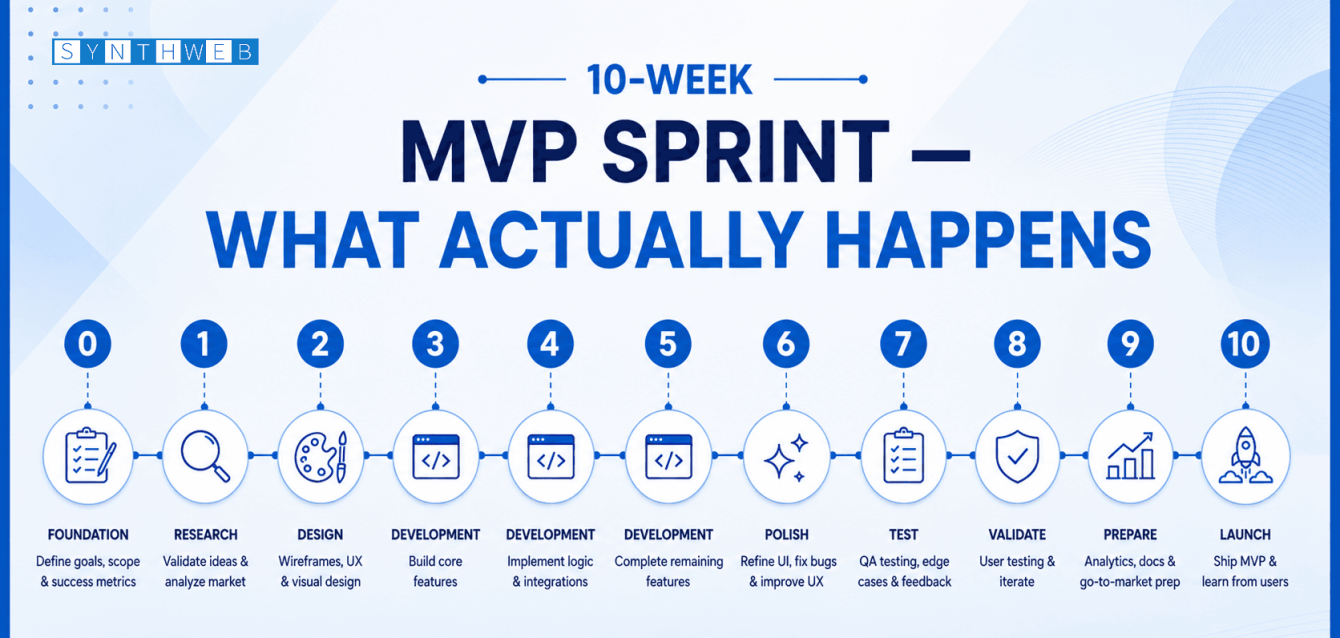
Most agencies promise a 10-week build, but few can explain what happens in every phase. Our 10 Week MVP Development Process is fully transparent—from planning and design to development, testing, and launch—so you know exactly what happens in week 4 and every week after. We can. This post walks through exactly what each of the ten weeks of a SynthWeb MVP Sprint looks like — what gets built, who is involved, what you should expect to receive, and where the typical points of friction sit. If you are a funded founder evaluating MVP partners, this is the level of process transparency you should demand from anyone pitching you a fixed-scope build.
The MVP Sprint is a $28,000 to $45,000 fixed-price engagement that delivers a v1 your funded round survives. Three slots per quarter. No discovery phase that bills for itself, no scope creep that doubles your timeline, no surprise change orders. You sign on Friday, we start on Monday.
Week 0 — Pre-kickoff in the MPV Build Timeline (the week before week 1)
The 10 week mvp development process begins with the week between contract signing and engineering kickoff is reserved for three things: legal paperwork (MSA, NDA, IP assignment), repository and infrastructure setup under your accounts, and onboarding our engineers to your existing materials — Figma files, brand assets, any prior research, competitor analyses, and any technical decisions you have already made. By Friday of week 0, the engagement lead has built a project brief that gets approved by you before sprint zero starts.
Week 1 — Discovery and architecture
The first week of the 10 week mvp development process begins with three to four 60-minute discovery sessions with you and your team. We map user flows, identify the must-have features (typically 8–12 for a credible MVP, never more), document the constraints (regulatory, payment, compliance), and propose the technical architecture. Deliverable at the end of week 1: a one-page architecture decision record listing stack choices, hosting model, third-party services, and identified risks. You approve before week 2 begins.
Week 2 — Design system and clickable prototype
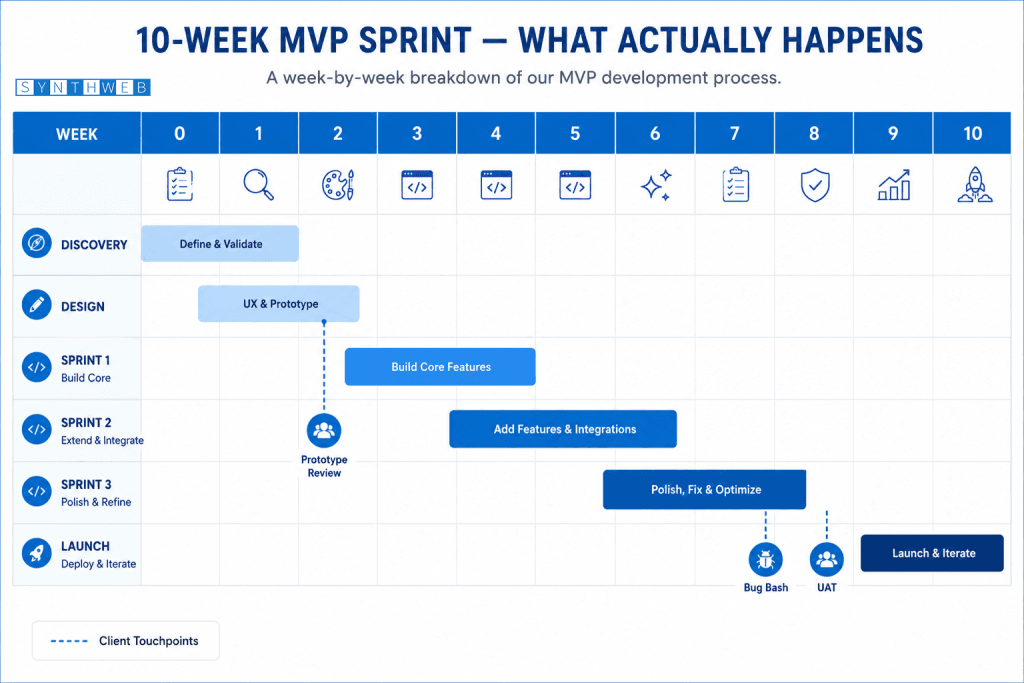
Our UI/UX designer builds the design system (colors, typography, spacing, component library) and a clickable Figma prototype of the 8–12 must-have screens. You walk through the prototype with us in a single 90-minute session at end of week 2 of the 10 week mvp development process. Major changes happen here — pixel-level changes happen later, structural changes happen now. Deliverable: approved Figma file ready for build.
Weeks 3–4 — Sprint 1, the foundation
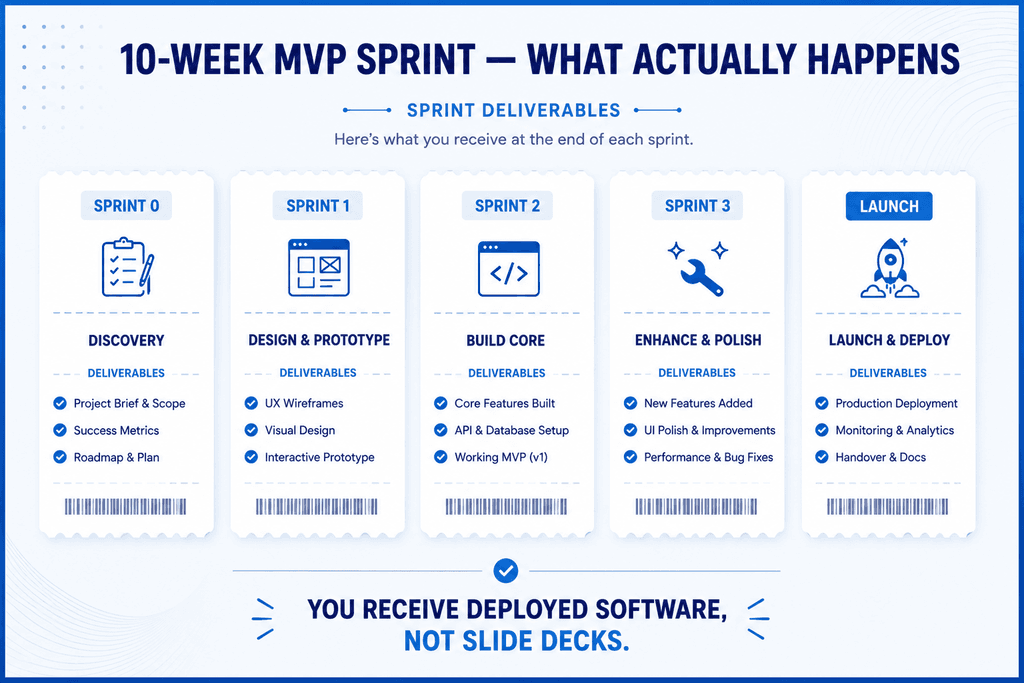
Engineering kicks off in earnest. Sprint 1 covers authentication, database schema, the deployment pipeline, and the first 2–3 screens. You see deployed software at the end of week 4 of the 10 week mvp development process — not screenshots, not videos, deployed software you can log into on your phone. Daily 15-minute standups via Slack huddle. Weekly 45-minute sync with your engagement lead.
Weeks 5–6 — Sprint 2, the core build
The bulk of feature development. We typically build 6–8 of the 8–12 must-have features in this two-week window. End of week 6: the product is functionally complete for 70% of the planned scope, deployable to a staging environment, and you can run it through end-to-end happy paths. This is the week most founders realise the MVP is going to ship.
Weeks 7–8 — Sprint 3, polish and integrations
Remaining features, third-party integrations (Stripe billing, analytics, transactional email, anything customer-facing), and the first round of QA. Bug bash on Friday of week 8 of the 10 week mvp development process — the entire SynthWeb team plus you and any of your team you nominate spends 90 minutes trying to break things. Bugs get triaged into “fix before launch” and “post-launch backlog.”
Week 9 — UAT and launch preparation
In the 10 week mvp development process, this week tests user acceptance with you and 5–10 friendly testers you supply (existing users, design partners, advisors). We fix priority bugs as they come in. Production environment provisioning, domain DNS, app store submission if mobile, email infrastructure setup, monitoring and alerting. All the pre-launch infrastructure that founders forget about.
Week 10 — Launch
In the last week in 10 week mvp development process, soft launch on Monday — limited rollout to your initial user base, monitoring closely. By Wednesday, full launch. Engineering team on standby for 5 working days for any post-launch fires. Friday of week 10: handover meeting, retrospective, knowledge transfer document, and the MVP-to-Pod conversation.
About 40–50% of MVP Sprint clients convert to a 3-month Engineering Pod at this point. The conversation is built into week 8, not surprise-pitched at the end. You get our pricing for ongoing support before you decide.
Where MVP Sprints fail (and how we prevent it)
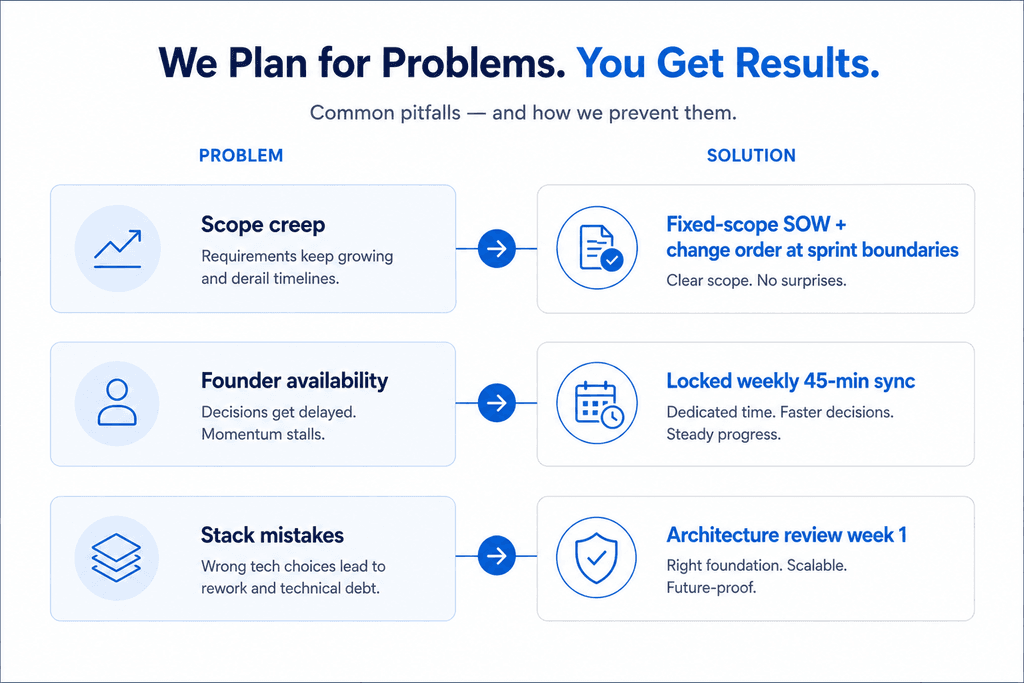
Three failure modes account for 90% of missed MVP timelines across the industry. Scope creep — solved by the fixed-scope SOW and the structural decision to do scope changes only at sprint boundaries via written change order. Founder availability — solved by lock-in of weekly 45-minute syncs at engagement start, with a documented escalation path if you go silent. Stack mistakes — solved by the architecture review at end of week 1, where we name our reasons for every technology choice.
Reference: Lean Startup Methodology
FAQ
What if our scope changes mid-engagement? Change orders happen at sprint boundaries. We quote the time and cost. You decide.
Can we add features after week 4? Only at the end of week 6 or week 8 sprint boundaries, and only if it fits in the remaining time. Otherwise it goes into post-launch backlog.
What if we want to extend into a 12-week build instead of 10? Quoted at engagement start as a price band. The 10-week scope is the standard offer; extensions are common.
Read More: Vibe Coding: The Powerful AI Shift Transforming Programming