Beyond Chatbots: How Autonomous Agents are Redefining Productivity and Strategy in 2026

For the past few years, the world has been captivated by Generative AI. We’ve marveled at its ability to draft emails, create art, and write code. However, as we move through 2026, a new titan has emerged : Agentic AI .
While Generative AI is reactive, waiting for your prompt to produce an output—Agentic AI is proactive. It doesn’t just “talk” about a task; it plans, executes, and adapts to complete it.
What is Agentic AI?
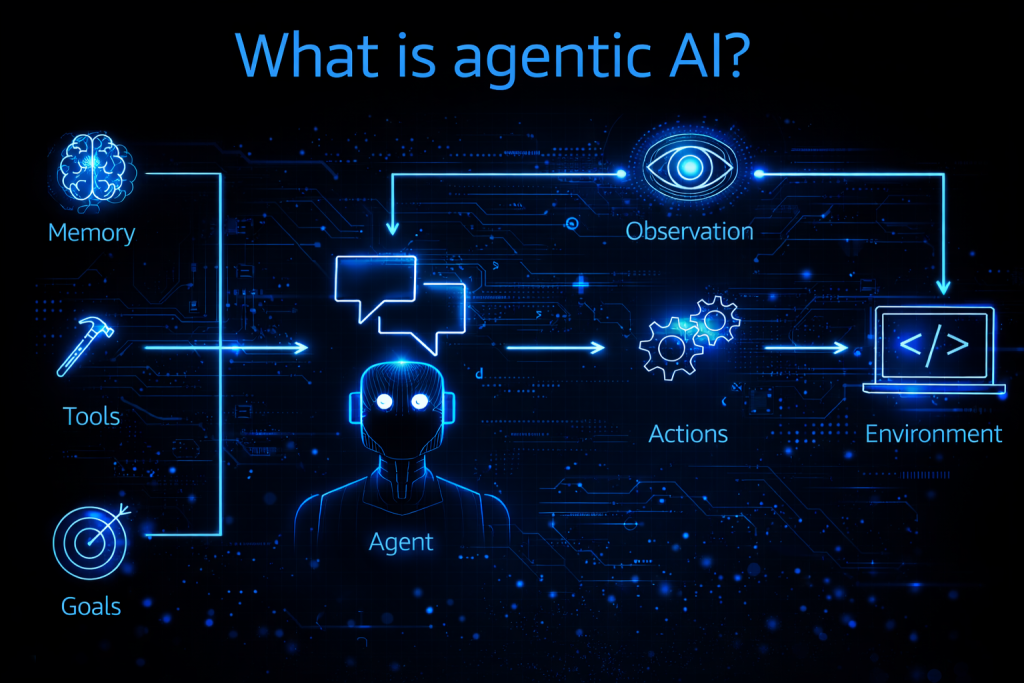
Agentic AI refers to artificial intelligence systems designed with agency. These systems use Large Language Models (LLMs) as a “brain” to orchestrate a series of actions across different software tools to achieve a high-level goal.
Unlike a standard chatbot, an Agentic AI system can:
- Reason: Break a complex goal into smaller, actionable steps.
- Use Tools: Access APIs, browse the web, or edit files autonomously.
- Self-Correct: If a specific step fails, the agent observes the error and tries a different approach.
The transition to agentic workflows represents a fundamental change in how we interact with technology. Traditional software requires a human to click every button and navigate every menu. Generative AI improved this by automating the creation of content within those steps. However, Agentic AI removes the friction of navigation entirely. By utilizing reasoning loops—often referred to as Chain of Thought processing—these agents can perceive their environment, evaluate the success of their previous actions, and pivot their strategy without a human having to re-prompt them. This “closed-loop” system transforms AI from a digital encyclopedia into a functional digital employee.
Agentic AI vs. Generative AI: The Core Differences
Understanding the distinction is vital for any modern digital strategy.
| Feature | Generative AI | Agentic AI |
| Nature | Reactive (responds to prompts) | Proactive (pursues goals) |
| Output | Static content (text, image) | Dynamic action & task completion |
| Workflow | Single-turn interaction | Multi-step autonomous loops |
| Autonomy | Low (requires human oversight) | High (minimal supervision) |
Why Agentic AI is the Future of Business
The shift toward agentic systems is more than a technical upgrade; it’s an operational revolution. By 2026, industry experts predict that nearly 15% of daily work decisions will be made autonomously by these systems.
1. Hyper-Efficiency in Workflows
In the past, a marketing manager might use AI to write an ad. With Agentic AI, the agent can write the ad, log into the ad manager, set the budget, monitor the click-through rate, and adjust the bidding strategy in real-time without being told.
2. Scaling Human Expertise
Agentic systems act as “force multipliers.” In software development, agents can now handle bug fixes, documentation, and unit testing simultaneously, allowing engineers to focus on high-level architecture rather than repetitive syntax.
3. Real-Time Problem Solving
Whether it’s a supply chain disruption or a cybersecurity threat, Agentic AI doesn’t just alert a human; it initiates mitigation protocols. It can reroute shipments or isolate compromised servers instantly, saving companies millions in potential downtime.
Implementation: The Three Pillars of Success
To successfully integrate Agentic AI, organizations must focus on:
- Data Readiness: Agents need high-quality, searchable data to make informed decisions.
- Governance: Establishing “human-in-the-loop” checkpoints ensures that autonomous actions remain within ethical and legal boundaries.
- Infrastructure: Moving away from legacy systems toward API-first architectures that allow agents to “talk” to your existing software stack.
Final Thoughts
Agentic AI is moving us from the era of “AI as a tool” to “AI as a teammate.” As these systems become more sophisticated, the competitive advantage will go to those who can effectively orchestrate these digital agents to handle the complexity of modern business.
The question is no longer “What can AI write for you?” but rather, “What can your AI agents achieve for you today?”
Are you ready to move from prompting to delegating?
Also read GEMMA4