AI workflow automation is the bridge between “having technology” and “having results.“
Imagine spending $200,000 on a state-of-the-art GPS system for your entire delivery fleet — then printing out the directions and handing them to drivers on paper. The technology is real. The investment is real. But the results? Nowhere to be found.
That is exactly what most businesses are doing with AI right now. They are investing in tools, but they are ignoring the necessity of a structured AI workflow automation strategy.
In 2025, companies poured an estimated $30-40 billion into AI tools, dashboards, and platforms. Yet according to MIT’s NANDA initiative, 95% of those pilots delivered zero measurable ROI (MIT NANDA, 2025). S&P Global found that 42% of companies abandoned most AI projects in 2025, up from just 17% the year before.
This is not a technology problem. It is an architecture problem. Businesses are buying AI tools. They are not building AI workflow automation systems.
What Does “AI Without Workflow” Actually Mean?
An AI tool gives you information. An AI workflow automation system acts on it.
When AI is deployed without an integrated process — no data flow, no decision triggers, no automated actions — it becomes an expensive dashboard that still requires humans to do all the work. Real AI value only materializes when the tool is embedded inside an end-to-end operational workflow that eliminates manual steps and makes decisions at scale.
Why Most Businesses Fail After Implementing AI
- They Bought a Tool, Not a Process : The most common mistake: a team subscribes to an AI tool, runs a few demos, and calls it “implementation.” A tool sitting outside your operations is just a glorified interface. Without AI workflow automation, nothing scales.
- No Data Flow Between Departments : AI is only as powerful as the data feeding it. When your CRM, marketing platform, and finance data live in separate silos, your AI sees fragments—not the full picture. According to Salesforce, 54% of businesses cannot even map their own processes clearly enough to automate them.
- AI Has No Decision Authority : Most AI implementations are stuck in advisory mode. They suggest. They predict. But they never do. Until you implement AI workflow automation that triggers real actions—sending the email, updating the record, routing the ticket—it stays passive.
AI Tools vs. AI Workflow Automation: The Difference
| AI Tool (Passive) | AI Workflow Automation (Active) |
| ChatGPT drafts your content | System generates, reviews, and publishes automatically |
| CRM shows a lead score | Lead scored → email triggered → follow-up scheduled |
| Dashboard shows low stock | AI predicts shortfall, triggers purchase order |
| Chatbot answers a question | Ticket classified, resolved, or escalated with full context |
What a Real AI Workflow Looks Like
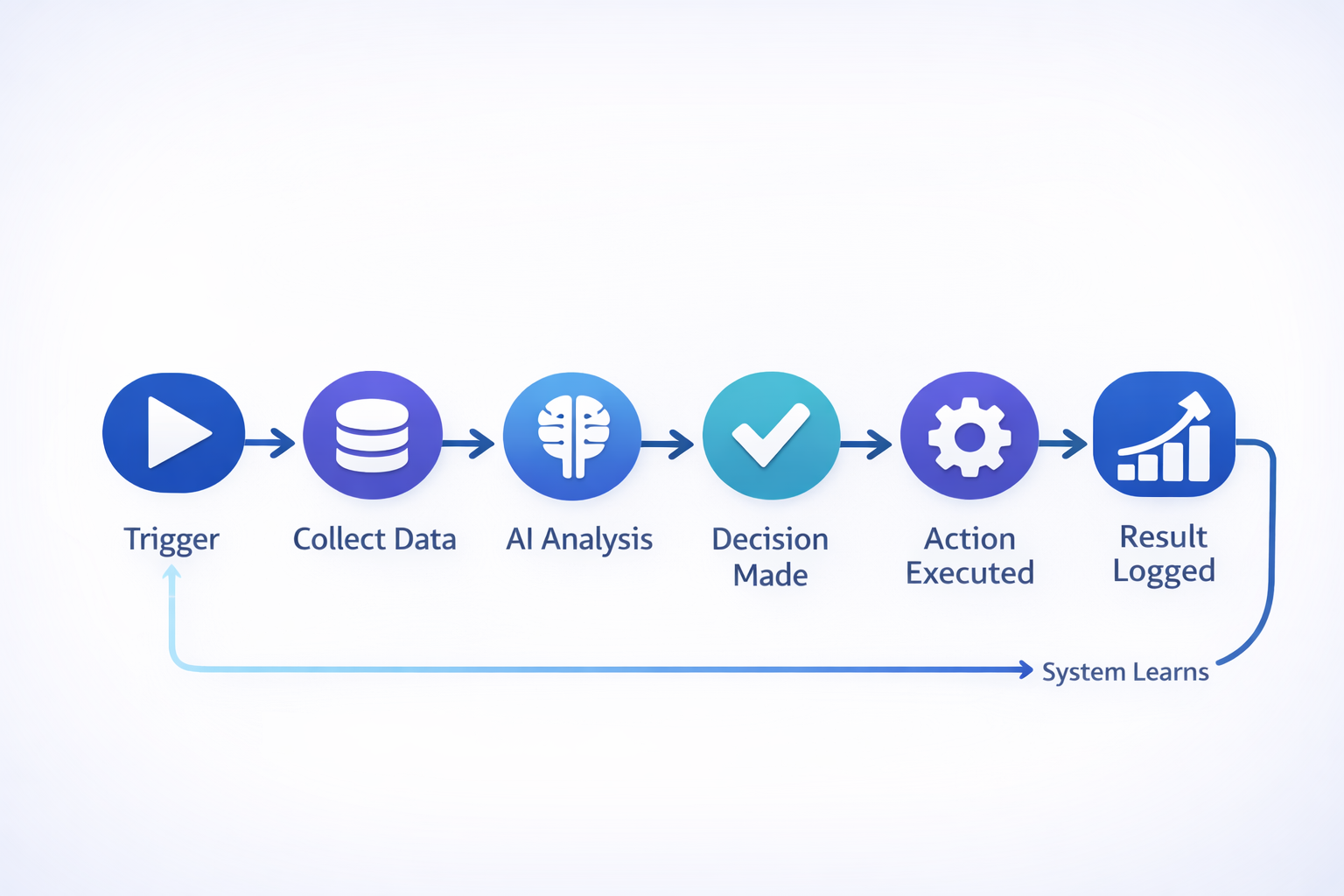
A genuine AI workflow automation sequence is a connected chain where every step feeds the next:
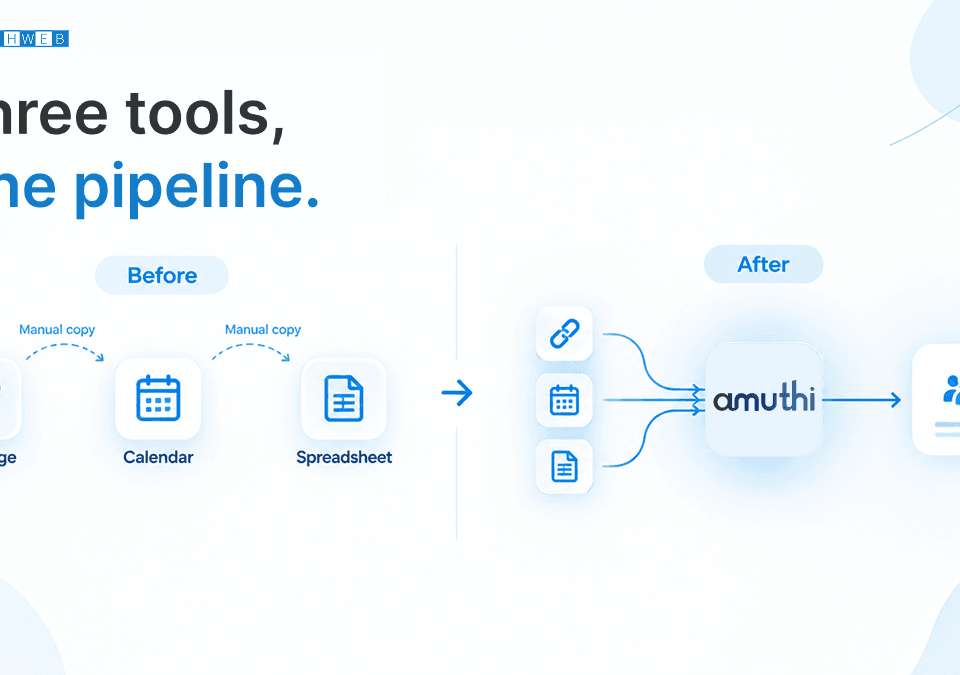
Trigger→ Collect Data → AI Analysis → Decision Made →Action Executed →Result Logged →System Learns
Each output becomes the input for the next stage. Over time, the system improves because feedback is built in—not bolted on as an afterthought.
How to Implement AI Workflow Automation: A 6-Step Framework
- Map your core processes: List every repeating operational sequence your team performs.
- Find the friction: Identify where humans are manually connecting systems.
- Structure your data: Ensure key systems are connected before adding AI.
- Define AI decision points: Start with low-risk decisions like lead scoring.
- Automate the action layer: Connect AI outputs directly to system-level actions.
- Monitor and refine: Track outcome metrics, not just activity metrics.
Frequently Asked Questions
What is AI workflow automation?
It is an automated sequence where AI collects data, makes a decision, and triggers a real business action without manual approval at every step.
Is ChatGPT an AI workflow?
No. ChatGPT is a tool. It generates outputs but cannot connect to your systems or take autonomous action without a larger AI workflow automation setup.
Why do AI projects fail?
Mainly because tools are deployed without process redesign. McKinsey found companies that redesign workflows before selecting AI tools are twice as likely to report significant financial returns.
How much does AI implementation cost?
Costs range from a few thousand dollars for a single workflow to $50,000+ for a full operational system. Forrester recorded a 248% three-year ROI for well-implemented automation.
The Bottom Line
Companies that treat AI as software will fall behind. Companies that treat AI as infrastructure will win. The question is not whether you have AI—it’s whether you have the AI workflow automation required to turn that intelligence into profit.
Sources: MIT NANDA (2025) | S&P Global (2025) | McKinsey State of AI (2025) | Forrester TEI Study (2024) | Salesforce Survey (2024)