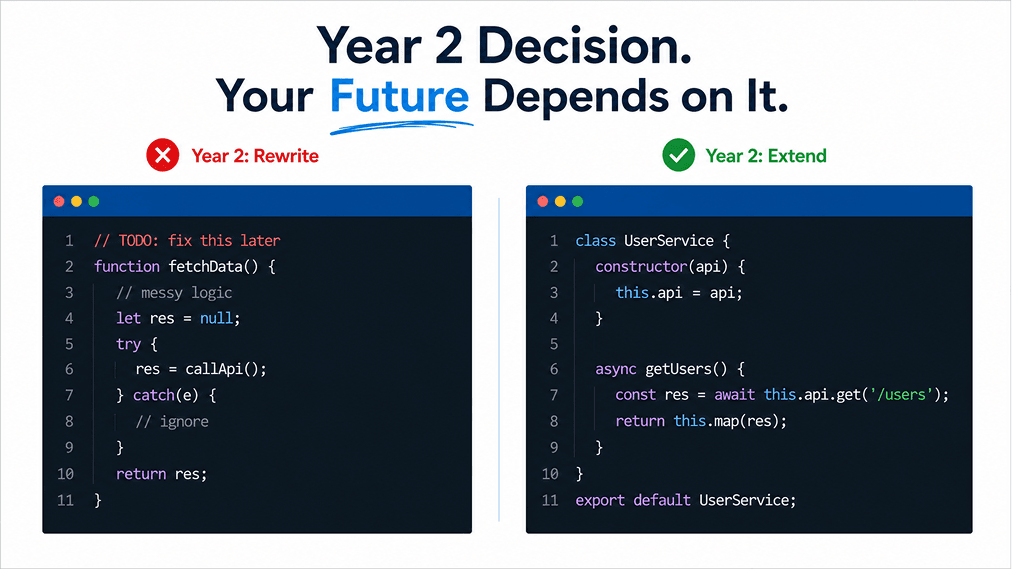
Technical debt MVP startup decisions made in the first two weeks of a build determine whether you face a rewrite at Series A or a clean technical audit.
Not all technical debt is created equal as Martin Fowler’s Technical Debt Quadrant frames it, the difference between prudent, deliberate trade-offs and reckless shortcuts is exactly what separates a manageable audit from a full rewrite.
Roughly half of all agency-built MVPs end up in a rewrite conversation by month 18. The pattern is predictable: you raise Series A, hire your first two in-house engineers, and they spend their first quarter telling you the codebase is unworkable.
New feature velocity drops to near zero while they rebuild what the agency shipped. This costs you three to six months of product roadmap and often $50,000 to $150,000 in engineering time on work that delivers no new user value. Every founder underestimates how fast this compounds; the choices that prevent it are made in the first two weeks, not after the fact.
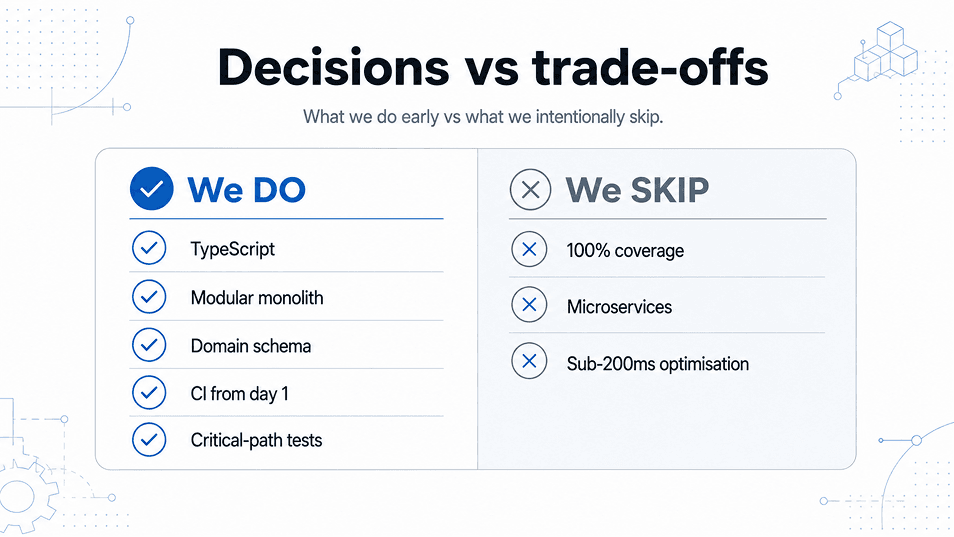
Technical Debt MVP Startup: The Three Deliberate Choices We Always Make
TypeScript everywhere.
The upfront cost is roughly 10 percent more development time. The return is a codebase that a new engineer can read in days rather than weeks, runtime bugs that are caught at compile time rather than in production, and refactoring that is safe because the type system tells you what breaks. Every SynthWeb MVP is TypeScript end-to-end. This is not optional on any engagement.
Modular monolith, not microservices.
A four-person engineering team does not have the coordination problems that justify microservices. What they have is the infrastructure overhead, the distributed tracing cost, and the network resilience requirements without the scale that would make those costs worthwhile. We build modular monoliths: a single deployable with enforced internal module boundaries. Each module has a public interface. ESLint rules prevent cross-module imports of private files. If a module ever needs to scale independently, the boundary becomes a service boundary. The refactor is clean. The Torus build has run on this architecture for 14 months without a rewrite.
Domain-model database schema, not UI-driven schema.
The most common cause of schema rewrites is building the database to match the UI instead of the domain. When the UI changes and it always changes the schema breaks. We design the schema to reflect the business domain: entities, relationships, and the queries the product actually needs to run. Screen layout does not drive table structure.
Technical Debt MVP Startup: The Three Conscious Trade-Offs We Skip
100% test coverage.
We write tests for business-critical paths authentication, payments, data writes, API contracts. We target 60 to 70 percent coverage on an MVP, not 100. Full coverage on an MVP doubles testing time and produces tests that mostly validate that a function does what it obviously does. Critical path coverage at 65 percent catches 90 percent of the bugs that matter.
Sub-200ms performance optimisation.
If a page loads in under 2 seconds, we move on. We do not optimise further unless user feedback or analytics identifies a specific performance problem. Pre-optimising adds complexity without evidence of need.
Premature infrastructure abstraction.
We do not add Kubernetes, a service mesh, or a message broker to a product with 500 users. The infrastructure grows with the product. Starting with a single container on ECS Fargate and a managed RDS instance is the right call for an MVP. Adding complexity before scale is the wrong call.
The 5-Question Technical Debt MVP Startup Risk Diagnostic
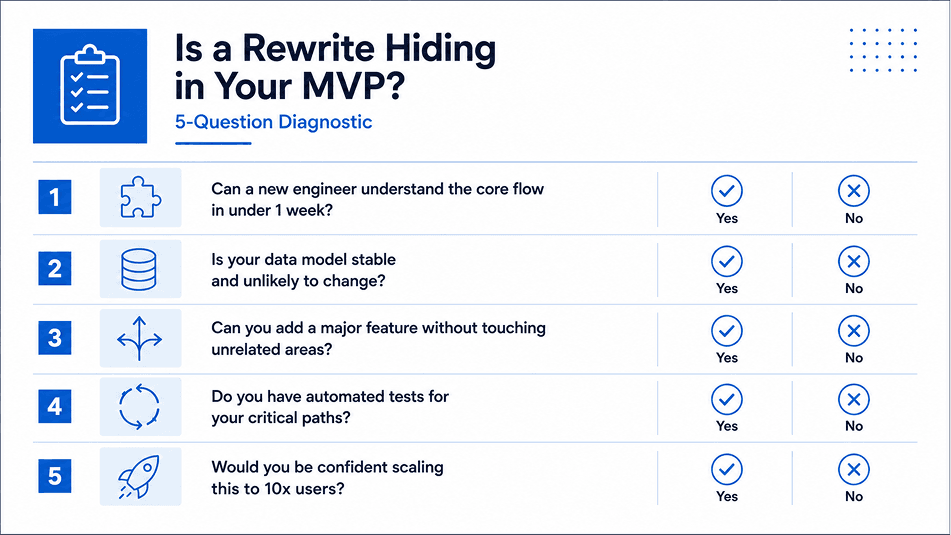
Before engaging any vendor, run these five questions against their previous work or their proposed approach: Does the codebase use TypeScript or type-safe equivalents throughout? Are modules separated with enforced boundaries? Are critical-path flows covered by automated tests? Is the database schema normalised and domain-driven? Is deployment reproducible from a single command? Three or more “no” answers means budget a significant refactor before any Series A technical due diligence. This diagnostic is the fastest way to catch technical debt mvp startup risk before it shows up in your engineering timeline.
FAQ
What triggers a rewrite vs a refactor? A refactor is cleaning up one layer usually the database schema, the API layer, or the test suite. A rewrite means the architecture itself is wrong: the data model is inverted, the modules are entangled, or the language choice makes everything slow. Rewrites take three to six months. Refactors take three to six weeks.
Does the Torus build still use the original architecture? Yes. The modular monolith and TypeScript stack we shipped in 2023 are still in production. New features are added to new modules. The schema has been extended but not rewritten. See /case-studies/torus/.
Does this approach cost more upfront? Approximately 10 to 15 percent more than a cut-corners MVP. The rewrite it prevents costs 10 to 20 times that in engineering time. Founders evaluating a technical debt MVP startup budget should treat this as insurance, not overhead the ROI on building it right the first time is not close.
Also Read:
10-Week MVP Build Process: What Actually Happens, Week by Week