In a first technical round, a hiring manager is rarely trying to establish whether a candidate has completed enough courses. The more useful question is whether the candidate demonstrates the capabilities expected of industry ready engineers when the problem is unfamiliar, the requirements are not perfectly defined and there is no tutorial telling them what to do next.
That distinction becomes clear quite quickly.Many bootcamp graduates arrive with a reasonable technical foundation. They may know a programming language, understand common development concepts and have projects they can discuss. What is harder to establish is how they work when that structure is removed.
Can they investigate a problem they have not seen before? Can they read an existing codebase? Can they explain why they chose one approach over another? Can they debug something without being given the solution?
These are the questions that tend to matter in an early technical hiring conversation.
Hiring experience at SynthWeb has made one gap particularly noticeable: the distance between learning how to build something and learning how to work through the problems that come with building and maintaining it.That is where the meaning of “industry-ready” needs to become more specific.
What hiring managers actually screen for
A first technical round is not simply a test of how much information a candidate can remember.
For an early-career engineering role, the conversation reveals more through the candidate’s approach to a problem. How do they break down an unfamiliar task? How do they investigate an error? How do they make a technical decision? Can they explain the reasoning behind it?
Technical fundamentals still matter. A candidate needs to understand the programming concepts, tools and technologies relevant to the role.But knowing something and being able to use it are different capabilities.
A candidate may know what an API is. That does not necessarily tell a hiring manager whether they can integrate an unfamiliar API, interpret an unexpected response or investigate why an implementation is failing.
A candidate may know Git. That does not necessarily tell you whether they can work safely in an existing repository.
A candidate may have built several applications. That does not necessarily tell you whether they can understand someone else’s code and make a change without creating another problem.
For industry ready engineers, these practical signals matter because real engineering work rarely arrives as a perfectly structured exercise.
Requirements change. Documentation can be incomplete. Existing systems can be unfamiliar. A solution that works in one situation may create a different problem somewhere else.The ability to work through that uncertainty is part of what hiring teams are trying to understand.
Where most bootcamp graduates fall short
The issue is not that bootcamps are ineffective. For many career switchers, structured learning provides an important foundation for becoming industry ready engineers. It introduces programming concepts, development tools and the knowledge required to begin building projects. The challenge comes when the learner moves from a controlled learning environment into a professional one.
In a course, the problem is usually already defined. The learner knows what they are expected to build. The technology may already be selected. Instructions are available, and feedback often comes quickly.Real work is different.
A junior developer may receive a requirement that needs clarification before implementation can begin. They may have to look through an unfamiliar codebase before deciding where to make a change. They may encounter an error that does not resemble anything they have previously worked on.
This is where differences between candidates become more visible.A candidate can have a polished project but struggle to explain the decisions behind it. Another may have a simpler project but be able to explain what went wrong during development, how the issue was investigated and why the approach was changed.
That second type of experience gives a hiring team something more useful to work with. It shows that the candidate has had to make decisions without being given every step in advance.
For a career switcher looking for tech jobs in India, this distinction matters. A career switcher is not expected to arrive with years of professional experience. But there needs to be a way to demonstrate that what has been learned can translate into practical work.
That is where the gap between a completed course and an industry-ready candidate becomes clearer.
The difference between learning technology and learning to work with it
Technical knowledge remains the foundation for industry ready engineers. A junior developer needs to understand programming, databases, APIs, version control and the other technologies relevant to the role. Practical exposure does not replace technical fundamentals. It changes how those fundamentals are applied. Consider two candidates who have completed similar coursework..
The first can explain a concept correctly and has followed a tutorial to build an application.
The second can explain the same concept but has also worked through an unexpected problem while building an application. The candidate had to inspect the issue, find relevant documentation, test possible solutions and explain the final decision.
That difference does not, by itself, determine who should be hired. But it demonstrates something course completion alone cannot: the ability to apply knowledge when the path is not predetermined.
This is also where the discussion around cohort based learning vs bootcamp needs some nuance.The format itself does not create job-readiness. A cohort can still be overly structured, and an individual course can still provide meaningful practical experience.
What matters is what learners are actually asked to do.
Do they make decisions? Do they work with constraints? Do they receive feedback and revise their work? Do they have to investigate problems instead of being shown the solution?
Those experiences are much closer to the conditions in which industry ready engineers eventually have to work.
What industry ready engineers actually demonstrate
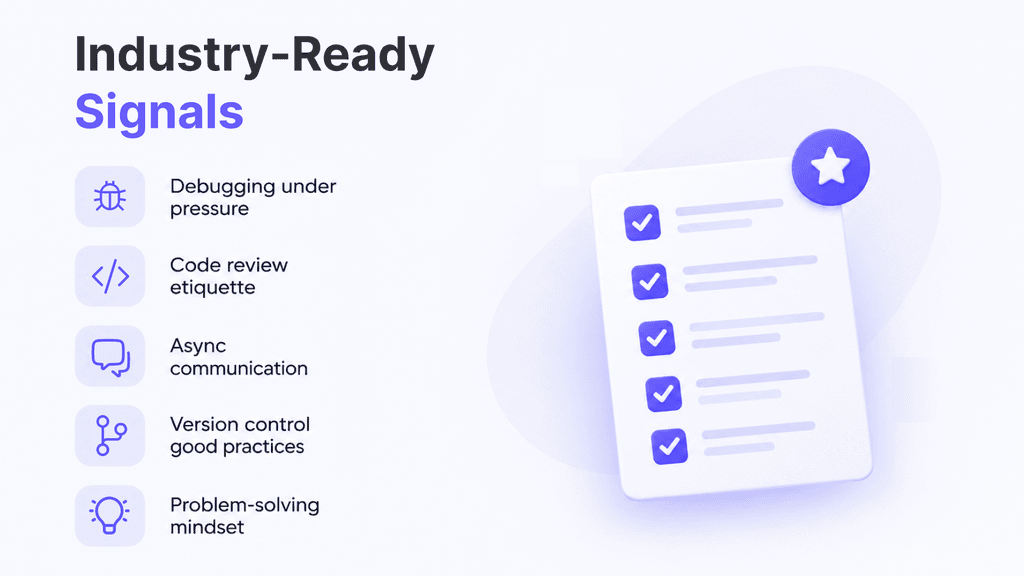
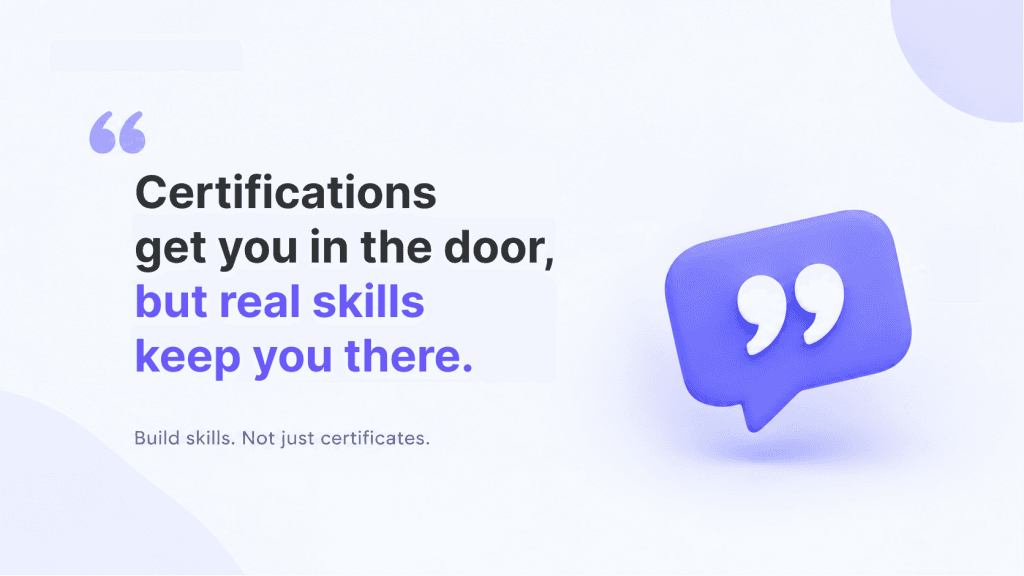
There is no single certificate, project count or course completion that makes someone industry-ready.For early-career engineers, readiness is better understood through a combination of technical foundation, practical application and professional behaviour.
Some of the signals hiring teams look for include:
Problem-solving: Can the candidate break an unfamiliar problem into smaller parts and decide where to begin?
Debugging: Can the candidate investigate why something is not working instead of immediately replacing the implementation?
Technical reasoning: Can the candidate explain why an approach was chosen and recognise its limitations?
Working with existing systems: Can the candidate read and modify code that they did not write themselves?
Communication: Can the candidate explain a technical issue clearly, ask useful questions and communicate when they are stuck?
Independent learning: When something unfamiliar comes up, can the candidate find the information needed and work through it?
Working within constraints: Can the candidate make sensible decisions when time, requirements or technical options are limited?
These capabilities are difficult to establish through certificates alone.They become visible through practice.That is an important distinction for anyone preparing to become one of the industry ready engineers companies need.
Why realistic practice changes the hiring conversation
There is a meaningful difference between asking someone to complete a project and asking them to work through a realistic engineering task. A project can demonstrate that a candidate has built something. A realistic task can show how the candidate thinks while building it.
Instead of giving a learner a complete specification and a clear sequence of steps, a task might involve an existing application, an incomplete requirement and a technical issue that needs investigation.
The learner has to decide what information matters, determine where to begin, make a change and explain the reasoning behind it.That process creates evidence.For hiring teams, evidence can be more useful than a long list of completed lessons.For candidates, it creates another benefit: they experience the nature of professional engineering work before entering their first role.
This matters particularly for career switchers. Someone moving into technology does not necessarily need to spend all their preparation time collecting more course certificates. They need opportunities to translate what they have learned into the behaviours expected in a professional environment.
That is how industry ready engineers are developed: through repeated opportunities to apply knowledge, make decisions and work through problems under realistic conditions.
What career switchers should assess before applying
Before applying for a junior engineering position, a career switcher should ask a more useful question than, “Have I completed enough courses?”
The better question is:
“What can I demonstrate that I can actually do?”
Can you take an unfamiliar task and decide how to approach it?
Can you work without a tutorial telling you what to do next?
Can you explain the decisions behind your project?
Can you debug something you did not build yourself?
Can you read documentation and work out how to use an unfamiliar tool?
Can you respond to feedback and change your implementation?
Can you explain a technical problem clearly to another person?
If some of these answers are uncertain, that does not mean you are not capable of becoming an engineer.
It tells you where your preparation needs to become more practical.
“Industry-ready” should not be treated as a label that someone either has or does not have. It is better understood as a collection of capabilities that can be developed, practised and demonstrated.
For candidates, that makes preparation more measurable. Instead of asking whether they feel ready, they can ask whether they have evidence for the capabilities a junior engineering role requires.
The gap companies can actually help close
There is also a role for companies in closing the gap between education and employment. Early-career candidates cannot reasonably be expected to have years of professional experience. At the same time, hiring teams need meaningful signals that a candidate can function beyond a classroom environment. That means creating better connections between learning and the practical capabilities expected of industry ready engineers.
Learning environments can incorporate realistic technical tasks. Employers can communicate expectations more clearly. Candidates can build portfolios that show their decisions, problem-solving and outcomes rather than simply displaying completed projects.
This creates a more useful connection between education and hiring.
It also changes the role of organisations working across that connection. A hiring partner pipeline in edtech becomes more meaningful when it is connected to the capabilities companies actually assess, rather than simply increasing the number of course completers entering the market.
The objective should not be to make candidates appear ready. It should be to help them become ready and give employers enough evidence to assess that readiness. That is a shared responsibility between learners, educators and industry.
From course completion to demonstrable capability
The technology industry will continue to change. Tools will change. Frameworks will change. The expectations placed on industry ready engineers will change as well. What remains important is the ability to learn, reason, solve problems and work through ambiguity.
That is why the distance between “I completed the course” and “I can contribute to a real engineering team” matters.
For career switchers, closing that distance does not necessarily mean collecting another certificate. It means creating more opportunities to practise the kind of work they are preparing to do.
For companies, it means looking beyond credentials and asking what evidence a candidate can provide for the capabilities the role actually requires.
That is a more useful definition of industry readiness.Not a certificate.Not a course-completion badge.Not the number of projects listed on a resume.Demonstrable ability to work through real problems is what makes the difference.
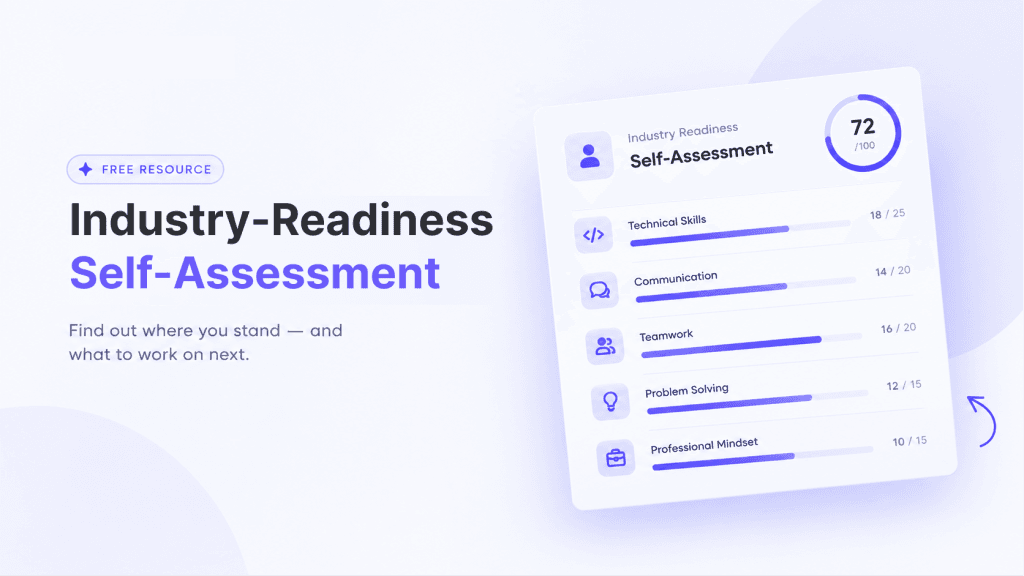
If you are a career switcher preparing for your first technology role, the Industry-Readiness Self-Assessment can help you evaluate where you currently stand across the capabilities companies look for before you start applying.
Take the Industry-Readiness Self-Assessment →
The assessment is designed to identify the areas that may need more practical work before entering the hiring process. From there, those who want to continue developing these capabilities can explore GrowthCraft.
Also Read:
Guwahati to the World: Why We Build From Northeast India and What It Changes About How We Work