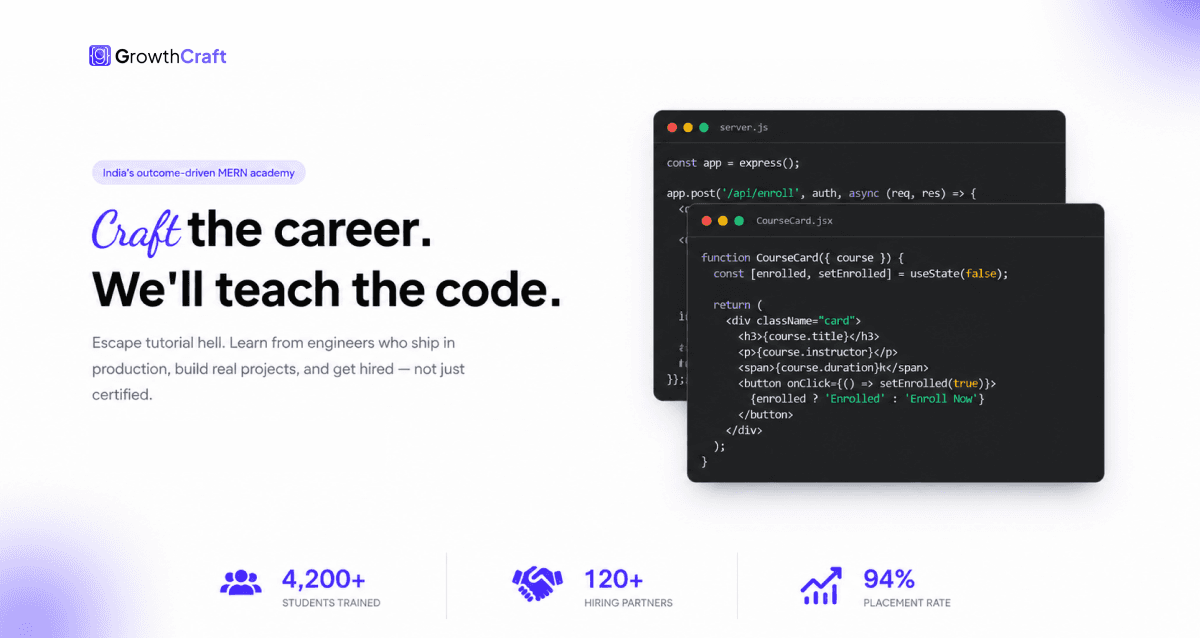
GrowthCraft launched publicly at SYNC’26 in August 2026, but the product decision that shaped it happened months earlier, when we decided to build a simulated work platform edtech product instead of another course library.
The edtech market for early-career skills is saturated with video courses and certificates. What it isn’t saturated with is a platform where a student actually does the work a job involves before they’re hired to do it. That became the starting point for GrowthCraft, a simulated work platform edtech product built around application rather than passive learning.
The product bet
A course teaches information. A simulation forces application.
GrowthCraft’s modules put a learner inside a realistic version of a real job task — writing a cold outreach sequence, scoping a technical estimate, or structuring a content calendar. Instead of simply watching a lesson and completing a quiz, the learner has to produce something while working within constraints and feedback that mirror what actually happens on a team.
The product bet is that a portfolio of completed simulated work is more credible to an employer than a completion certificate. It is also more useful to the learner because it is closer to the real thing: doing the work rather than simply learning about it.
That is what makes GrowthCraft different from a conventional course platform. As a simulated work platform edtech product, it is designed around the gap between knowing how something works and being able to actually perform the task.
The goal is not to remove learning from the process. It is to make the learning experience closer to the situations learners will encounter when they enter a real role.
What that meant technically
The product decision had direct architectural consequences.
A course library is mostly a content management and video delivery problem. A simulated-work platform is a state-machine and feedback-loop problem. Each module needs branching logic, evaluation criteria, and a way to score open-ended submissions rather than multiple-choice answers.
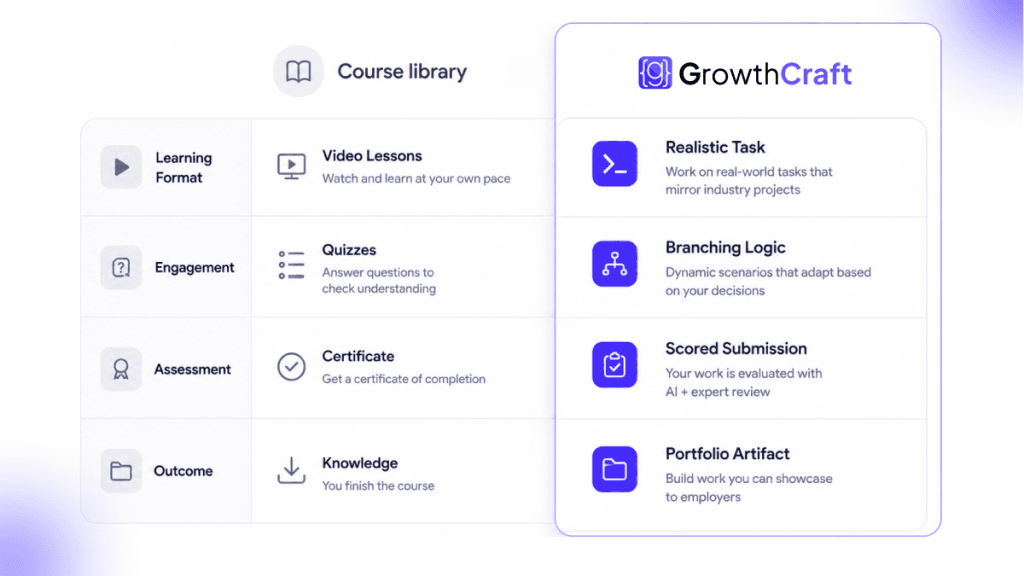
For GrowthCraft, that meant the platform needed to understand what stage a learner was in, what action they had taken, what should happen next, and how their submission should be evaluated.
We built this with a modular architecture that separates the simulation engine — module logic, branching, and scoring — from the content layer containing the actual scenarios. This allows new modules to be authored without changing the underlying platform code.
That separation was important because the scenarios will change and expand as the product grows, while the core mechanics of the simulated work platform edtech experience should remain stable.
The decision came directly out of our own experience building Amuthi’s modular monolith. That experience reinforced the value of separating concerns within a product instead of allowing different parts of the system to become tightly coupled.
Why we’re talking about our own build
We don’t usually publish case studies on products we own outright, because there’s no client permission question and it’s tempting to oversell.
We’re including GrowthCraft because the architecture decision — separating the simulation engine from the content — is the same category of decision we make on every client MVP.
The question is: what’s the platform, what’s the content that sits on top of it, and how do you keep those two things from becoming tangled together as the product grows?
For GrowthCraft, answering that question meant building the technical foundation around the actual product requirement rather than starting with the architecture and fitting the product into it.
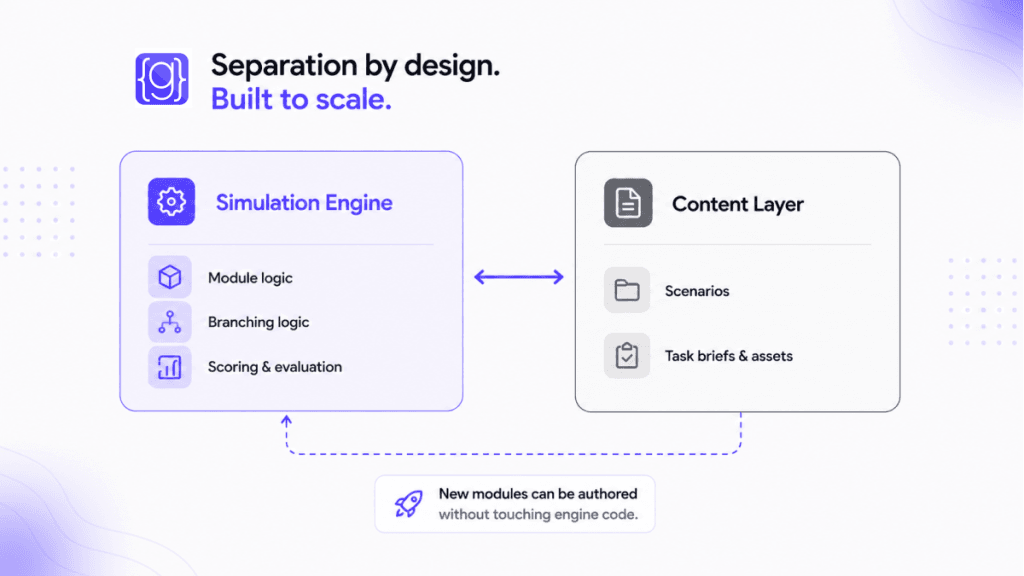
That is ultimately what shaped the GrowthCraft SynthWeb build: the product needed to simulate real work, so the architecture needed to support realistic tasks, branching, evaluation, and reusable content. It wasn’t a course library with simulations added later. The simulated work platform edtech model was the product decision from the beginning.
FAQ
What is GrowthCraft?
GrowthCraft is a simulated-work edtech platform built by SynthWeb, where learners complete realistic job-task simulations instead of watching video courses — launched publicly at SYNC’26 in August 2026.
How is GrowthCraft different from a normal online course platform?
It’s built around a simulation engine with branching logic and scored open-ended submissions, rather than video content and quizzes. The goal is applied work experience, not information delivery.
Is GrowthCraft available to try?
Confirm current availability and access with our team through the MVP Sprint page.
Also Read:
Why We Ran SYNC’26 as a Product Day, Not a Marketing Event