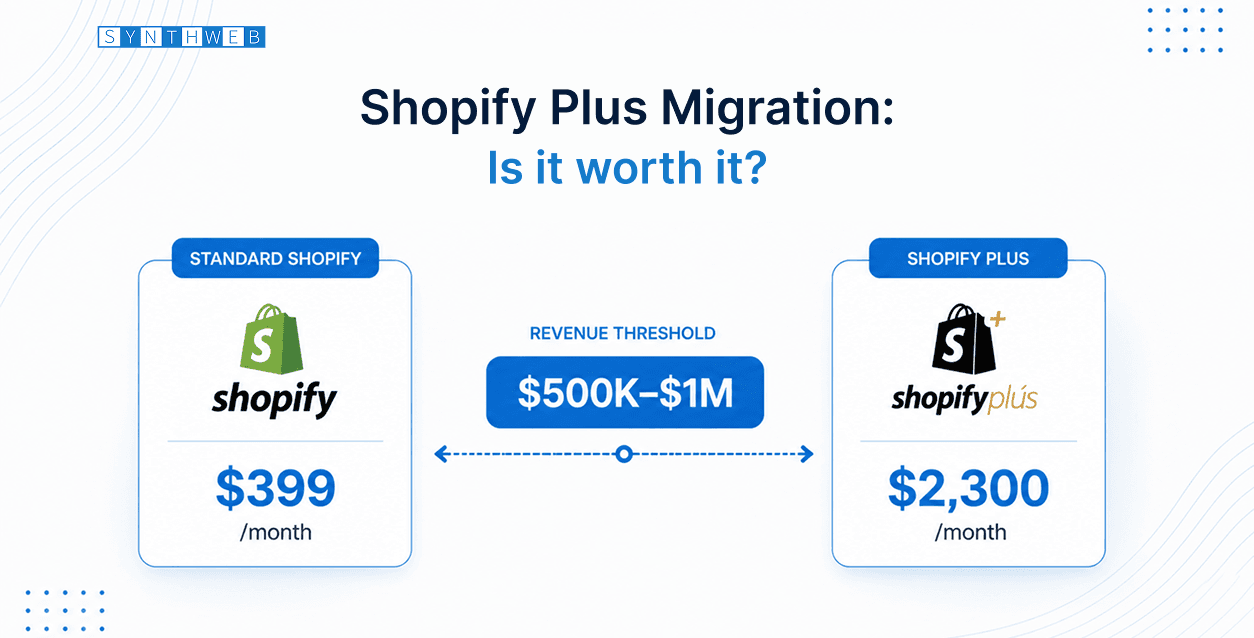
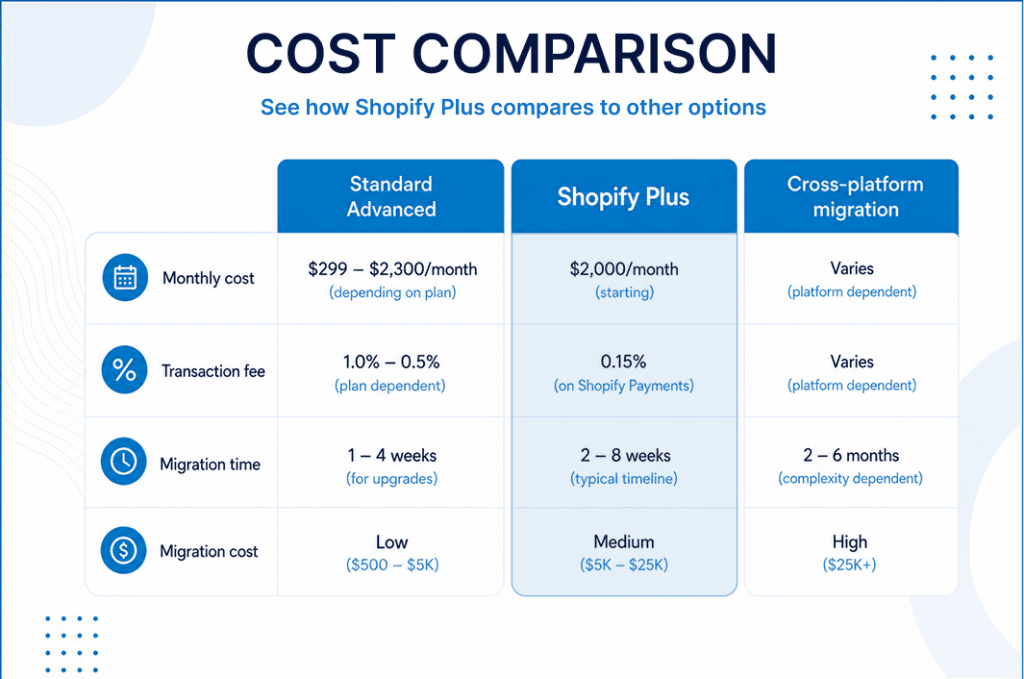
So, when is Shopify Plus migration worth it for an e-commerce business? That is the question every growing ecommerce brand eventually asks. Standard Shopify Advanced costs $399 per month, while Shopify Plus starts at $2,300 per month. You can review Shopify’s latest enterprise pricing on the official Shopify Plus Pricing page, a significant jump in platform costs. Instead of asking whether you should upgrade, the better question is when Shopify Plus pays for itself. Based on SynthWeb’s ecommerce projects, the answer is typically between $500,000 and $1 million in annual revenue, but only if several key business requirements justify the move.
One of the biggest questions ecommerce founders ask is whether Shopify Plus migration worth it depends on revenue alone. In reality, the decision should be based on a combination of annual sales, operational complexity, checkout requirements, and automation needs. Understanding these factors makes it much easier to decide whether upgrading will generate a measurable return on investment.
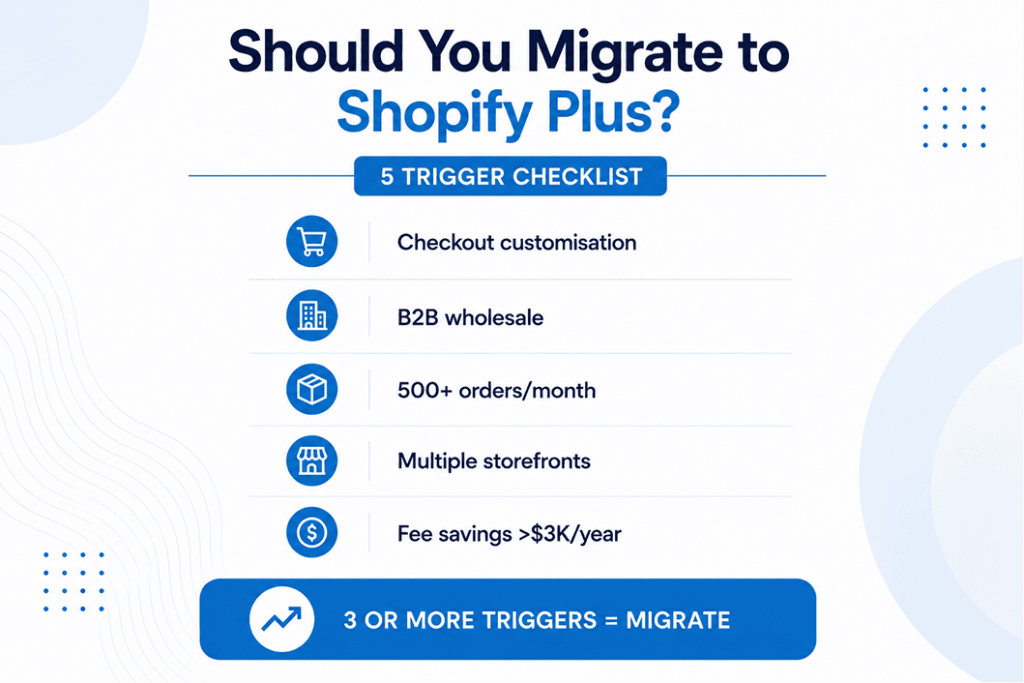
Shopify Plus Migration Worth It? 5 Feature Triggers That Justify the Upgrade
Checkout customisation via Checkout Extensibility. Standard Shopify locks the checkout template. You can add apps to the cart, but you cannot fundamentally alter the checkout flow, add custom fields, change the layout, or implement checkout experiments without Plus. If your conversion optimisation strategy requires anything beyond Shopify’s stock checkout, Plus is the only path. This is the single most commonly cited reason SynthWeb ecommerce clients migrate.
For businesses focused on conversion rate optimisation, Shopify Plus migration worth it becomes much easier to justify because advanced checkout customisation can directly improve customer experience and increase completed purchases.
B2B wholesale channels. Plus enables Shopify’s B2B features: company accounts, net payment terms (net 30, net 60), custom pricing per company, and draft orders with approval workflows. If you have wholesale buyers who buy in bulk at negotiated prices, the standard plan cannot serve them without complex workarounds. Plus does it natively.
Shopify Flow automation. At over 500 orders per month, repetitive tasks — tagging high-value customers, flagging suspicious orders, sending wholesale order confirmations, triggering fulfilment workflows consume 10 to 20 staff hours per week without automation. Shopify Flow (Plus-only) handles these with no-code rule builders. At $25 per hour for operations staff, 15 hours per week of saved time is $1,500 per month which covers most of the Plus premium.
Multiple storefronts. For brands managing multiple regions or customer segments, Shopify Plus migration worth it becomes much easier to justify because operational efficiency often offsets the higher monthly subscription cost. Shopify Plus allows up to 9 stores under one account at the base price. If you run separate regional stores, a B2C and B2B store side by side, or stores for distinct product lines, Plus consolidates these under one admin without paying separate platform fees. At three stores on standard Shopify Advanced, you are paying $1,197 per month more than Plus.
If your business operates multiple brands or international storefronts, Shopify Plus migration worth it often becomes clear because managing everything from one admin dashboard significantly reduces operational overhead.
Lower transaction fees. Shopify Payments on Plus charges 0.2 percent per transaction versus 0.5 percent on Advanced. At $1,000,000 annual revenue, that difference is $3,000 per year in saved fees. At $2,000,000 annual revenue, it is $6,000 per year. This rarely justifies the migration alone, but it contributes to the ROI calculation at scale.
When Is Shopify Plus Migration Not Worth It?
Under $500,000 in annual revenue and no B2B or checkout customisation requirements: the Advanced plan covers 95 percent of standard ecommerce functionality. Plus is headroom you are not using yet.
Conversion problems upstream of checkout: if your product pages are slow, your mobile experience is poor, or your trust signals are weak, Plus does not fix these. A Shopify Plus checkout with a 1.4-second mobile page load is still going to lose sales. Fix the upstream problems first (see our May posts on checkout optimisation and speed). Before investing in Shopify Plus, fix the upstream issues first. Our guide on Shopify Checkout Optimization: 7 Fixes That Increase Conversions explains where most brands lose sales before customers even reach checkout.
Cross-platform migration (WooCommerce to Plus) before stabilising on standard Shopify: migrating from WooCommerce or Magento directly to Shopify Plus doubles the risk. Migrate to standard Shopify first, run for three to six months, identify the platform gaps, and then upgrade to Plus with a clear understanding of what you need from it.
Shopify Plus Migration Cost and Timeline
Shopify-to-Shopify-Plus upgrade (same platform, just tier change): 2 to 4 weeks, $5,000 to $15,000 in agency fees for theme updates, app audits, and Checkout Extensibility implementation. Cross-platform migration (WooCommerce or Magento to Shopify Plus): 8 to 16 weeks, $15,000 to $50,000. This is SynthWeb’s Ecom Sprint at the upper end of scope a 6-week fixed-price engagement.
The biggest migration risk is SEO. URL structure changes, redirect failures, and metadata loss can devastate organic rankings that took years to build. SynthWeb implements a comprehensive redirect map before any migration and verifies post-migration rankings within 30 days.
FAQ
If you’re still evaluating whether Shopify Plus migration worth it applies to your business, an expert platform audit can identify whether the additional investment will produce measurable returns.
Can SynthWeb handle our migration? Yes cross-platform migrations to Shopify Plus are a core Ecom Sprint deliverable. See /ecom-sprint.
What is the biggest single migration risk? SEO. The redirect strategy is the most critical document in any migration project.
Is Shopify Plus the only scaling option? No WooCommerce with managed WordPress hosting and BigCommerce Enterprise are alternatives. For DTC brands under $10,000,000 annual revenue, Plus is typically the lowest-friction path.