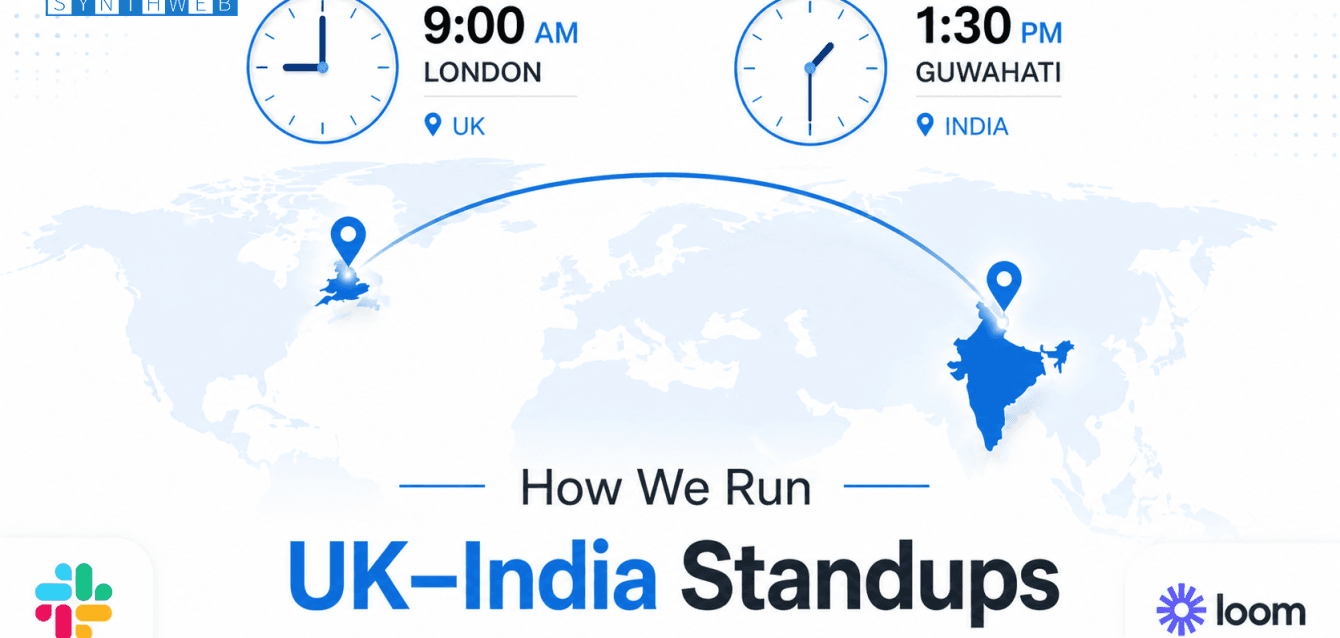
UK India Time Zone Standup in SynthWeb: The most common operational question UK CTOs ask us in discovery calls is some version of “how does the day-to-day actually work?” Specifically, they want to know how we run standups, where the overlap windows are, what gets handled async versus live, and how we make sure engineering decisions do not get bottlenecked on a 5.5-hour time-zone gap. This post walks through the operating model we have refined across four years of UK client work.
The mental model that works: treat the time-zone gap as a feature, not a problem. Used correctly, the gap means work is happening 16 hours out of every 24 — your end-of-day handoff becomes our start-of-day morning. The trick is structuring communication so the gap accelerates work instead of bottlenecking it.
The overlap window between the uk india time zone standup
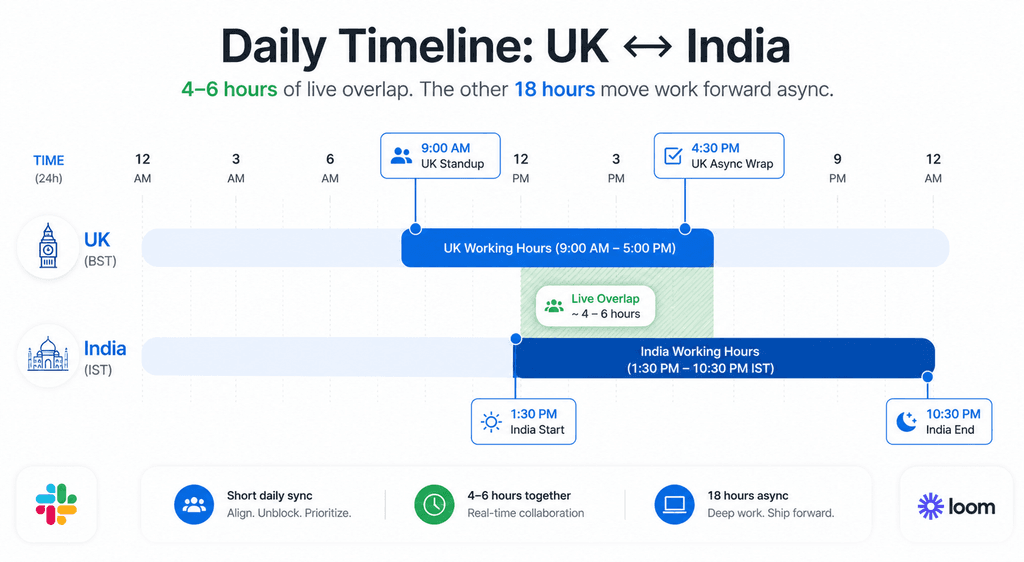
India Standard Time is UTC+5:30. UK time is UTC+0 in winter and UTC+1 in summer. That gives a default overlap of 4–6 hours per working day depending on shift patterns. Our default working hours for UK clients are 1:30 PM IST to 10:30 PM IST, putting the overlap window at 9:00 AM to 5:00 PM UK time. Engineers rotate this shift on a 4-week cycle so no one carries the late-shift indefinitely.
For US East Coast clients, we run a different shift — 6:30 PM IST to 3:30 AM IST — giving a 4-hour overlap. We do not pretend a longer overlap is possible without burning out engineers. We run two shifts, two teams, and we are honest about the constraint.
The standup itself: 15 minutes, twice a day
We run two short standups per working day for UK clients, each at the edge of the overlap window. The 9:00 AM UK standup is the live sync — 15 minutes, voice or video over Slack huddle, attended by the engineering pod plus the client’s nominated point of contact. Three questions: what shipped yesterday, what is shipping today, what is blocked. No discussion of solutions in this meeting — blockers get tagged for a follow-up.
The 4:30 PM UK standup is the async wrap — engineers post a written status update in the Slack channel before they sign off. The client reads it the next morning. This is the handoff that lets work continue overnight on the client’s side: questions get asked at 5:00 PM UK time, answered at 8:00 AM UK time the next day, work resumes immediately.
What gets handled async, and what does not
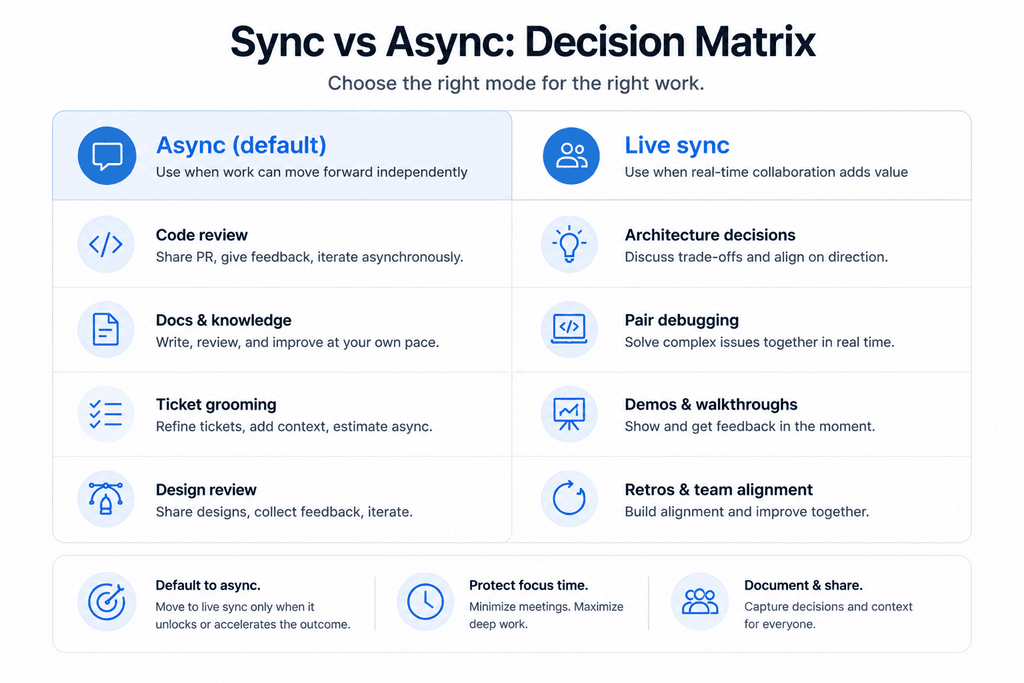
Async is the default. Code review, documentation, ticket grooming, retrospective notes, design reviews of static screens — all async. PRs get reviewed within 4 hours during overlap window, within 16 hours overnight.
Live sync is reserved for: architecture decisions where multiple engineers need to whiteboard, debugging sessions where pair programming saves hours, demo recordings of new functionality, retrospectives at the end of sprints. We default to recording live sessions and posting to a shared Loom or Drive folder so anyone who missed it can catch up async.
The escalation path
Production-down or critical bugs do not wait for the overlap window. Each engagement has a documented escalation path with named on-call engineers, a Slack channel that bypasses normal hours, and a phone number for catastrophic situations. We have called UK clients at 11:00 PM UK time exactly twice in the last two years. Both times they were grateful the system worked.
Tools that make this work
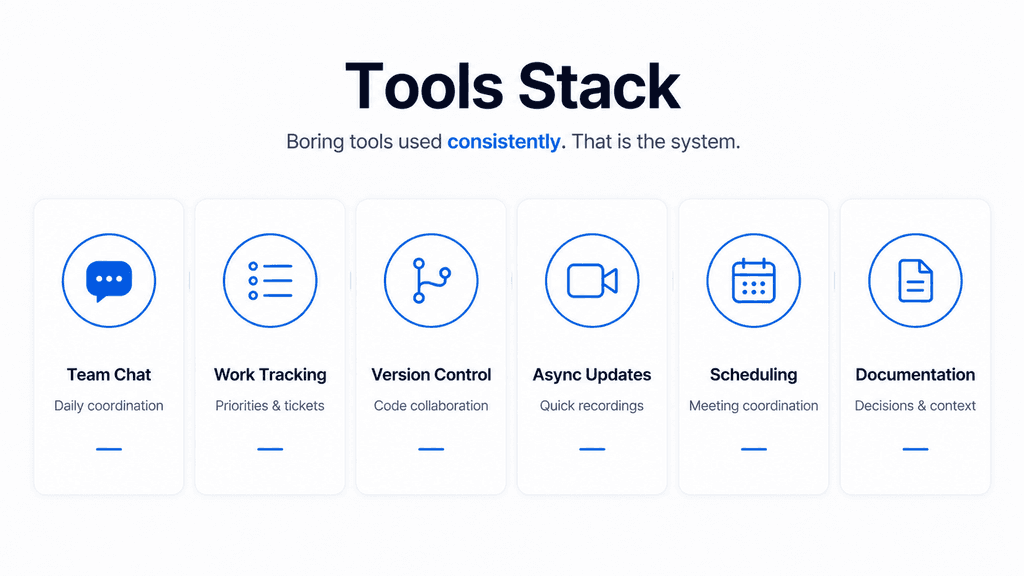
For UK India time zone standup we use Slack for real-time and async channels, with channel-specific notification rules so engineers are not pinged outside working hours unless on-call. Linear or Jira for the work board. GitHub for code. Loom for asynchronous video updates. Cal.com for cross-time zone scheduling that respects everyone’s working hours. None of these are exotic — the discipline of using them consistently is what makes the system work.
FAQ
Can we have a UK India time zone standup at a different UK time? Yes — we adjust shift patterns at engagement start. Some teams prefer 8:00 AM UK; some prefer 11:00 AM.
What if our team works 9-to-5 UK and we want full-day coverage? We schedule the engineering shift to overlap your working hours fully. The trade-off is engineers working 1:30 PM to 10:30 PM IST — sustainable on rotation, not as a permanent assignment.
How do you handle holidays and time off? UK and India have different public holidays. We provide 3 weeks notice of any team absence, and we maintain coverage during India holidays through scheduled rotation.
Do engineers ever come on-site to UK? Yes for engagements over 6 months. Typically a 1–2 week visit at engagement midpoint.
Also read: 10-Week MVP Build Process: What Actually Happens, Week by Week