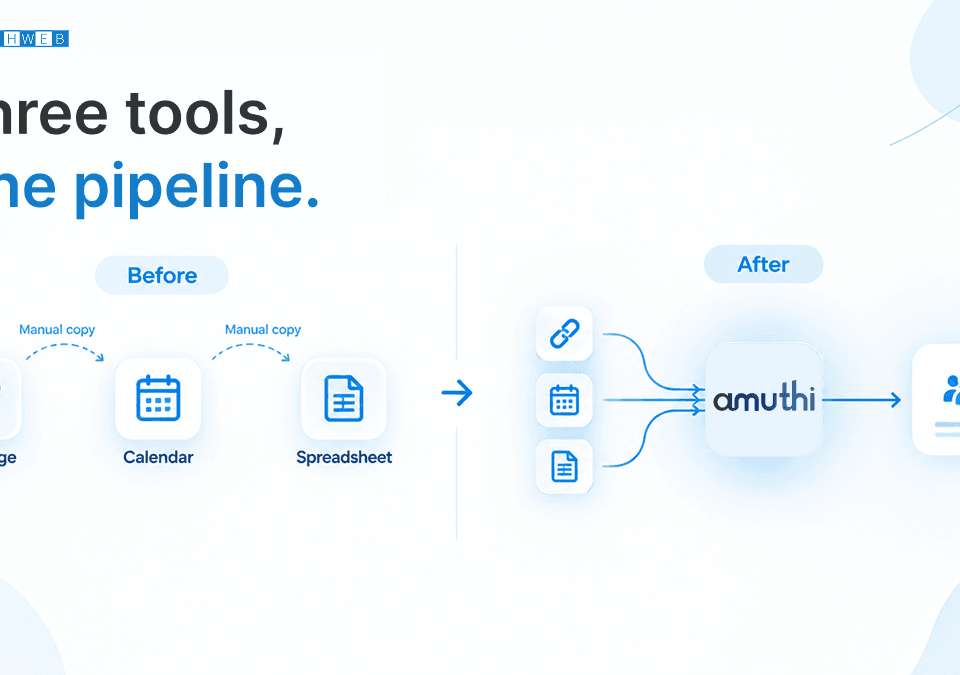
Modular monolith startup architecture has become a practical alternative for early-stage products that need to move quickly without the operational complexity of distributed systems. The default architectural recommendation for a new product in 2026 is “microservices.” Startups read about Netflix and Amazon, see the industry consensus, and assume the pattern that works at 500 engineers works equally well at four. It does not. At four engineers on a 12-week timeline, microservices solve problems you do not have while creating problems you do not need. Amuthi is built as a modular monolith, and this post explains precisely what that means and what it has delivered.
What a modular monolith startup architecture actually is
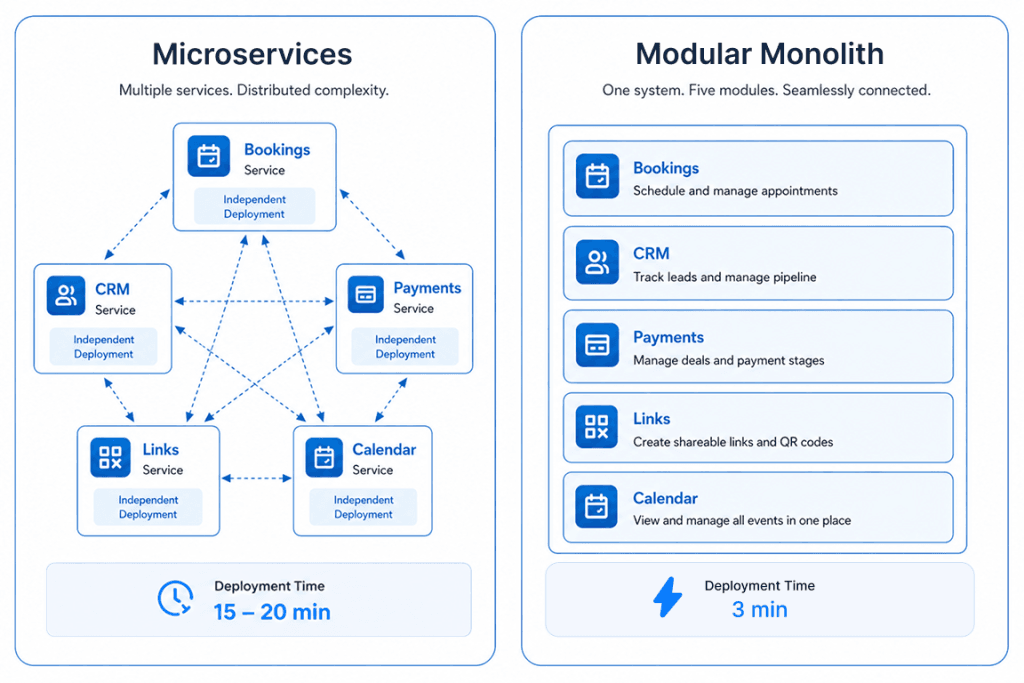
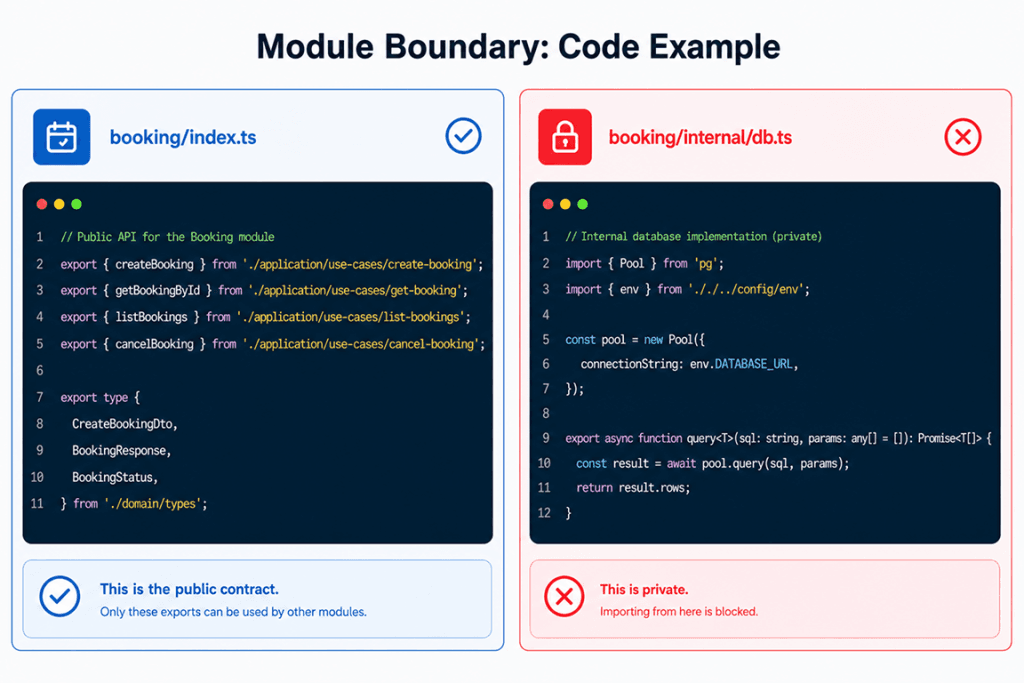
A modular monolith startup architecture is a single deployable application with enforced internal boundaries between its functional areas. It is not a big ball of mud: the internal structure is as disciplined as microservices, without the network topology, as described in The Majestic Monolith by David Heinemeier Hansson. Amuthi has five modules: booking, CRM, payments, links, and notifications. Each module has an index.ts file that exports a public interface—the functions and types that other modules are allowed to use. Everything else in the module directory is private
ESLint rules enforce this. If a file in the CRM module attempts to import directly from a private file inside the booking module’s internals, the lint check fails and the PR does not merge. The boundaries are real. They are just in-process rather than over a network.
Inter-module communication that does not need to be synchronous uses an in-process event bus. When a booking is created, the booking module emits a `booking.created` event. The notifications module listens for this event and sends the confirmation SMS. Neither module knows about the other’s internal, they communicate through the event contract.
The three specific gains vs microservices
Deployment speed.
Amuthi deploys as a single container on ECS Fargate. A code change in any module, merged to main, produces a new image and deploys to production in approximately three minutes. A comparable microservices setup with five services, orchestrated through a CI/CD pipeline managing five independent containers, takes 15 to 20 minutes. For a four-person team shipping multiple times per day, that 12 to 17 minute difference compounds into hours of deployment overhead per week.
Debugging simplicity.
A single log stream with a single request ID traces every action in the system from the HTTP request to the database query to the Stripe API call. In a microservices setup, the same trace spans multiple log streams across multiple services, requiring distributed tracing tooling: Datadog or Jaeger; at a cost of $200 to $500 per month. The modular monolith’s log trace is linear and complete. Debugging a production incident takes minutes, not hours of correlation across services.
Team productivity.
Every SynthWeb engineer working within our engineering pods on the Amuthi engagement can work on any module. There are no team ownership boundaries to navigate, no service API contracts to coordinate before starting a feature that touches two modules, no “that is the booking team’s service” handoff. Four engineers with full-stack access to a well-organised monolith ship faster than four engineers with divided microservices ownership.
When to extract a service
The trigger for extracting a module into an independent service is scale, not complexity. If one module receives ten times the traffic of the others and needs independent horizontal scaling, extract it. If a module needs a different deployment cycle from the rest of the application (a real-time WebSocket service, for example, that needs to scale independently of the API), extract it. Amuthi has not hit either trigger. Most startups do not before Series B, which is why a modular monolith startup architecture remains the more practical choice during the early stages of growth. A pattern also reflected in insights shared by Shopify Engineering on scaling modular systems
The extraction, when it comes, is clean. The module’s public interface, already defined and enforced in the monolith becomes the service API contract. The in-process event bus calls become HTTP or message queue calls. The refactor is surgical, not structural.
FAQ
Is a modular monolith just a regular monolith with a fancy name?
No. The difference is the enforced boundaries. A regular monolith allows any file to import any other file . The result is tangled code where a change anywhere can break anything. A modular monolith with ESLint-enforced boundaries behaves like microservices at the interface level, with none of the operational overhead.
Can you migrate to microservices later?
Yes, incrementally, module by module, as scale justifies it. The module boundaries are already the service boundaries.
Does SynthWeb use this architecture on all projects?
Yes for MVPs and early-stage products. For teams of 10 or more engineers with genuinely independent product areas, a service-oriented architecture becomes appropriate.