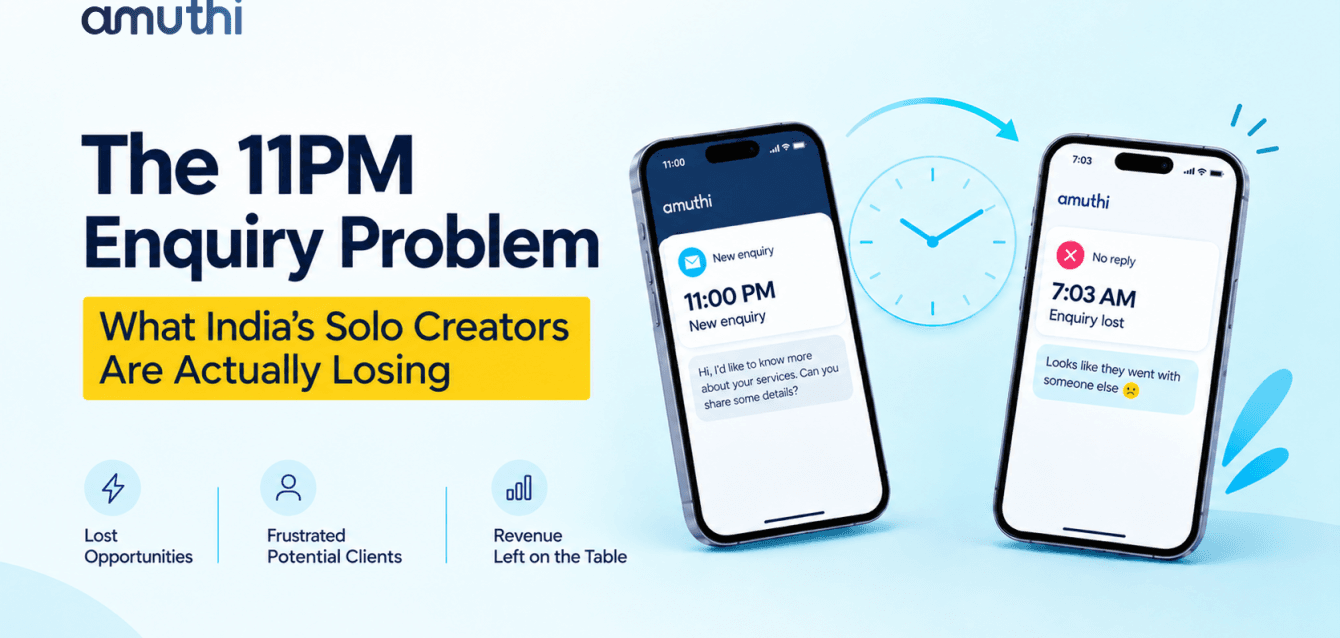
We’ve seen the same pattern come up repeatedly with solo creators across India: a client sends an enquiry at 11 PM, the freelancer replies at 7 AM, and the opportunity has already gone to someone else. It is easy to think the problem is simply the delayed reply. It isn’t. Freelancer client response time India is the real story, and it starts shaping outcomes long before either side realises it.
An enquiry that lands at 11 PM has usually reached more than one freelancer by morning. By the time a reply goes out at 7 AM, well within what most people would call a reasonable turnaround, other conversations are already hours ahead. In conversation after conversation with the creators we work with, the work is frequently awarded before their actual skills, portfolio, or rates ever enter the picture.

I’ve come to think of this as the 11 PM enquiry problem, and if you run a one-person creative or service business in India, you have almost certainly lived it. It isn’t a story about the quality of anyone’s work. It’s a structural gap built into how solo work actually happens, and it’s worth understanding properly, because the fix has very little to do with working longer hours.
A market too big to compete in on instinct alone
India’s freelance economy isn’t a niche anymore, and we see the scale of it every day in the people we talk to. According to the NASSCOM-Zinnov Indian Freelance Landscape Report 2024, India has over 15 million freelancers and is the world’s #2 largest freelance market. NITI Aayog has projected the country’s broader gig and platform workforce will keep climbing sharply through the end of the decade, with IT, design, content, and business services leading that growth. The direction is the same: more people are freelancing, more clients are hiring freelancers, and the pool of options available to a client for any given brief has never been larger.
That’s good news if you’re a client. It’s a harder environment if you’re one of those fifteen million-plus people competing for attention. A crowded market changes the economics of a first impression. When a client had three options, waiting for the best one to reply was affordable. With thirty, waiting is no longer necessary. Someone else’s inbox is always open.
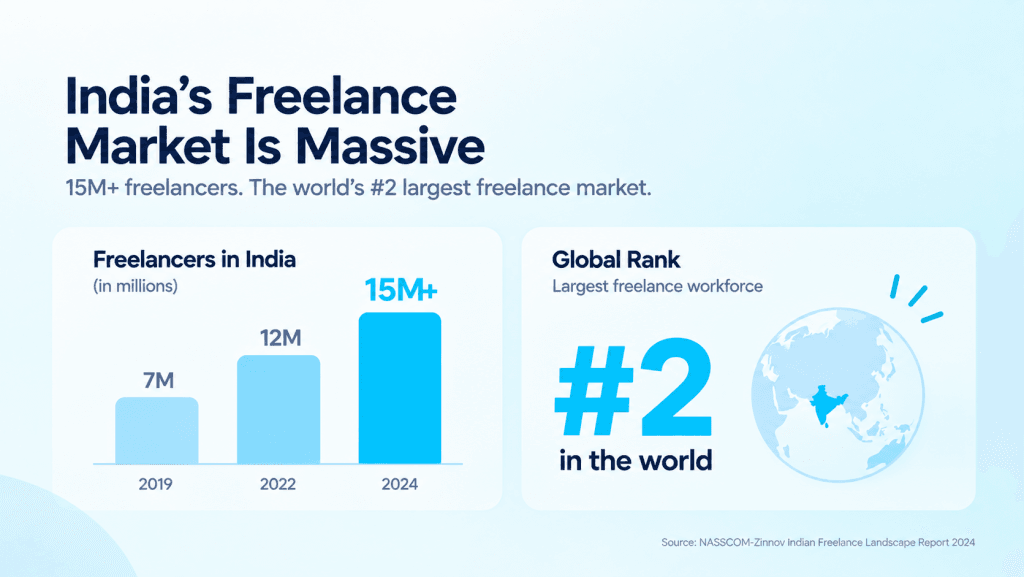
This surplus is exactly what turns freelancer client response time India into a competitive edge rather than a footnote: not a shortage of talent, but too much of it, competing in real time for a shrinking window of client attention.
Why freelancer client response time India quietly decides who gets hired
Enterprise sales teams have obsessed over response speed for years, chasing leads within minutes rather than hours, because the odds of a meaningful conversation drop sharply the longer a prospect waits. I think solo creators are living a compressed, informal version of the same dynamic, usually without recognising it as such.
A client reaching out to a freelancer isn’t simply asking a question. She’s conducting an informal audition. Response time is one of the only signals she has before any work has been delivered, and she reads it as a proxy for reliability, professionalism, and how the working relationship might feel three weeks into a live project. A same-day reply signals dependability. A three-day silence, even from someone whose portfolio she admired, signals the opposite, whether or not that reading is fair.
This is the part that stings, and it’s something I’ve watched happen to genuinely talented people: freelancer client response time India isn’t losing them work because their work is weak. It’s losing them work because the client made a decision before their actual skills ever entered the conversation.
What’s actually being lost isn’t just the one enquiry
It’s tempting to think of a missed enquiry as a single lost project, and to file the freelancer client response time India problem under bad luck. In my experience, the real cost compounds in three ways that are easy to overlook.
The first is the project itself. The second is the referral chain attached to it. Solo creative and service work in India runs heavily on word of mouth, and a client who books someone else this time is also the client who recommends someone else the next time a colleague asks. The third, and the one I think gets missed most often, is negotiating position. The freelancer who replies first usually gets to set the terms of the conversation. The freelancer who replies fourth is negotiating against a brief someone else has already shaped.
None of this shows up on an invoice. It shows up eighteen months later as a business that’s technically busy but never quite growing the way its work quality should allow.
What’s actually in a solo operator’s control right now
The instinctive response is to conclude you need to be reachable at all hours. That isn’t a solution, it’s a route to burnout, and most solo creators already sense this. The more useful question, the one I’d ask if it were me, is what remains controllable without becoming a round-the-clock operation.
The first step is identifying your actual enquiry window instead of guessing at it. Most of the creators we talk to discover their enquiries cluster at specific times, often late evening for consumer-facing work and mid-morning for B2B enquiries, once they track it for a week instead of assuming. Knowing that window lets you decide, deliberately, when to be available, rather than reacting to notifications as they arrive.
The second is a genuinely fast first reply that doesn’t require composing something from scratch every time. This isn’t about sounding automated. A short, specific holding reply, one that acknowledges the enquiry, asks a single clarifying question, and gives a clear time for a proper follow-up, buys you hours without sacrificing the personal tone that got you the enquiry in the first place.
The third is removing the back-and-forth that eats the gap between interest and commitment. Much of the delay in freelance conversations isn’t the first reply at all, it’s the several messages afterward spent confirming availability, rates, and next steps. A simple booking link, a one-page rate sheet, or a saved set of answers to frequently asked questions closes that gap without requiring anything new to be built.
The fourth is delegation. If you genuinely can’t be the one checking messages at odd hours, a trusted person can triage and hold enquiries until you’re back online. I’ve seen too many solo operators treat this as a luxury reserved for larger studios, when in practice it’s one of the simplest ways to close the freelancer client response time India gap without spending on new software, since it costs time from someone you already trust rather than a subscription.
Where this stops being a personal habit and becomes a business problem
Here’s the honest part: the habits above work for a while, then stop scaling. Once enquiries arrive across Instagram DMs, WhatsApp, email, and a contact form, tracking response time by memory becomes impossible, and the habits that worked at five enquiries a month quietly break down at twenty. This is usually the point where fixing freelancer client response time India by habit alone stops being enough, not because the habits failed, but because volume outgrew what one inbox and one memory could hold.
It’s why we built Amuthi the way we did, to pick up where personal habits leave off, centralising enquiries, tracking response windows automatically, and giving creative professionals a booking flow that removes the back-and-forth entirely, rather than requiring it to be managed manually indefinitely.
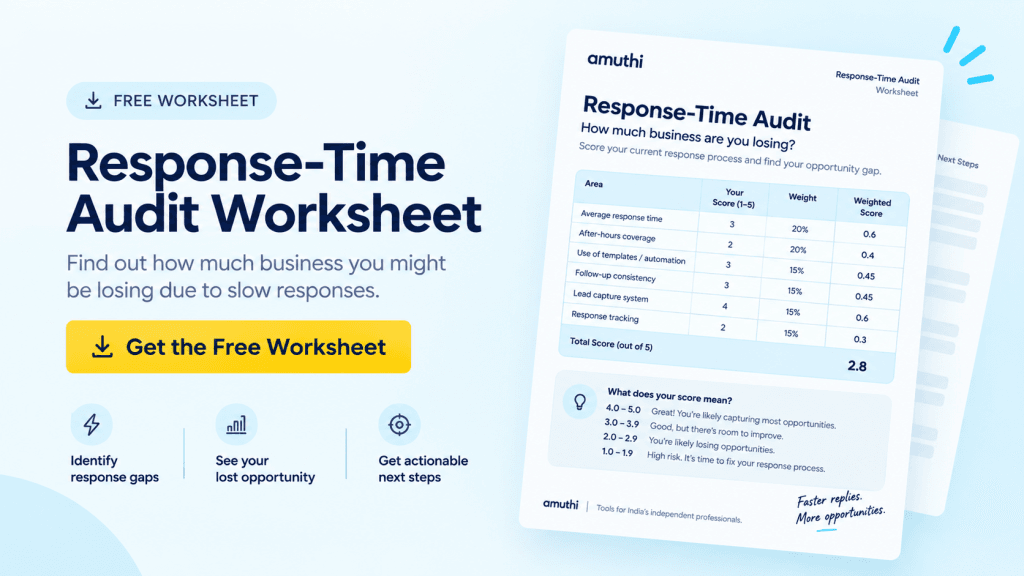
But I’ll be the first to say the tool is only worth reaching for once you actually know your own numbers. That’s the real starting point, which is why we put together something simpler first.
We built this because “I think I reply fast enough” isn’t a number.
We built the Response-Time Audit as a simple first step. Track your enquiry-to-reply time, score your current process, and see where opportunities may be slipping through. Once you know where the gap is, you can decide what needs to change — whether that’s a faster first reply, a better booking flow, or a more structured way to manage enquiries.
Get the free Response-Time Audit worksheet and find your response-time gaps.MVP Sprint
Also Read: Why Timezone Overlap Beats Timezone Coverage