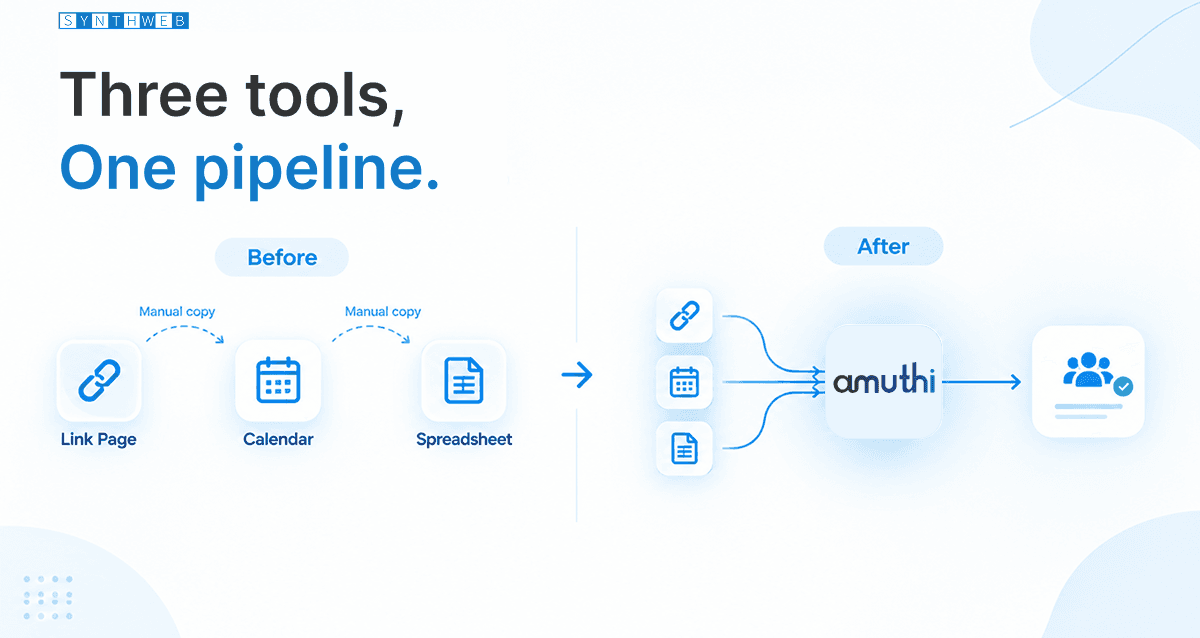
Amuthi’s first target segment was photographers and makeup artists — vendors whose entire client-acquisition and booking flow was stitched together from tools never designed to talk to each other. One early example from Phase 0, documented in the amuthi photographer crm case study, involved a bridal photographer using a link-in-bio tool for inquiries, a separate calendar app for scheduling, and a spreadsheet functioning as a CRM. None of these tools shared data with each other.
The Problem With Three Disconnected Tools
A lead would come in through the link-in-bio page, get manually copied into the scheduling tool once a call was booked, and then manually copied again into the spreadsheet to track where the client stood in the booking pipeline.
Every step was a place a lead could get lost. Nothing showed the photographer, at a glance, which inquiries had gone cold and which were close to booking. Keeping the information updated also meant repeating the same work across different tools.
The problem was not that the photographer lacked software. The problem was that each tool handled one part of the process without sharing information with the others.
What Changed With One Connected Flow
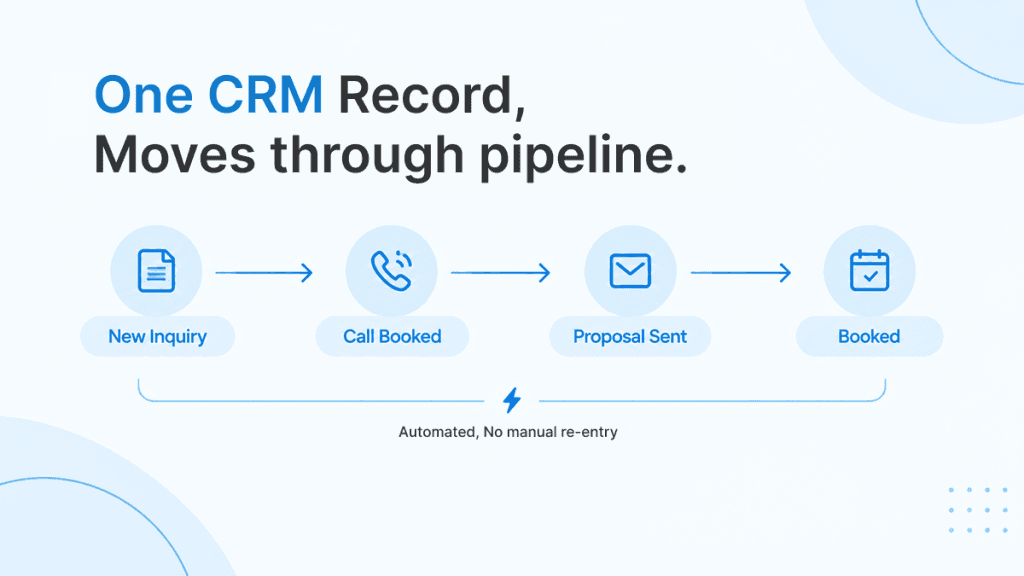
Amuthi’s Pages, Bookings, and CRM modules share the same underlying data. A lead captured through a link page automatically becomes a CRM record, and a booked call automatically updates that same record’s status — no manual copying between three separate tools.
The photographer sees one pipeline view: new inquiry, call booked, proposal sent, booked. The client’s information stays connected throughout the process, so there is no need to re-enter the same information at each stage.
This is the central change highlighted in the amuthi photographer crm case study. Instead of managing separate tools and manually keeping them in sync, the photographer can manage the client journey through one connected flow.
Why This Mattered More Than Any Single Feature
None of the three individual capabilities — links, booking, CRM — is novel on its own; each exists as a standalone tool already.
What Amuthi’s Phase 0 target segment actually needed wasn’t a better version of any one of those tools. It was for the three to stop requiring manual reconciliation.
That’s the core Amuthi pitch validated with this segment: bundling isn’t a feature checklist, it’s the removal of the manual work that happens in the gaps between separate tools.
The amuthi photographer crm case study shows why this distinction matters. The value came from connecting the different stages of the workflow rather than adding another standalone tool.
For a photographer managing inquiries, calls, proposals, and bookings, having those steps connected means less manual movement of information and a clearer view of where each client stands.
For Amuthi, this Phase 0 example provided a clear product signal: the opportunity was not simply to offer links, booking, or CRM separately, but to bring these functions together around the same client workflow.
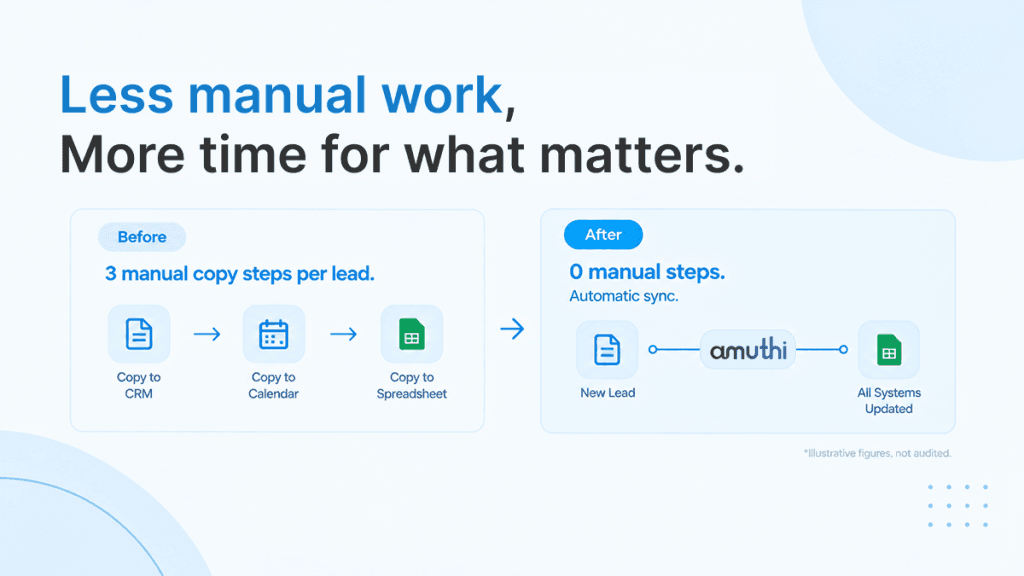
The amuthi photographer crm case study ultimately demonstrates a straightforward product principle: when businesses are already using multiple tools to manage one process, connecting those tools can address the friction between them.
FAQ
What is Amuthi?
Amuthi is a connected booking, CRM, and links platform built by SynthWeb, initially targeting photographers and makeup artists whose client-acquisition workflow was spread across disconnected tools.
What problem did Amuthi solve for this bridal photographer?
It replaced a link-in-bio tool, a separate scheduling app, and a spreadsheet CRM with one connected flow where a lead automatically becomes a CRM record and a booked call automatically updates its status.
Is Amuthi available for other vendors outside photography?
Confirm current availability and target segments with our team. Reach out through /mvp-sprint.
Also Read :
What It Takes to Build a Platform That Has to Satisfy Students, Mentors, and Hiring Companies at Once