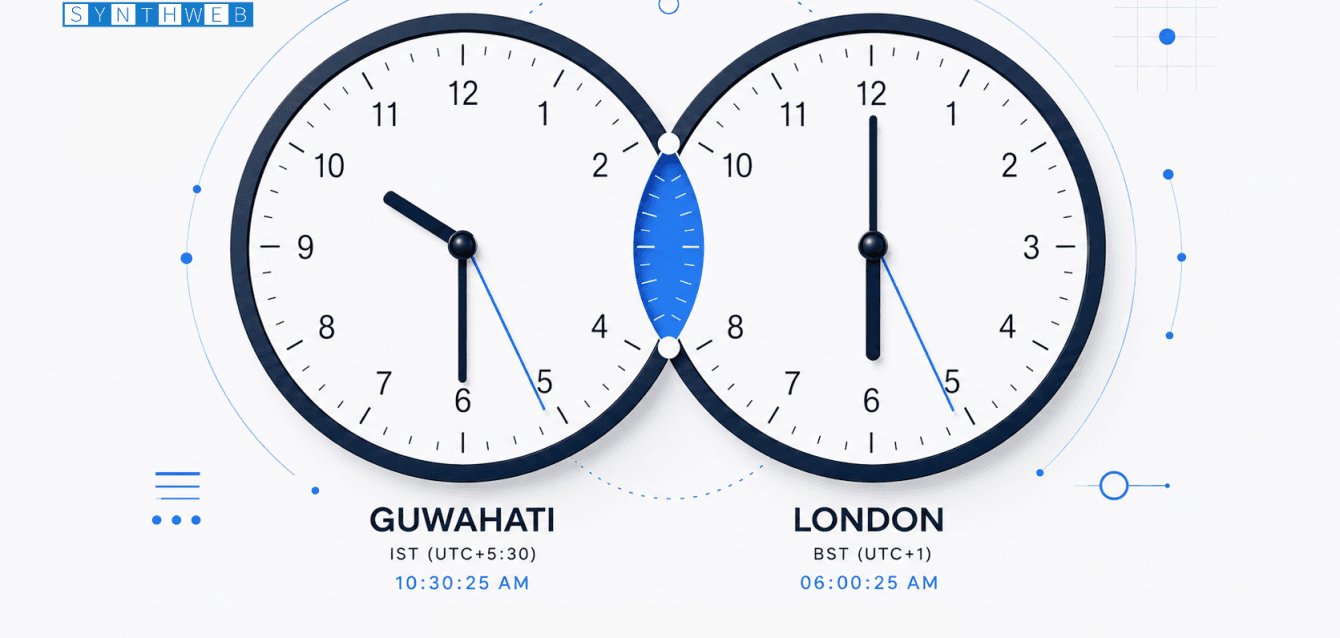
A UK founder sends a Slack message at 9am.It is a straightforward product question, but the engineering team needs an answer before it can move forward. Someone is online, but the person who can make the decision is not. This is where timezone overlap software development matters: the right people need to be available at the same time.
By the time that person comes online, the founder is close to the end of their working day. The question gets answered, engineering picks it up the following morning, and a decision that could have taken ten minutes has effectively added almost a day to the schedule.
This is one of the less obvious costs of distributed engineering.
Teams often optimize for timezone coverage: someone is always working somewhere. It sounds efficient because work can theoretically continue around the clock.
But continuous coverage does not necessarily mean continuous progress.
The more useful measure is overlap: how much time do the people making decisions and the people executing the work actually have together?
That distinction is at the center of how we think about timezone overlap software development. The objective is not to keep an engineering team online for as many hours as possible. It is to make sure the people who need to collaborate, clarify requirements, and make decisions have enough shared working time to do so.
Being Online Does Not Guarantee Decision-Making Availability
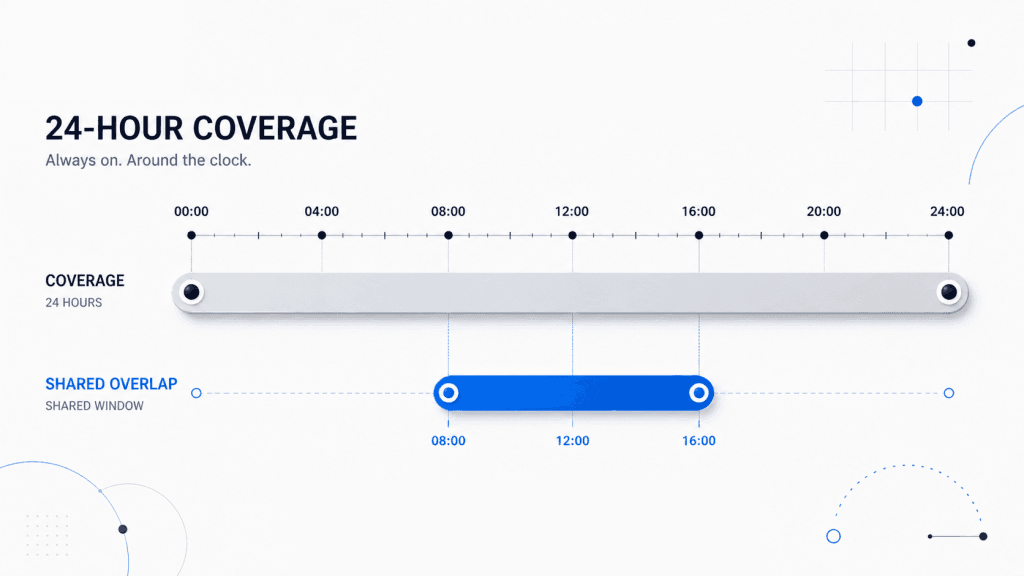
A 24-hour engineering operation looks attractive on paper. One team finishes its day, another starts, and work continues across time zones.
For clearly defined execution work, that model can work well. A developer can pick up a documented task. Automated tests can run overnight. A completed task can move to another engineer without requiring an immediate conversation.
The problem begins when the next step requires context or a decision.
A developer discovers an ambiguity in the requirements. A product decision affects the data model. A designer needs clarification before frontend work can continue. An engineer discovers something during implementation that changes the original scope.
Having someone online does not solve these problems.
Having the right person online at the same time does.
This is why timezone overlap software development matters more than simply maximizing the number of hours a team is available. Coverage tells you that work can happen. Overlap tells you whether the people responsible for moving that work forward can actually work together.
That distinction becomes particularly important in client engineering, where development rarely happens in isolation. Product decisions, technical trade-offs, reviews, and scope questions are part of the development process itself.
The Cost of a 12-Hour Wait
The immediate cost of poor timezone overlap is a delay.The larger problem is that small delays compound across a sprint.
One unanswered question pushes a task into the next working day. That delays a dependent task. A developer waits for clarification before completing their part. A code review sits until the relevant person comes online. A product decision arrives after the engineer has already moved on to another task.
None of these delays necessarily look serious on their own.Across several sprints, they become a meaningful constraint on delivery.This is where timezone overlap software development has an operational advantage over a pure handoff model. Not because every engineering task requires synchronous communication, but because certain tasks cannot move efficiently without it.
Architecture discussions are one example. Debugging another. Scope changes, code reviews, and decisions that affect multiple parts of the product often require the people involved to share context.
Trying to force all of these conversations into asynchronous messages can create another problem: interpretation.
A developer makes an assumption. The founder responds hours later. The engineer continues based on a different assumption. By the time the discrepancy is discovered, code has already been written around it.
The issue is not that asynchronous communication is ineffective. It is that not every type of communication should be asynchronous.
What Useful Overlap Actually Looks Like
Good overlap does not mean putting everyone in meetings for eight hours a day. It means deliberately creating a working window for the conversations that benefit from being immediate.
A founder can raise a question and get an answer while they are still working. An engineer can explain a blocker directly to the person who owns the decision. A product change can be clarified before development continues. A code review can be discussed while the context is still fresh.
The rest of the work can remain asynchronously. That is the practical distinction between async and sync engineering communication: they should complement each other rather than compete.
Implementation, testing, documentation, and clearly defined tasks can continue asynchronously. Decisions, blockers, reviews, and discussions with significant downstream impact benefit from real-time overlap. This is where timezone overlap software development becomes valuable: it creates enough shared working time for important decisions to happen without unnecessary delays.
This is the operating principle behind timezone overlap software development: use synchronous time where it removes friction, and asynchronous time where it allows engineers to work without interruption.The goal is not more communication.It is better-timed communication.
How We Approach It at SynthWeb
Our engineering teams operate from Guwahati while working with stakeholders across different time zones, including the UK and US.
We don’t approach this as a simple question of how many hours the engineering team can technically be online. The more useful question is when the people making decisions and the people executing the work are available at the same time.
Our Guwahati–UK/US working model is built around that overlap.
The specific overlap window matters because it creates a predictable period for decisions, blockers, reviews, and conversations that can materially affect the sprint. Timezone overlap software development works around this principle: outside that shared window, engineers can continue with focused implementation, testing, documentation, and other work that does not require an immediate response.
We would use the actual confirmed Guwahati–UK/US overlap windows here rather than present a generic number. The point is not the number itself. It is that the overlap is intentional and part of how the work is organized.
That is also an important distinction between an offshore engineering pod and a traditional offshore handoff model.
The objective is not simply to finish one team’s tasks and pass them to another team at the end of a shift. A pod needs enough shared context and decision-making capacity to keep work moving without turning every unresolved question into an overnight handoff.
A Framework You Can Apply to Any Distributed Team
This principle is not specific to SynthWeb.If you are evaluating an offshore engineering pod, an internal distributed team, or an external development partner, start by looking at where work actually gets blocked.
Ask three questions.
1. Who makes the decisions?
Identify the people responsible for product, architecture, technical direction, and scope. These are the people whose availability can determine whether a blocker gets resolved immediately or waits until the next working day.
2. Who needs those decisions?
Look at the engineers, designers, and other team members who depend on those decisions to continue their work. Then compare the working hours of both groups.
3. How much meaningful overlap exists?
This is the number that matters.Not how many hours the vendor says someone is online. Not whether the team technically provides 24-hour coverage.The useful measure is how many hours the people who can unblock work are available at the same time as the people who need them.
A practical distributed engineering setup usually has three layers: Decision overlap: A defined window when founders, product owners, and engineering leads can resolve important decisions.
Engineering overlap: enough shared time for developers to discuss blockers, reviews, debugging, and technical questions.
Async execution: the remaining hours are used for implementation, testing, documentation, and other work that does not require immediate interaction.This gives the team a balance between real-time collaboration and focused execution.
Coverage Sounds Better. Overlap Is More Useful.
Coverage is easy to communicate.A vendor can say that someone is working on your product at almost any hour of the day. It sounds reassuring because there is always activity somewhere.But activity is not the same as progress.The more useful question is:
How much meaningful working time do we have with the people who can actually make decisions?
That is the question we would use when evaluating timezone overlap software development arrangements, whether the team is internal, offshore, or distributed across several regions.
Timezone coverage tells you that someone is working.
Timezone overlap tells you whether the people involved can work together.
For distributed engineering, that distinction affects how quickly blockers are resolved, how easily decisions are made, and how consistently work moves through a sprint.
If your team currently relies on shift-based handoffs, map the decision-makers, engineers, and working hours before changing the structure. You may find that the issue is not a lack of engineering capacity. It is a lack of shared decision-making time.
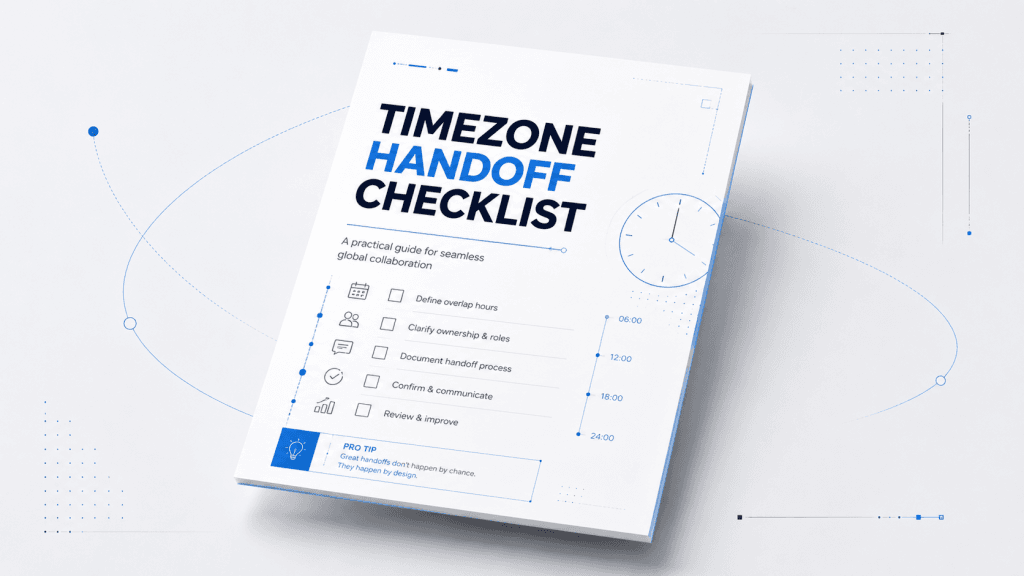
And if you want to make that handoff process more deliberate, start with the basics: every shift change should make the current state of the work, outstanding decisions, blockers, and next actions explicit.
Download the Timezone Handoff Checklist :A one-page checklist covering the five things a distributed team should hand off explicitly at each shift change, so important work does not wait for another time zone to wake up.
Also Read:
Why Client Code Reviews Happen Every Sprint, Not Just at Launch