We wrote about where AI coding tools fit into client builds earlier this year. The honest update, several sprints later: the boundary hasn’t moved much, but our confidence in exactly where that boundary sits has gotten sharper.
For AI coding tools client development, the question isn’t simply whether AI can produce the code. It is whether the code fits the existing system, whether an engineer can verify it quickly, and what the cost would be if something goes wrong.
Where AI tools genuinely speed us up: ai coding tools client development 2026
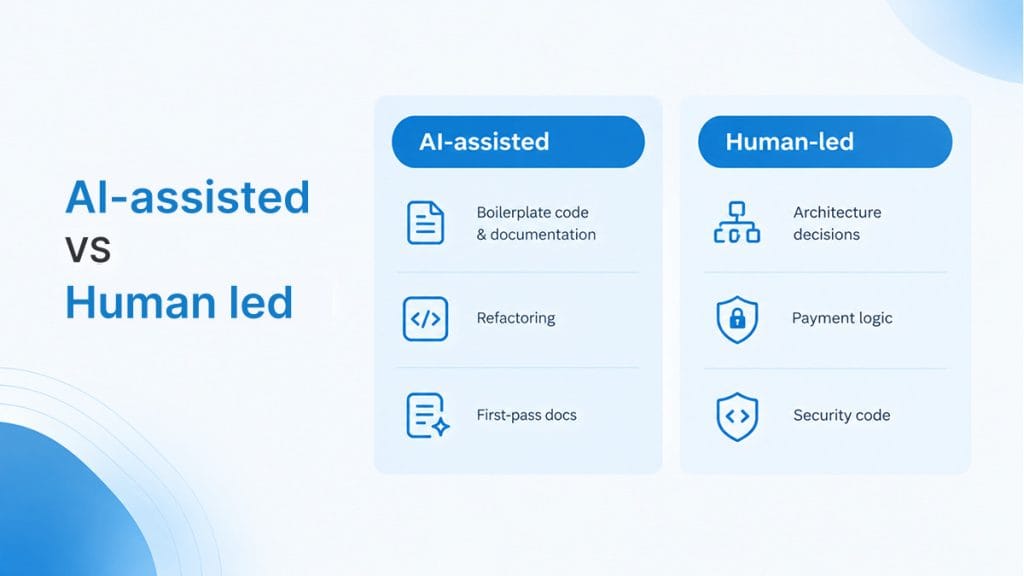
Boilerplate and scaffolding, new module structure, repetitive CRUD endpoints, test file setup is faster with AI assistance and carries almost no risk, because the pattern is well-established and easy to review. These are the kinds of tasks where the expected implementation is already clear, so AI can remove repetitive work without changing how we approach the underlying system.
Refactoring within a known, well-tested boundary is another strong case: renaming, restructuring, extracting shared logic, where the test suite catches regressions immediately. The important part is that the boundary is already understood and tested. AI is helping with the execution of a change rather than deciding what the system should fundamentally do.
And first-pass documentation: architecture notes, API docs, runbook drafts gets a real head start from AI tools, though it always gets a human edit pass before it goes into a handoff package. The tool can speed up the first draft, but the engineer still needs to verify that the documentation accurately reflects what was actually built.
That’s where AI coding tools client development has proved useful for us: speeding up work that is repetitive, clearly defined, and straightforward to verify.
Where we still don’t use it, deliberately
Architecture decisions with long-term consequences, how a data model handles multi-tenancy, how auth boundaries are drawn stay human-led. This isn’t caution for its own sake; these are the decisions that, done wrong, compound into the kind of technical debt that costs weeks to unwind later, and an AI tool doesn’t carry the accountability for a decision it can’t be held responsible for six months later.
Anything touching payment logic or security-sensitive code gets written and reviewed by a person first, AI-assisted second at most the failure mode there (a double-charge, an auth bypass) is expensive enough that we’d rather move slower.
The same principle applies because the risk isn’t limited to whether the generated code looks correct during review. Some problems only become visible when the system is handling real transactions or operating under real-world conditions.
This is an important boundary for AI coding tools client development 2026 because the cost of an undetected mistake is much higher in these areas.
The actual rule we use
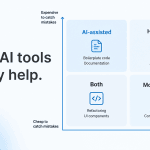
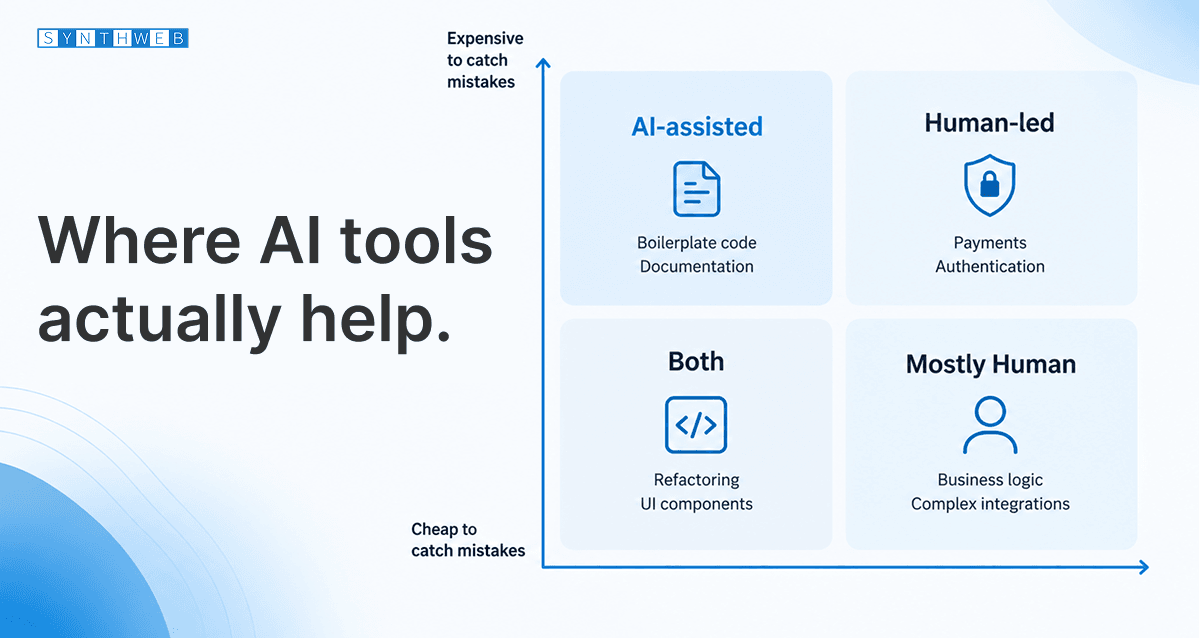
If a mistake in this code is cheap to catch and cheap to fix a failing test, an obvious visual bug AI assistance is fair game and usually faster. The important part is that the mistake has a clear feedback loop and can be corrected without affecting the foundation of the system.
If a mistake is expensive to catch (it ships silently) or expensive to fix (it’s load-bearing for everything built after it), a person writes it and a person reviews it, full stop. That distinction gives the team a practical way to decide where AI assistance belongs instead of treating every coding task the same way.
That rule hasn’t changed since our last post on this. What’s changed is how confidently we can apply it sprint to sprint, because we’ve now got enough builds behind it to know where it holds. For us, AI coding tools client development is about knowing where AI creates useful leverage without giving up human ownership of decisions that carry a higher cost of failure.
FAQ
Does SynthWeb use AI tools like Claude in client engineering work?
Yes, for boilerplate, scaffolding, refactoring within well-tested boundaries, and first-pass documentation always with human review before anything ships.
Does SynthWeb use AI to write payment or security code?
No, payment logic and security-sensitive code are written and reviewed by engineers first, with AI assistance used minimally if at all, because the cost of a mistake there is too high.
How does SynthWeb decide where AI coding tools are appropriate?
Based on how cheap a mistake is to catch and fix. Cheap-to-catch, cheap-to-fix code is fair game for AI assistance; expensive-to-catch or load-bearing code is human-led.
Also Read: Why Client Code Reviews Happen Every Sprint, Not Just at Launch